DU LLB (VI SEMESTER): ENVIRONMENT LAW (UNIT I) SHORT NOTES
0x2e6f2563

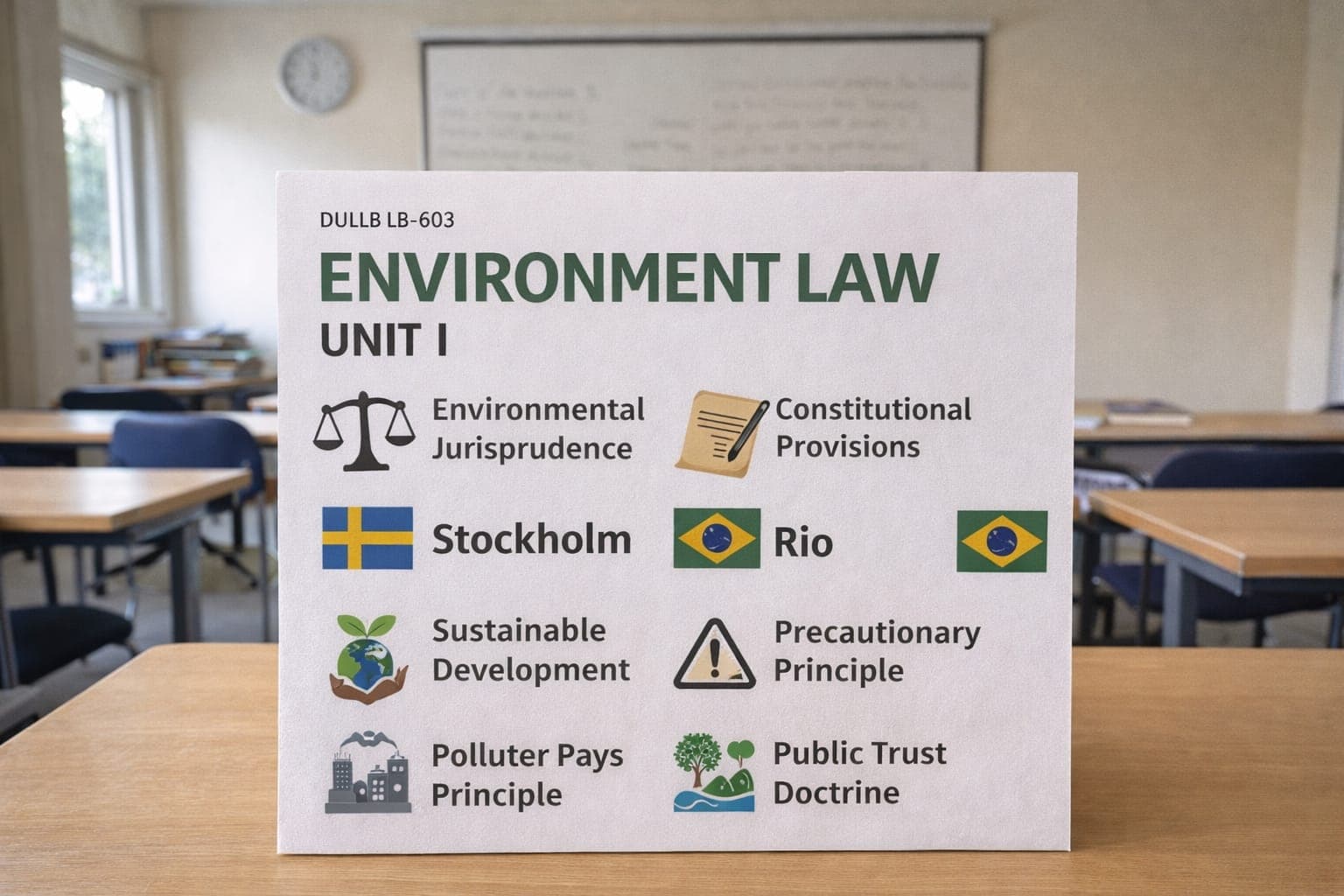
Topic 1:The United Nations Conference on the Human Environment (UNCHE), Stockholm, 1972
The United Nations Conference on the Human Environment (UNCHE), held in Stockholm, Sweden, from June 5 to 16, 1972, was the first major international gathering focused specifically on environmental protection. It is widely considered the birth of modern international environmental law.
Here is a breakdown of its key components and impact:
1. The Stockholm Declaration
The conference produced the Stockholm Declaration on the Human Environment, which consists of 26 Principles. Some of the most influential include:
- Fundamental Right: Principle 1 states that humans have a fundamental right to "freedom, equality, and adequate conditions of life, in an environment of a quality that permits a life of dignity and well-being."
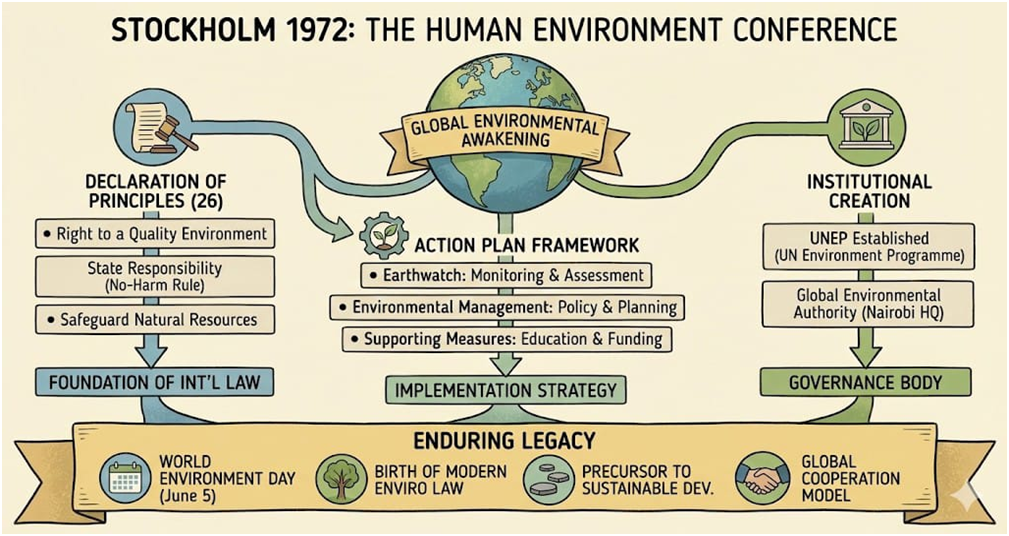
- Sovereignty vs. Responsibility (Principle 21): This is perhaps the most famous principle. it recognizes that states have the sovereign right to exploit their own resources, but they also have the responsibility to ensure that activities within their jurisdiction do not cause damage to the environment of other states (codifying the "No-Harm" rule).
- Resource Management: It emphasized that natural resources (air, water, land, flora, and fauna) must be safeguarded for the benefit of present and future generations.
2. Creation of UNEP
One of the most practical outcomes of the 1972 conference was the establishment of the United Nations Environment Programme (UNEP).
Headquartered in Nairobi, Kenya, UNEP became the leading global environmental authority that sets the global environmental agenda and promotes the implementation of sustainable development.
3. The Action Plan for the Human Environment
The conference approved a functional "Action Plan" divided into three categories:
- Global Environmental Assessment Program (Earthwatch): To identify and monitor environmental problems of international significance.
- Environmental Management Activities: To implement measures to protect the environment.
- International Measures to Support Action: Focusing on education, training, public information, and financial assistance.
4. Bridging the Gap: Development vs. Environment
The conference was the first to address the tension between economic development and environmental protection.
Developed nations were primarily concerned with industrial pollution.
Developing nations (led significantly by India’s then-Prime Minister Indira Gandhi) argued that poverty was the "greatest polluter" and that environmental standards should not be used as an excuse to hinder their economic growth.
This dialogue laid the early groundwork for what would later be called Sustainable Development.
5. World Environment Day
To commemorate the opening day of the Stockholm Conference, the UN General Assembly designated June 5th as World Environment Day, which has been celebrated annually ever since to raise global awareness.
6.Legal Status: Non-Binding (Soft Law).
It was a "Declaration" of principles, not a treaty.
Effect: Countries couldn't be sued for breaking it, but it became the "moral foundation" for future laws.
Ratification: Not applicable (Declarations are adopted by vote, not ratified).
Key Elements of this convention
Event: Stockholm Conference (1972) – The central starting point.
- Outcome 1: The Stockholm Declaration:
26 Principles: The legal and ethical foundation (e.g., Right to Environment, State Responsibility).
- Outcome 2: Action Plan for the Human Environment:
Earthwatch: For monitoring and assessment.
Environmental Management: Setting goals and planning.
Supporting Measures: Education, training, and funding.
- Outcome 3: Institutional Arrangement:
Creation of UNEP: The body responsible for implementation.
Legacy:
World Environment Day (June 5th): Established to mark the event.
Precursor to Rio 1992: Showing the path toward future sustainability goals.
Simple Memory Sentence
"UNEP was born in Stockholm to give the Earth a Right to be SAFE."
UNEP: Reminds you of the organization created.
Stockholm: The location.
Right: The "Right to a healthy environment”
SAFE: SOVEREIGNTY, ACTION PLAN, FUTURE GENERATIONS, EARTHWATCH
Topic 2: World Charter for Nature, 1982
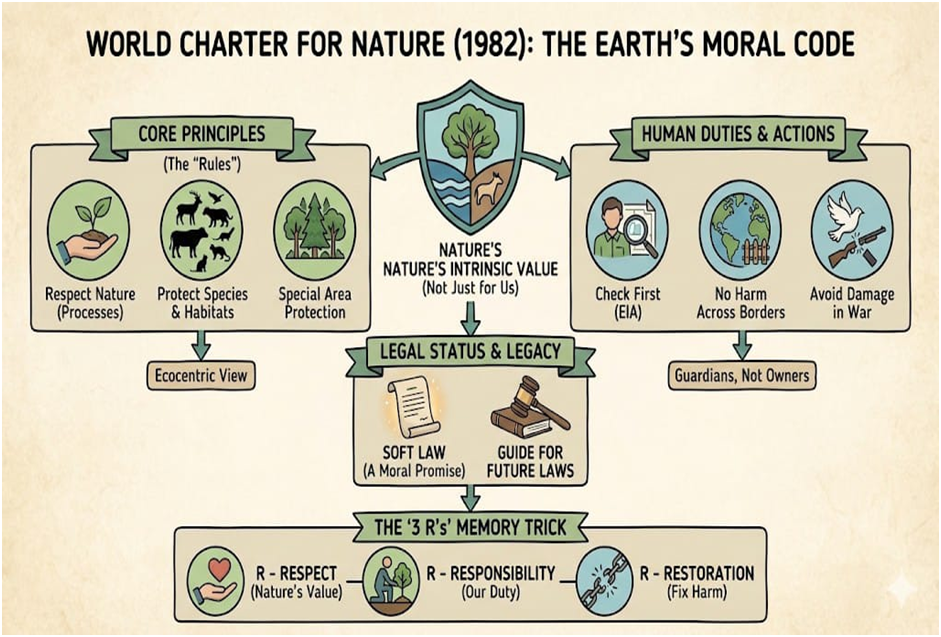
The World Charter for Nature (1982) was a landmark resolution passed by the United Nations General Assembly. If the Stockholm Conference (1972) was a "meeting," the World Charter was like a "Moral Constitution" for the planet.
Here is the explanation in a simple, pointwise manner:
1. What is it?
It is a high-level declaration that says nature has its own value, regardless of whether humans find it useful or not.
Unlike other treaties that focus on human health or pollution, this focuses entirely on protecting ecosystems and wildlife.
2. Key Principles (The "Rules of Nature")
- Respect Nature: Nature shall be respected and its essential processes shall not be impaired.
- Protect Habitats: Species and their habitats must be protected to maintain a "population level" sufficient for their survival.
- Special Protection: Unique areas (like rainforests or coral reefs) and representative samples of all types of ecosystems must be given special protection.
- Sustainability: Resources (like soil, water, and forests) should only be used in a way that doesn't exhaust them.
3. Key Human Responsibilities
- Environmental Assessment: Before starting any big project (like building a dam or a factory), the impact on nature must be checked.
- No Damage Beyond Borders: Similar to the Stockholm principles, countries must ensure they don't damage nature outside their own borders.
- Warfare: Military activities and war should be conducted in a way that avoids damaging nature.
4. Why is it unique?
- Non-Binding but Influential: It is "soft law." This means it isn't a strict contract you can go to jail for breaking, but it set the moral standard for all environmental laws that followed.
- Ecocentric View: Most laws are "Anthropocentric" (focused on humans). This Charter is "Ecocentric" (focused on nature itself).
The Legal Status
Soft Law: It’s not a "must-follow or go to jail" law. Instead, it’s a "moral promise" that helps judges and lawmakers create better local laws later.
Comparison
- Stockholm (1972): Focus on Humans (Our right to a clean environment).
- World Charter (1982): Focus on Nature (Nature's right to exist).
💡 Short Trick to Remember: "R.E.S.P.E.C.T."
R – Respect for nature’s intrinsic value.
E – Ecosystems must be protected.
S – Species survival is a priority.
P – Planning (assessments) before development.
E – Environmental damage during war must be avoided.
C – Conservation of all life forms.
T – Treaty that acts as a Moral Constitution.
Layman’s Summary
The World Charter for Nature is the world’s way of saying: "The Earth doesn't just belong to humans; it belongs to all living things. We are the guardians, not the owners, and we must respect the balance of life."
Topic 3: OZONE LAYER PROTECTION EFFORTS
1. The "Earth’s Sunscreen"- OZONE LAYER
The Ozone Layer: It’s like a giant pair of sunglasses or "sunscreen" for the Earth. It sits in the sky and blocks harmful UV rays from the sun.
The Problem: In the 1970s, scientists found that gases used in fridges and ACs (called CFCs) were eating a hole in this sunscreen.
The Danger: No sunscreen = Skin cancer, eye damage, and dead plants.
2. The Two Big Agreements
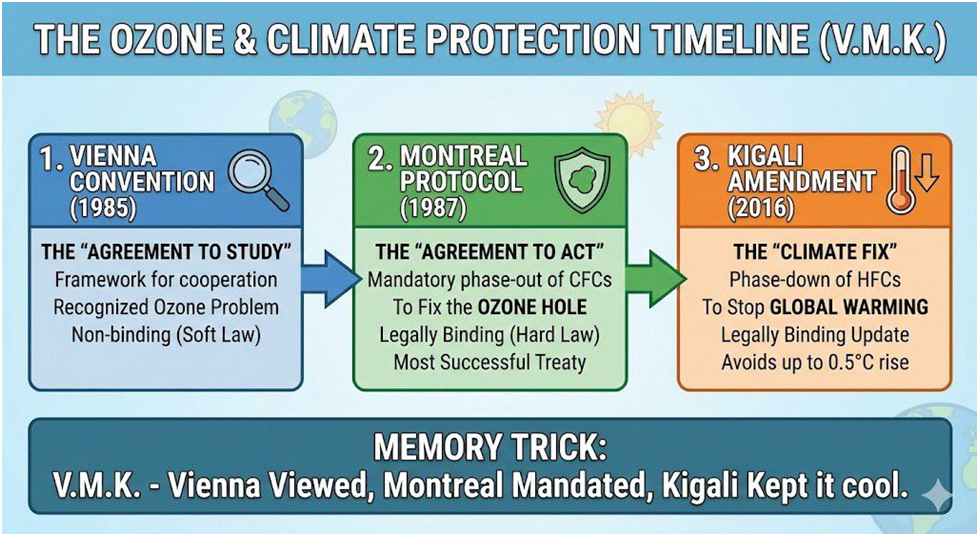
A. Vienna Convention (1985): The "Agreement to Talk"
What it was: The "Framework." Countries agreed that the Ozone hole was a problem and promised to study it.
Weakness: It didn't force countries to stop using the bad gases. It just said, "Let's cooperate."
Key Status: It was the first step.
B. Montreal Protocol (1987): The "Action Plan"
What it was: This is the star of environmental law. It listed specific chemicals (like CFCs and Halons) and set strict deadlines to stop making them.
How it worked: Rich countries had to stop first; poor countries got more time and money to switch to safer chemicals.
Why it's famous: It is the most successful environmental treaty in history. Every country in the world signed it (Universal Ratification). The Ozone hole is now healing!
C. Kigali Amendment (2016): The "Update"
The Twist: We replaced CFCs with HFCs. HFCs didn't eat the Ozone, but they caused Global Warming.
The Fix: The Kigali Amendment was added to the Montreal Protocol to phase out HFCs too, to save the climate.
3. Key Points
Target: Phase out Ozone Depleting Substances (ODS) like Chlorofluorocarbons (CFCs).
Different Timelines: It recognized "Common but Differentiated Responsibilities" (Rich countries act first).
Binding: Unlike the Vienna Convention, the Montreal Protocol is legally binding (You must do it).
Success: It is the only UN treaty to be ratified by every country on Earth (198 states).
💡 Short Trick to Remember
"Vienna Viewed it, Montreal Made it stop, Kigali Kept it cool."
Vienna = View (They just looked/studied the problem).
Montreal = Mandatory (They made binding rules to ban CFCs).
Kigali = Kill the heat (Banned HFCs to stop global warming).
Layman’s Summary
Imagine the Ozone layer is a roof protecting us from rain (UV rays).
Vienna (1985): Neighbors met and said, "Hey, there's a hole in the roof."
Montreal (1987): They signed a contract to stop throwing rocks (CFCs) at the roof.
Kigali (2016): They realized the new material they used was making the house too hot, so they agreed to change that too.
Present condition and status of the Kigali Amendment (as of early 2026)
1. Global Status: "Almost Everyone is In"
Ratification Count: As of early 2026, 171 countries (including the EU) have ratified the amendment.
Goal: The UN aims for "Universal Ratification" (all 198 countries) by late 2026.
Legal Status: It is currently active and binding. It officially entered into force on January 1, 2019.
2. India's Current Status
- Did we sign it?
Yes, India ratified it on September 27, 2021.
- What is India doing right now (2026)?
We are in the "Baseline Years" (2024–2026): India is currently measuring how much HFCs it uses. This average amount will set the limit for future reductions.
- Updating Laws: India is in the process of amending its Ozone Depleting Substances (Regulation and Control) Rules to legally control HFCs.
- When does the hard work start?
Freeze Year: 2028 (India must stop increasing HFC use).
Reduction Target: India aims to cut HFC use by 85% by 2047.
- Which Group is India in?
India is in Group 2 (High Ambient Temperature countries), along with countries like Saudi Arabia and Pakistan. We got extra time because our hot climate requires more cooling.
3. Who is doing what right now? (The 3 Tracks)
The world is split into three tracks based on how rich or hot the country is.
Group Who? Status in 2026
- Track 1 Developed Countries (USA, UK, EU) Already Cutting: They started reducing HFCs in 2019. The USA ratified in late 2022 and is currently enforcing cuts via the "AIM Act".
- Track 2 Developing Group 1 (China, Brazil, Africa) Just Started: They froze their consumption in 2024 and are now capping their usage.
- Track 3 Developing Group 2 (India, Gulf Nations) Preparing: Currently in "Baseline Years" (2024-2026). The freeze starts in 2028.
4. Layman's Summary of the Status
The Rich World (USA/EU): Is actively dieting (cutting HFCs).
China/Brazil: Has just stopped eating more (froze usage).
India: Is currently weighing itself (calculating baseline) before starting the diet in 2028.
💡 Short Trick for India's Status
Remember "I-28-47"
I = India.
28 = Freeze in 2028.
47 = Finish in 2047 (100 years after Independence).
Ashutosh Kumar, [05-02-2026 18:00]
Group Who? Status in 2026
Track 1 Developed Countries (USA, UK, EU) Already Cutting: They started reducing HFCs in 2019. The USA ratified in late 2022 and is currently enforcing cuts via the "AIM Act".
Track 2 Developing Group 1 (China, Brazil, Africa) Just Started: They froze their consumption in 2024 and are now capping their usage.
Track 3 Developing Group 2 (India, Gulf Nations) Preparing: Currently in "Baseline Years" (2024-2026). The freeze starts in 2028.
4. Layman's Summary of the Status
The Rich World (USA/EU): Is actively dieting (cutting HFCs).
China/Brazil: Has just stopped eating more (froze usage).
India: Is currently weighing itself (calculating baseline) before starting the diet in 2028.
💡 Short Trick for India's Status
Remember "I-28-47"
I = India.
28 = Freeze in 2028.
47 = Finish in 2047 (100 years after Independence).
TOPIC 4: BASEL CONVENTION 1989 AND BASEL PROTOCOL 1999
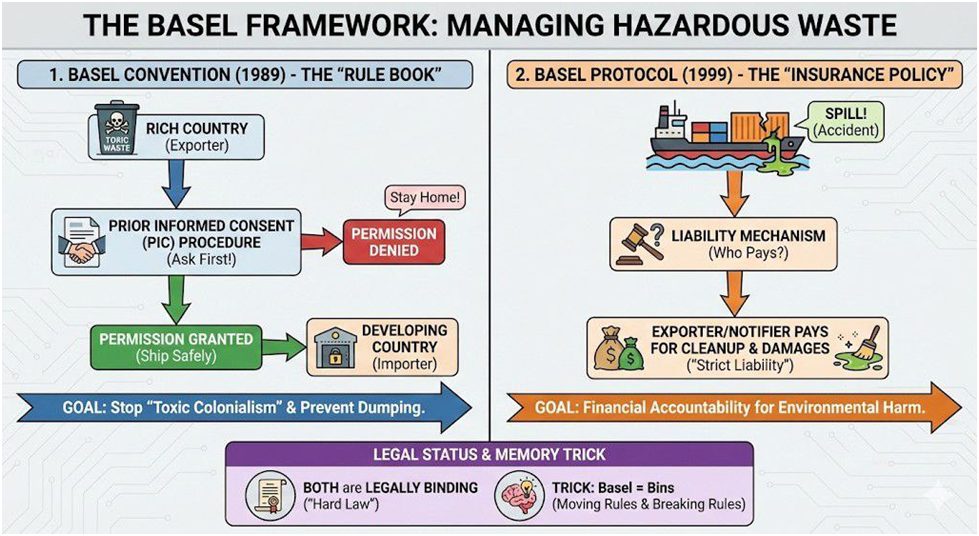
The Basel Convention (1989) and the Basel Protocol (1999) work together like a "Rule Book" and an "Insurance Policy" for the world's garbage.
1. The Rule Book: Basel Convention (1989)
"Stop Dumping Trash on Poor Countries"
The Problem: In the 1980s, rich countries (like in Europe) started shipping their toxic waste to developing countries (like in Africa) because it was cheaper than treating it safely at home. This was called "Toxic Colonialism."
The Solution: The Convention created strict rules to control the transboundary movement (shipping across borders) of hazardous waste.
Key Rules:
- Minimize Waste: Countries should generate less waste to begin with.
- Treat at Home: Waste should be treated as close to where it was produced as possible.
- Prior Informed Consent (PIC): Just like the Rotterdam Convention, you cannot ship waste to another country without their written permission.
The "Ban Amendment" (Important Update): Later, a stricter rule was added (which entered into force in 2019) completely banning rich countries (OECD) from exporting hazardous waste to developing countries, even for recycling.
2. The Insurance Policy: Basel Protocol (1999)
"Who Pays If It Spills?"
What is it? This is the Protocol on Liability and Compensation.
The Problem: Even with rules, accidents happen. If a ship carrying toxic waste sinks or leaks while crossing borders, who pays for the cleanup?
The Solution: It sets clear rules on who is financially responsible (Liable).
Strict Liability: The notifier (usually the exporter) is responsible for paying damages, even if it wasn't their fault (e.g., an accident).
Compensation: It ensures that victims of pollution or environmental damage get paid.
Comparison: Basel Convention vs. Basel Protocol
1. Main Job:
- Convention (1989): Control the movement and disposal of hazardous waste.
- Protocol (1999): Provide a system for Liability and Compensation (Money).
2. Simple Logic:
- Convention: "Don't dump it here." (Regulation)
- Protocol: "If it spills, you pay." (Accountability)
3. Primary Focus:
- Convention: Prevention and monitoring of waste trade.
- Protocol: Accountability and financial responsibility.
4. Key Mechanism:
- Convention: Prior Informed Consent (PIC) Procedure.
- Protocol: Strict Liability for the notifier/exporter.
5. Legal Status & India
Legally Binding: Yes, both are "Hard Law."
Ratification:
Convention: Very popular (191 parties). India ratified it in 1992.
USA Status: The USA has signed but NOT ratified the Basel Convention. They are the only developed nation that hasn't joined.
💡 Short Trick to Remember
"Basel = Bins"
- Basel Convention: The rules for moving the Bins (Don't move them to poor neighbors).
- Basel Protocol: The rules for breaking the Bins (If you spill the bin, you pay the cash).
TOPIC 5: ROTTERDAM CONVENTION, 1998
Rotterdam Convention (1998)
"The Permission Slip Treaty"
1. What is it? (Layman’s Concept)
Imagine you want to sell a dangerous weapon to your neighbor. You can't just throw it over the fence; you have to ring the bell and ask, "Do you want to buy this weapon?" and they must say "Yes" before you hand it over.
The Problem: Rich countries were selling dangerous pesticides and chemicals to poor countries without telling them the risks.
The Fix: This treaty forces exporters to get Permission before shipping dangerous chemicals.
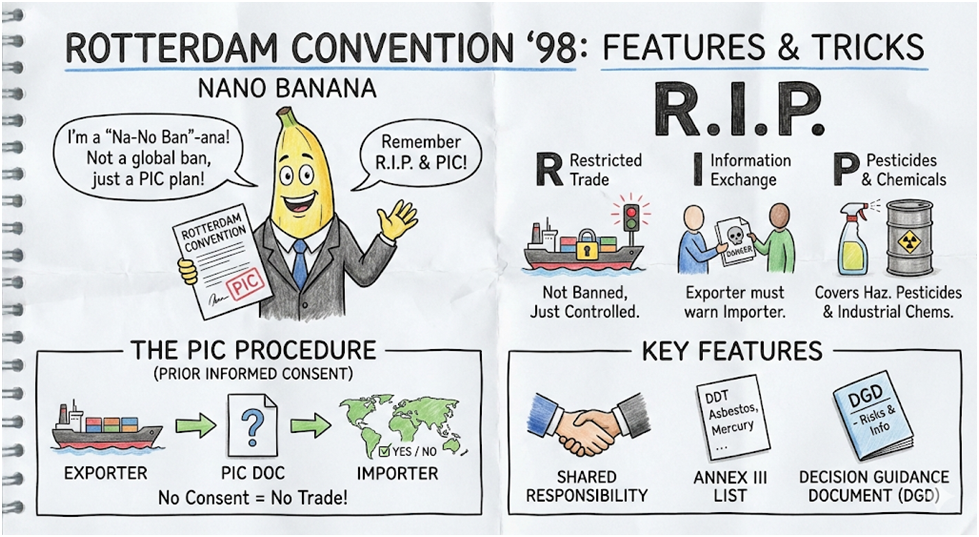
2. The Key Rule: "PIC" Procedure
The heart of this treaty is the Prior Informed Consent (PIC) procedure.
Prior: Before shipping.
Informed: Telling the truth about the danger (Labels & Data).
Consent: The receiver must explicitly say "Yes, I accept it."
3. What does it cover?
It doesn't ban chemicals outright (that’s the Stockholm Convention's job). Instead, it monitors the trade of:
- Hazardous Pesticides (Chemicals used in farming).
- Industrial Chemicals (Chemicals used in factories).
These are listed in Annex III of the treaty (The "Watch List").
· Information Exchange: It requires a "Decision Guidance Document" (DGD) to be sent to importers so they know the risks before saying "Yes."
· Annex III: This is the specific list of chemicals covered by the convention (e.g., DDT, Asbestos, Mercury compounds).
4. "Shared Responsibility"
It creates a partnership:
Exporter's Duty: Inform the buyer and respect their decision.
Importer's Duty: Decide if they can handle the chemical safely or refuse it.
💡 Short Trick to Remember
"Rotterdam = Request"
Rotterdam: Sounds like Rotter-Dam ~ Request Data.
The 3 R's of Rotterdam:
Request (Ask permission).
Receive (Get consent).
Responsibility (Shared between countries).
Feature Rotterdam Convention (1998)
The Rotterdam Convention is an international treaty promoting shared responsibility in the trade of hazardous chemicals (Pesticides & Industrial) through the Prior Informed Consent (PIC) procedure.
Main Idea : "Knock before you enter."
Key Mechanism : PIC (Prior Informed Consent).
Focus Trade of Chemicals (Not banning them).
Status :Legally binding
The Trick to Remember 🧠
Use the mnemonic "R.I.P." and the word "PIC".
The Trick:
"To stop the ROT (Rotterdam), you need a PIC."
The Breakdown:
- ROT = Rotterdam Convention.
- PIC = Prior Informed Consent (The heart of the treaty).
The Acronym: R.I.P. (For the specific features)
- R = Restricted Trade (not total ban, just regulated).
- I = Information Exchange (Exporters must warn importers).
- P = Pesticides & Chemicals (The two categories covered).
TOPIC 6: STOCKHOLM CONVENTION ON PERSISTENT ORGANIC POLLUTANTS (2001)
"The Forever Chemicals Treaty"
This convention targets specific, dangerous chemicals known as POPs.
How does the Stockholm Convention Work?
-Under the Stockholm Convention, which currently manages 29 POPs( initially 12 POPs) parties agreed to adopt a range of control measures to reduce and, where feasible, eliminate the release of POPs.
For intentionally produced POPs, parties shall prohibit or restrict their production and use, subject to certain exemptions such as the continued use of DDT.
The Stockholm Convention also requires parties to restrict trade in such substances. For unintentionally produced POPs, the Stockholm Convention requires countries to develop national action plans to address releases and to apply “Best Available Techniques” to control them.
The Stockholm Convention also aims to ensure the sound management of stockpiles and wastes that contain POPs.
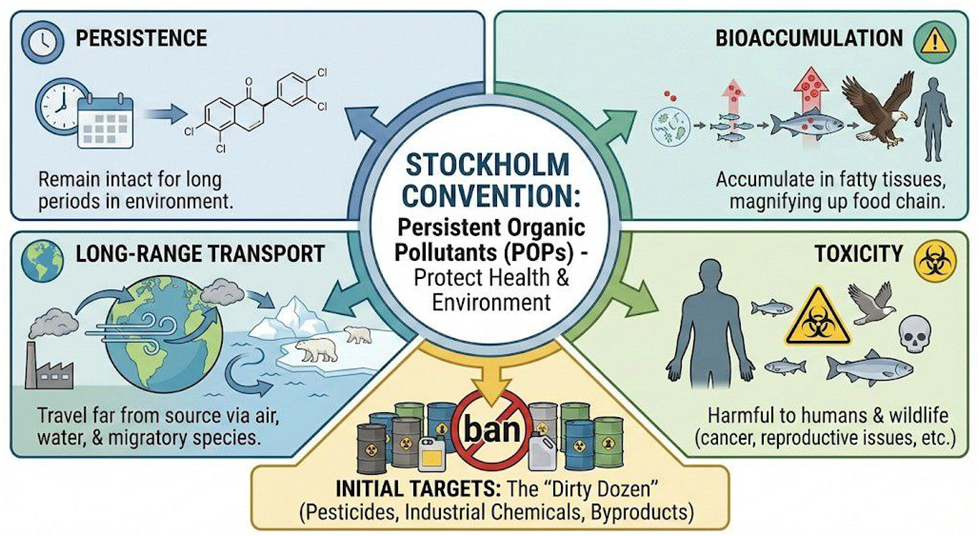
What are POPs?
POPs are "Persistent" (they don't break down), "Bioaccumulative" (they build up in your body fat), and they "Travel" (they can fly across the world on the wind). Scientists call this the "Grasshopper Effect" because these chemicals jump from place to place.
Key Provisions
The Dirty Dozen: It originally targeted the 12 worst chemicals( currently 29), like DDT (pesticide) and PCBs (industrial chemical). They are divided into 3 groups:
A. Pesticides (The "Farm Killers")
-Used to kill insects in agriculture.
Aldrin
Chlordane
DDT (Most Important for India)
Dieldrin
Endrin
Heptachlor
Mirex
Toxaphene
Hexachlorobenzene (Also an industrial chemical)
B. Industrial Chemicals (The "Factory Fluids")
-Used in machines, transformers, and paints.
10. PCBs (Polychlorinated Biphenyls) – Used in electrical transformers/capacitors.
11. Hexachlorobenzene (Also a pesticide).
C. Unintentional By-products (The "Accidents")
-These are not made on purpose. They are released when you burn plastic or chemical waste.
12. Dioxins
13. Furans
Important POPs Examples - India
These are the specific POPs important from India 's perspective:
DDT (Dichlorodiphenyltrichloroethane):
Status: Banned for farming, but allowed for public health (killing mosquitoes for Malaria control).
Why: India has a "Specific Exemption" under the treaty to use DDT for malaria.
Endosulfan (Added Later):
Status: Banned in India by the Supreme Court (2011) due to the tragedy in Kasargod, Kerala.
Note: It was added to the Stockholm Convention list later (2011).
PCBs:
Used widely in old electrical equipment in India. The government is currently working to dispose of old transformers containing PCBs.
Eliminate & Restrict:
Annex A: Chemicals to be Eliminated.
Annex B: Chemicals to be Restricted (e.g., DDT is allowed only for malaria control).
Annex C: Unintentional byproducts to be reduced.
Legal Status & India
Legal Status: Legally Binding (Hard Law).
Ratification: 186 Parties. India ratified it in 2006 and recently banned several hazardous POPs under its national rules.
Memory Trick: "The 3 P’s of POPs"
- Persistent (Stay forever).
- Poisonous (Cause cancer/birth defects).
- Pilgrims (They travel across borders).
Kasargod Endosulfan Case"
Case Title:
Democratic Youth Federation of India (DYFI) v. Union of India (2011)
(Citation: (2011) 15 SCC 530)
1. Facts
The Location: Kasargod District, Kerala (specifically villages like Padre and Enmakaje).
The Action: For over 20 years (starting in 1978), a government company (Plantation Corporation of Kerala) sprayed the pesticide Endosulfan from helicopters over cashew plantations to kill tea mosquitoes.
The Tragedy: The chemical didn't just stay on trees; it poisoned the water, soil, and people.
The Result:✓ Thousands of villagers developed horrific health issues:
✓Children were born with twisted limbs and physical deformities.
✓High rates of cancer, mental retardation, and skin diseases.
✓Locals called the aerial spraying the "Rain of Death".
2. The Legal Battle
The Petitioner: The Democratic Youth Federation of India (DYFI) filed a Public Interest Litigation (PIL) in the Supreme Court.
The Argument: They argued that the "Right to Life" (Article 21) includes the right to a healthy environment and that the government was poisoning its own citizens.
The Defense: The pesticide manufacturers argued that Endosulfan was safe if used correctly and that banning it would hurt farmers.
3. The Judgment (Supreme Court Order)
On May 13, 2011, a bench led by Chief Justice S.H. Kapadia passed a historic order:
Immediate Ban: The Court ordered an immediate Ad-Interim Ban on the manufacture, sale, use, and export of Endosulfan throughout India.
"Human Life First": The Chief Justice famously said: "I cannot allow the use of Endosulfan for even seven weeks. Effect on one child's health is also crucial and I can't have that on my head.".
Expert Committee: The Court appointed a committee headed by the Director General of ICMR (Indian Council of Medical Research) to study the health effects scientifically.
Compensation: Later (in 2017), the Court ordered the Kerala Government to pay ₹500 Crores as compensation to over 5,000 victims.
4. Legal Principles Applied
Right to Life (Article 21): The Court ruled that health is a fundamental right. Even economic benefits (cheap pesticides) cannot override the right to life.
Precautionary Principle: The Court applied this Rio Principle. It said, "We don't need 100% scientific proof that it kills people. If there is a risk of serious harm, we must ban it first to be safe".
5. Connection to Stockholm Convention
This case forced the Indian government to change its stance globally.
India eventually agreed to list Endosulfan in Annex A (Elimination) of the Stockholm Convention in 2011, leading to a global phase-out.
💡 Short Trick to Remember
"DYFI fought the Rain of Death"
DYFI: The Youth Federation that filed the case.
Rain: Reminds you of Aerial Spraying (Helicopters).
Death: Reminds you of Article 21 (Right to Life).
TOPIC 7: BRUNDLAND COMMISSION REPORT (1987)
The Brundtland Commission (formally known as the World Commission on Environment and Development) was actually established in 1983, but 1987 is the year it gained global fame for publishing its landmark report, “Our Common Future”.
The commission was appointed to address the growing conflict between global economic growth and the accelerating degradation of the environment.
Why was it appointed?
The United Nations General Assembly recognized that previous attempts to address environmental issues (like the 1972 Stockholm Conference) weren't enough to stop the "deterioration of the human environment." The commission was tasked with:
Defining Sustainable Development: Creating a framework where economic growth could coexist with environmental protection.
Proposing Long-term Strategies: Recommending ways for the international community to deal with environmental concerns into the 21st century.
Bridging the North-South Divide: Reconciling the needs of developing nations (focused on poverty alleviation) with developed nations (focused on ecological limits).
Key Outcome (1987)
In October 1987, the commission released the Brundtland Report.
Official Name: It was formally titled “Our Common Future” and was produced by the World Commission on Environment and Development (WCED).
The Global Definition: It introduced the standard definition of Sustainable Development:
"Development that meets the needs of the present without compromising the ability of future generations to meet their own needs."
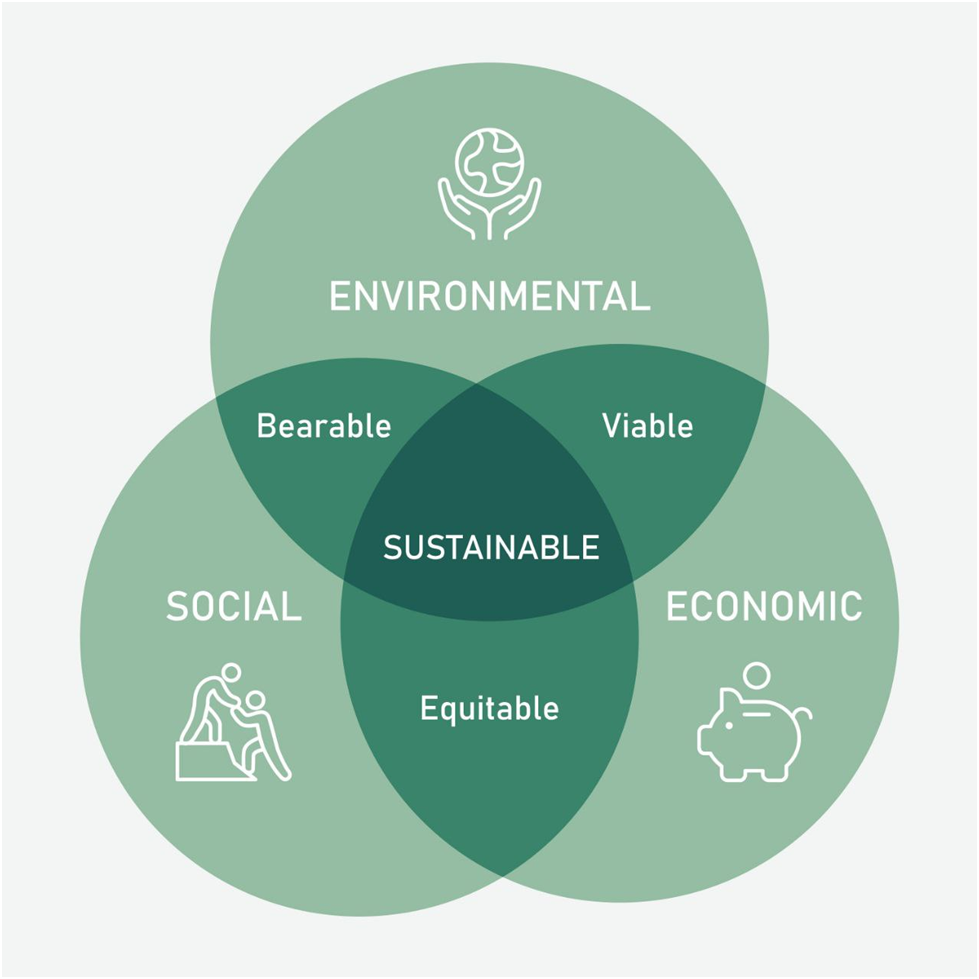
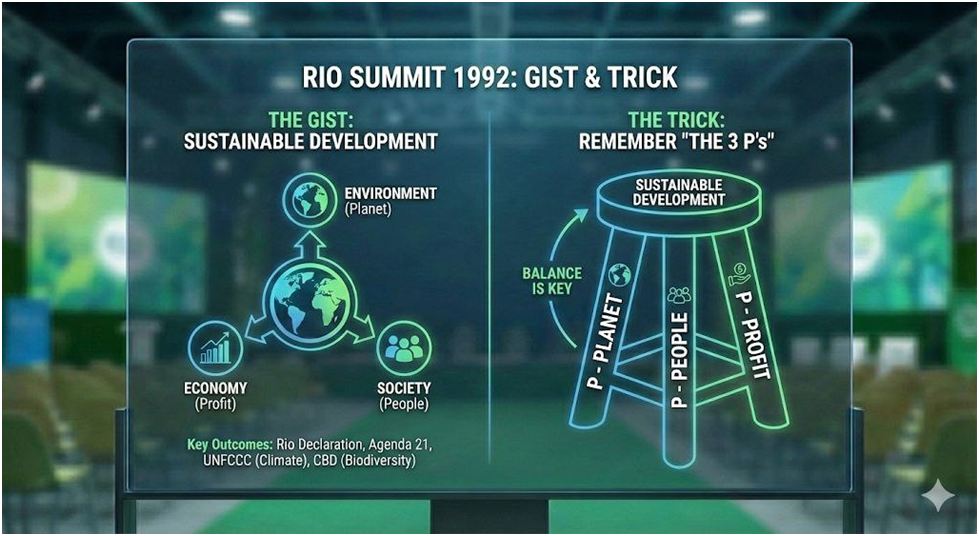
The "Three Pillars": It argued that sustainability requires a balance between three competing interests:
- Economic: Growth and financial stability.
- Social: Poverty reduction and equity.
- Environmental: Conservation and resource management.
✓Poverty and Environment Link: The report was one of the first to argue that poverty is a major cause of environmental degradation, as people struggling to survive often have no choice but to over-exploit their local resources.
✓Concept of "Limits": It acknowledged that while technology and social organization can improve, there are ultimate limits to the environment's ability to meet present and future needs.
✓Global Responsibility: It emphasized that environmental issues like global warming and ozone depletion are transboundary and require international cooperation rather than isolated national policies.
✓Legacy: This report paved the way for the 1992 Rio Earth Summit and directly influenced the development of the UN's Sustainable Development Goals (SDGs).
TOPIC 8: SUSTAINABLE DEVELOPMENT GOALS
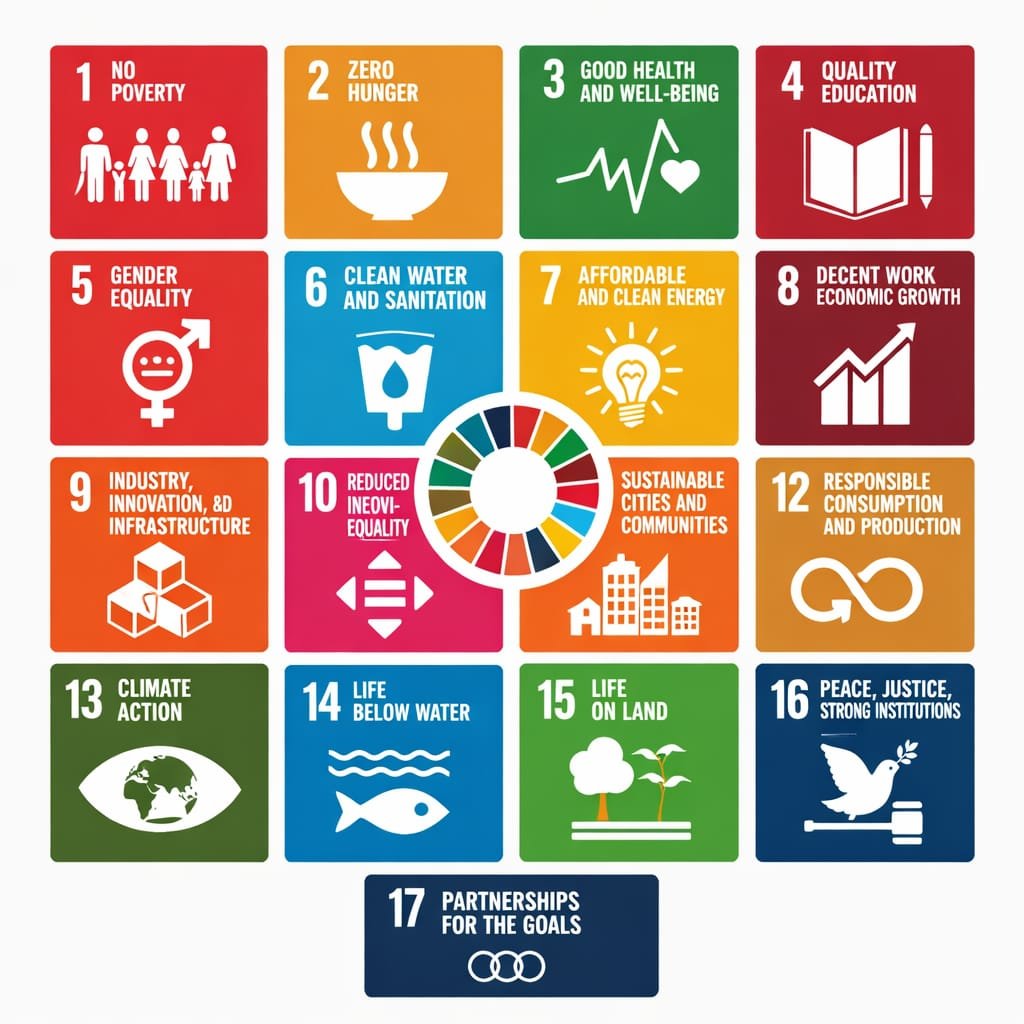
To memorize all 17 Sustainable Development Goals (SDGs), here is a simple story-based trick.
Imagine a person's journey from struggle to a perfect world:
Part 1: Basic Needs (SDGs 1–6)
1. No Poverty: First, you have no money.
2. Zero Hunger: Because you have no money, you are hungry.
3. Good Health: Because you are hungry, your health suffers.
4. Quality Education: To fix this, you go to school for an education.
5. Gender Equality: In school, boys and girls are treated equally.
6. Clean Water: At school, you drink clean water to stay hydrated.
Part 2: Work & Growth (7–12)
7. Affordable Energy: You need light (electricity) to study at night.
8. Decent Work: Now that you've studied, you get a job.
9. Industry & Innovation: Your job is in a big factory (industry).
10. Reduced Inequality: In the factory, everyone (rich/poor) is treated fairly.
11. Sustainable Cities: You earn enough to live in a clean city.
12. Responsible Consumption: In the city, you don't waste food or plastic.
Part 3: The Planet (13–15)
13. Climate Action: Suddenly, the weather changes (Climate change).
14. Life Below Water: The oceans get affected.
15. Life on Land: The forests and animals get affected too.
Part 4: The Result (16–17)
16. Peace & Justice: We need peace and law to fix the planet.
17. Partnerships: Finally, we all work together to finish the goals.
TOPIC 9: U.N. CONFERENCE ON ENVIRONMENT AND DEVELOPMENT, 1992- RIO PRINCIPLES
A new blueprint for international action on the environment
The United Nations Conference on Environment and Development (UNCED), also known as the 'Earth Summit', was held in Rio de Janeiro, Brazil, from 3-14 June 1992.
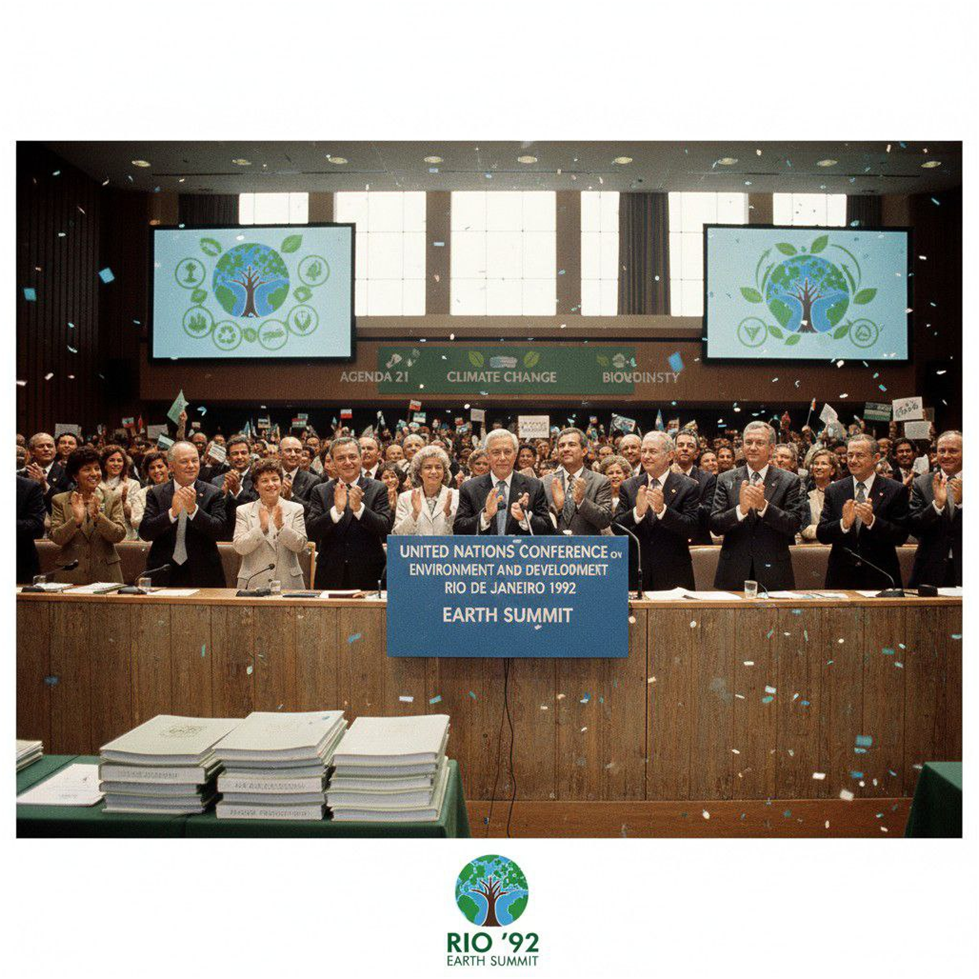
This global conference, held on the occasion of the 20th anniversary of the first Human Environment Conference in Stockholm, Sweden, in 1972, brought together political leaders, diplomats, scientists, representatives of the media and non-governmental organizations (NGOs) from 179 countries for a massive effort to focus on the impact of human socio-economic activities on the environment.
A 'Global Forum' of NGOs was also held in Rio de Janeiro at the same time, bringing together an unprecedented number of NGO representatives, who presented their own vision of the world's future in relation to the environment and socio-economic development.
The Rio de Janeiro conference highlighted how different social, economic and environmental factors are interdependent and evolve together, and how success in one sector requires action in other sectors to be sustained over time.
The primary objective of the Rio 'Earth Summit' was to produce a broad agenda and a new blueprint for international action on environmental and development issues that would help guide international cooperation and development policy in the twenty-first century.
The 'Earth Summit' concluded that the concept of sustainable development was an attainable goal for all the people of the world, regardless of whether they were at the local, national, regional or international level. It also recognized that integrating and balancing economic, social and environmental concerns in meeting our needs is vital for sustaining human life on the planet and that such an integrated approach is possible.
The conference also recognized that integrating and balancing economic, social and environmental dimensions required new perceptions of the way we produce and consume, the way we live and work, and the way we make decisions. This concept was revolutionary for its time, and it sparked a lively debate within governments and between governments and their citizens on how to ensure sustainability for development.
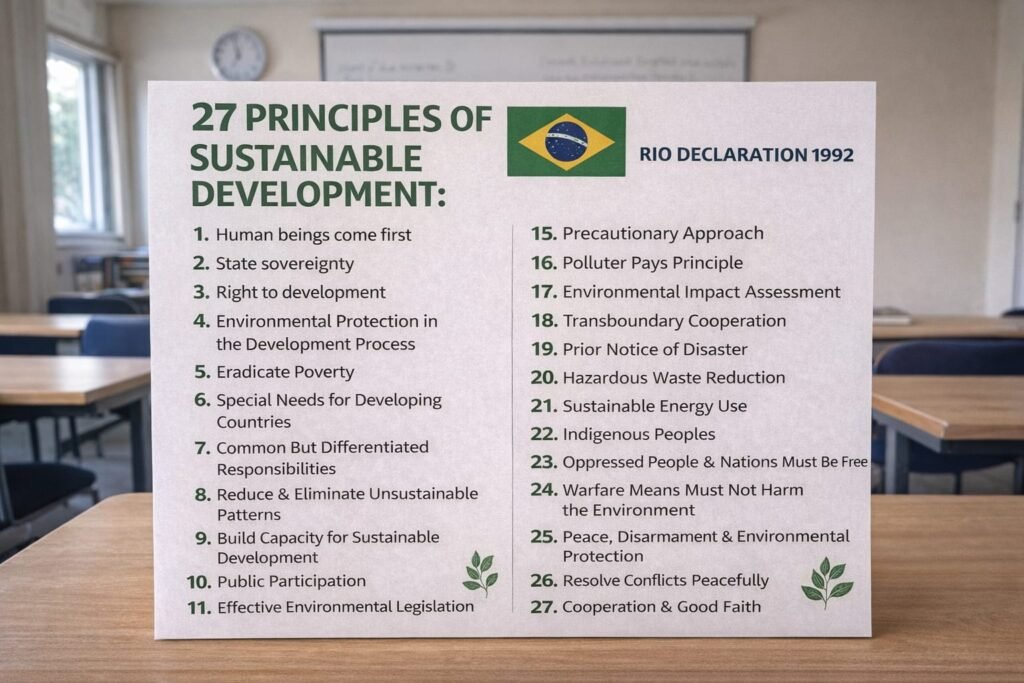
The 1992 Rio Declaration on Environment and Development (often called the Earth Summit) established 27 Principles to guide sustainable development. While 27 is a lot to memorize, they are generally grouped into core themes.
1. The Core Rio Principles (Key Categories)
Rather than memorizing all 27 individually, focus on these major clusters is sufficient:
Principle 1 (Human-Centric): Humans are at the center of concerns for sustainable development.
Principle 3 (Right to Development): Development must be fulfilled so as to equitably meet developmental and environmental needs of present and future generations.
Principle 4 (Integration): Environmental protection shall constitute an integral part of the development process.
Principle 7 (CBDR): Common But Differentiated Responsibilities. Developed countries acknowledge the responsibility they bear in the international pursuit of sustainable development.
Principle 10 (Public Participation): Environmental issues are best handled with the participation of all concerned citizens.
Principle 15 (Precautionary Principle): Where there are threats of serious or irreversible damage, lack of full scientific certainty shall not be used as a reason for postponing cost-effective measures.
Principle 16 (Polluter Pays): The polluter should, in principle, bear the cost of pollution.
One of the major results of the UNCED Conference was Agenda 21, a daring program of action calling for new strategies to invest in the future to achieve overall sustainable development in the 21st century. Its recommendations ranged from new methods of education, to new ways of preserving natural resources and new ways of participating in a sustainable economy.
The 'Earth Summit' had many great achievements:
the Rio Declaration and its 27 universal principles, the United Nations Framework Convention on Climate Change (UNFCCC), the Convention on Biological Diversity; and the Declaration on the principles of forest management .
The 'Earth Summit' also led to the creation of the Commission on Sustainable Development, the holding of first world conference on the sustainable development of small island developing States in 1994, world conference on the sustainable development of small island developing States in 1994, and negotiations for the establishment of the agreement on straddling stocks and highly migratory fish stocks.
TOPIC 10: Convention on biological diversity, 1992
The Convention on Biological Diversity (CBD), signed at the 1992 Earth Summit in Rio de Janeiro, is the most comprehensive international agreement dedicated to the conservation of life on Earth. It was the first global agreement to cover all aspects of biological diversity: genetic resources, species, and ecosystems.
1. The Three Main Objectives
The Convention is unique because it balances conservation with sustainable use and economic equity. Its three pillars are:
- Conservation of Biological Diversity: Protecting habitats, species, and genetic variations in their natural environments (in-situ) or in facilities like seed banks (ex-situ).
- Sustainable Use of its Components: Using biological resources in a way and at a rate that does not lead to the long-term decline of biological diversity.
- Fair and Equitable Sharing of Benefits: Ensuring that the benefits arising from the use of genetic resources (especially for commercial purposes, like pharmaceuticals) are shared fairly with the country of origin.
2. Key Principles
Sovereign Rights: States have the sovereign right to exploit their own resources pursuant to their own environmental policies.
The Precautionary Principle: The convention asserts that where there is a threat of significant reduction or loss of biological diversity, lack of full scientific certainty should not be used as a reason for postponing measures to avoid or minimize such a threat.
National Biodiversity Strategies (NBSAPs): Article 6 requires each member country to develop national strategies, plans, or programs for the conservation and sustainable use of biological diversity.
Comprehensive Note on International Biodiversity Frameworks & India
1. The Foundation: Convention on Biological Diversity (CBD), 1992
The global effort to protect life on Earth began in earnest at the Rio Earth Summit in 1992 with the Convention on Biological Diversity (CBD). It is a legally binding treaty with three main goals:
Conservation of Biological Diversity: Protecting habitats, species, and genetic variations in their natural environments (in-situ) or in facilities like seed banks (ex-situ).
Sustainable Use of its Components: Using biological resources in a way and at a rate that does not lead to the long-term decline of biological diversity.
Fair and Equitable Sharing of Benefits: Ensuring that the benefits arising from the use of genetic resources (especially for commercial purposes, like pharmaceuticals) are shared fairly with the country of origin.
The CBD recognizes that countries have sovereign rights over their own biological resources, moving away from the colonial idea that nature is free for anyone to take.
2. Regulating Technology: The Cartagena Protocol (2000)
As biotechnology advanced, the world needed rules to prevent "technological bullying" of nature. The Cartagena Protocol on Biosafety was adopted in 2000 to regulate the movement of Living Modified Organisms (LMOs), also known as GMOs, across borders.
Core Mechanism: It uses the Advance Informed Agreement (AIA) procedure. Before Country A exports GM seeds to Country B, it must inform Country B. Country B has the right to refuse entry if it fears environmental damage.
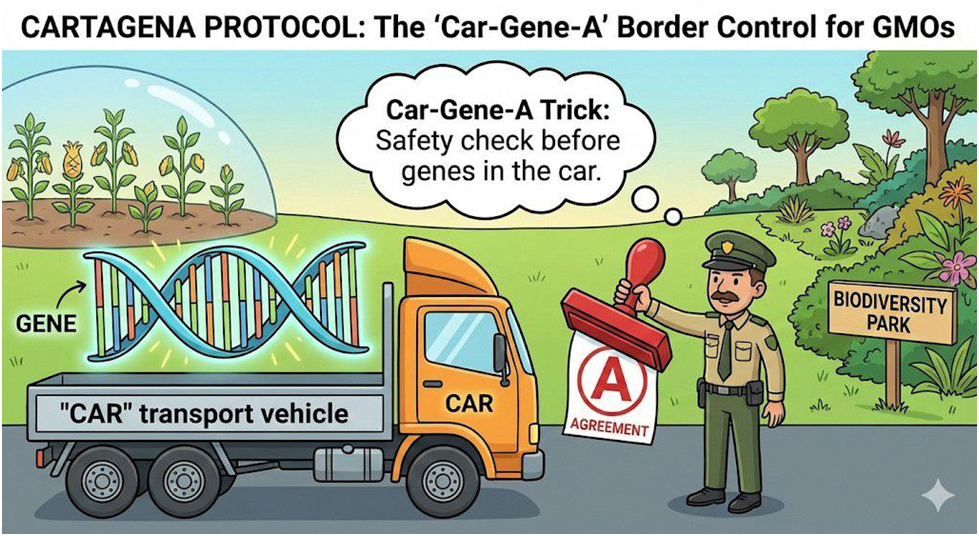
Purpose: It ensures that the profit-driven biotech industry does not compromise ecological safety or human health.
3. Understanding GMOs
Genetically Modified Organisms (GMOs) are the subject of the Cartagena Protocol. These are organisms whose DNA has been altered in a lab—for example, inserting bacteria genes into cotton to kill pests (Bt Cotton) or modifying rice to produce Vitamin A (Golden Rice). While they offer agricultural and medical breakthroughs (like synthetic insulin), they pose risks such as cross-contamination with wild species, necessitating strict "border control" via Cartagena.
4. Setting Goals: The Aichi Targets (2011–2020)
To operationalize the CBD, the world adopted the Strategic Plan for Biodiversity 2011–2020, which included the 20 Aichi Biodiversity Targets. These targets aimed to address the underlying causes of biodiversity loss, reduce pressures (like pollution and habitat loss), and safeguard ecosystems.
Outcome: By 2020, none of the 20 targets were fully met globally, though progress was made in designating protected areas.
Successor: The failure of Aichi led to the new Kunming-Montreal Global Biodiversity Framework (2022), which sets the ambitious "30x30" goal (protecting 30% of the planet by 2030).
5. The Indian Scenario
India is a megadiverse country and a committed party to the CBD and Cartagena Protocol.
Legal Framework: To implement the CBD, India enacted the Biological Diversity Act, 2002 and established the National Biodiversity Authority (NBA). For GMOs, India relies on the Environment (Protection) Act, 1986.
Regulatory Body: The Genetic Engineering Appraisal Committee (GEAC) is the apex body that approves or rejects GMOs.
Current Reality:India treads cautiously. Bt Cotton is the only GM crop allowed for commercial cultivation. Bt Brinjal remains under a moratorium due to safety concerns, and GM Mustard (DMH-11) is currently facing legal scrutiny in the Supreme Court.
India’s GMO Status "Traffic Light"
🟢 Green (Legal): Bt Cotton (the only one commercially grown).
🟡 Yellow (Pending): GM Mustard (stuck in Supreme Court).
🔴 Red (Banned): Bt Brinjal (under an indefinite ban since 2010).
Conclusion
From the 1992 CBD to the strict checks of the Cartagena Protocol and the domestic vigilance of the GEAC, the global and Indian frameworks attempt to balance the need for development and biotechnology with the urgent necessity of preserving the planet's ecological integrity.
TOPIC 11: U.N. FRAMEWORK CONVENTION ON CLIMATE CHANGE, 1992 , KYOTO PROTOCOL(1997), AND PARIS AGREEMENT(2015)
UN Convention on climate change, 1992
The United Nations Framework Convention on Climate Change (UNFCCC), adopted in 1992, is the foundational international treaty aimed at addressing climate change. It was opened for signature at the Earth Summit in Rio de Janeiro and remains the "parent treaty" of both the Kyoto Protocol (1997) and the Paris Agreement (2015).
1. Primary Objective
The treaty’s ultimate goal is defined in Article 2:
To achieve stabilization of greenhouse gas concentrations in the atmosphere at a level that would prevent dangerous anthropogenic (human-induced) interference with the climate system.
2. Key Principles
The UNFCCC introduced several landmark concepts that still govern international climate politics:
✓Common But Differentiated Responsibilities (CBDR): While all nations must address climate change, developed countries (who historically emitted the most) are expected to take the lead.
✓Precautionary Principle: Scientific uncertainty should not be used as a reason to postpone action to prevent serious or irreversible damage.
✓Sustainable Development: Climate measures should be integrated with economic development to ensure that the fight against poverty is not hindered.
3. Categorization of Countries
The Convention divided the world into three main groups based on their economic status and capability:
Group Description
✓ Annex I :Industrialized nations (OECD members in 1992) and "Economies in Transition" (former Soviet bloc). They committed to returning GHGs to 1990 levels.
✓Annex II : A subset of Annex I (wealthy OECD members) required to provide financial and technical resources to developing countries.
✓Non-Annex I :Mostly developing nations. They have no immediate emission reduction targets but must report on their climate activities.
How it Functions
The Convention established the Conference of the Parties (COP), which is the supreme decision-making body. It meets annually to review the implementation of the Convention and negotiate new legal instruments (like the Paris Agreement).
Key Quick Facts:
Signed: June 1992 (Rio de Janeiro).
Entered into Force: March 21, 1994.
Secretariat Location: Bonn, Germany.
Membership: Near-universal (198 Parties).
In simple terms, the 1992 UN Convention on Climate Change (UNFCCC) was the world’s first major "agreement to agree" on fixing the planet's climate.
Before this, there was no global plan to deal with rising temperatures. This treaty set the ground rules for how countries would work together.
1. The "Big Goal"
Imagine the Earth's atmosphere as a greenhouse. We are pumping too many gases (like CO_2) into it, which traps heat. The treaty’s goal was to stop those gases from reaching a dangerous level so that nature could adapt naturally and food production wouldn't be threatened.
2. The "Shared but Different" Rule
This is the most famous part of the treaty. It recognized two things:
Everyone is responsible for the planet.
Rich countries (like the US and European nations) started the problem by burning coal and oil for 150 years during the Industrial Revolution.
Therefore, the treaty said: "We all have to help, but the rich countries must lead the way and pay for it."
3. How the "Groups" Worked
To make it fair, the treaty split the world into two main camps:
The "Developed" Group: Countries that were already wealthy and industrialized. They were expected to cut their emissions first.
The "Developing" Group: Countries (like India and Brazil) that were still trying to grow their economies. They weren't forced to cut emissions yet because they needed to focus on lifting their people out of poverty.
4. The "Annual Meeting" (COP)
The treaty didn't just happen once and end. It created a yearly meeting called the COP (Conference of the Parties).
Every year, leaders from almost every country in the world meet to discuss progress.
Famous deals you’ve heard of, like the Paris Agreement, are actually just updates or "add-ons" to this original 1992 treaty.
Why it matters today
Even though the 1992 treaty didn't have strict "punishments" for countries that failed, it created the legal foundation for every climate law we have today. Without it, there would be no global system to track pollution or provide financial help to countries hit by climate disasters.
Kyoto Protocol (1997)
If the UNFCCC (1992) was a "gentleman’s agreement" to fix the climate, the Kyoto Protocol (1997) was the first time the world tried to turn those promises into a legal contract with penalties.
1. The Big Difference: Legally Binding
UNFCCC (1992): Asked countries to reduce emissions voluntarily. (It failed because most countries didn't do much).
Kyoto Protocol (1997): Forced 37 industrialized countries (the "rich" ones) to cut their greenhouse gas emissions by an average of 5% compared to 1990 levels. If they failed, there were consequences.
2. The "Top-Down" Approach
The Kyoto Protocol followed a very strict logic:
Who is responsible? Only the developed nations (called Annex I countries).
Who is exempt? Developing nations like India and China. They signed the treaty but were not forced to cut emissions yet because they needed to develop their economies.
3. The "Kyoto Mechanisms" (Market Solutions)
This is where it gets interesting for a Law student. Kyoto introduced three "flexible" ways for rich countries to meet their targets without only cutting smoke from their own factories:
Emissions Trading (The Carbon Market): If Country A reduced more pollution than required, it could sell its "extra credits" to Country B, which was struggling to meet its target.
Clean Development Mechanism (CDM): A rich country could get "points" by building a wind farm or a solar plant in a developing country like India.
Result: India benefited greatly from this, receiving a lot of green technology and investment in the early 2000s.
Joint Implementation: Two rich countries working together on a green project.
4. Why did it struggle?
Despite being a breakthrough, the Kyoto Protocol had two major "holes":
The US Problem: The United States signed it but refused to ratify (legally accept) it. They argued it was unfair that they had to cut emissions while India and China didn't have to.
The "developing" boom: Since 1997, countries like India and China grew so fast that their emissions became huge, but under Kyoto rules, they still weren't required to cut anything. This led to the eventual creation of the Paris Agreement (2015) to replace Kyoto.
Paris agreement
The Paris Agreement (2015) is the current "global rulebook" for fighting climate change. If the Kyoto Protocol was a strict, top-down contract for just a few countries, the Paris Agreement is a "everyone-in" team effort where every country sets its own targets.
1. In Layman’s Terms
Imagine a giant neighborhood meeting where the house is on fire.
The Old Way (Kyoto): The teacher pointed at the 30 oldest students and said, "Only you must fetch water."
The Paris Way: Every single student (196 countries) stood up and said, "I will bring two buckets," or "I will bring a hose," or "I will help carry the ladder."
Everyone decides their own contribution based on what they can afford, but everyone must participate.
2. The Core Goals (The "1.5°C" Rule)
The main goal is to stop the Earth from getting too hot. Scientists use "Pre-industrial levels" (the temperature before we had factories) as the starting line.
The "Must-Do" Goal: Keep global warming well below 2°C.
The "Dream" Goal: Try your hardest to limit it to 1.5°C.
Net Zero: By the middle of this century (2050), we should reach a point where we aren't adding any new carbon to the atmosphere (planting as many trees as the smoke we produce).
3. India’s Promises (Nationally Determined Contributions - NDCs)
India is currently one of the world's leaders in meeting these goals. In 2022, India updated its "to-do list" (called Panchamrit or 5 Nectar Elements):
Non-Fossil Energy: India will reach 500 GW of non-fossil energy capacity by 2030.
Renewable Energy: India will meet 50% of its energy requirements from renewable energy by 2030.
Carbon Intensity: India will reduce the carbon intensity of its economy by 45% by 2030.
Carbon Emissions: India wi ll reduce total projected carbon emissions by 1 billion tonnes from now until 2030.
Net Zero: India will achieve the target of Net Zero by 2070.
Difference between Kyoto protocol and Paris agreement
1.Responsibility (Who has to act?)
Kyoto: Only 37 developed (rich) nations were legally forced to cut emissions. Developing nations like India were exempt from cuts.( Top Down Approach)
Paris: Every country (Rich and Poor) must take action. India now has specific climate targets just like the US or Germany.( Bottom Up Approach)
2. Setting Targets (Who decides the numbers?)
Kyoto (Top-Down): The UN gave countries specific "homework" (targets). Countries didn't choose their own numbers.
Paris (Bottom-Up): Every country chooses its own goals based on what it can afford. These are called NDCs (Nationally Determined Contributions).
3. Legal Status (Is it a law?)
Kyoto: The targets were legally binding. If a country fails, they technically "broke the law."
Paris: The process is binding (you must report progress), but the targets are voluntary. You aren't "arrested" for missing your goal, but you are publicly named and shamed.
4. The Main Goal (What are we measuring?)
Kyoto: Aimed to reduce 6 specific greenhouse gases (like Cabon di oxide and Methane) by 5%.
Paris: Aims to keep the Earth's temperature from rising more than 1.5°C or 2°C.
5. USA Participation
Kyoto: The US signed it but refused to join officially because it didn't like that India and China were exempt.
Paris: The US is not a member ( as of January 2026). It joined first under President Obama,left under President Trump's first tenure, rejoined it under the Biden administration and finally left under President Trump in January 2025.
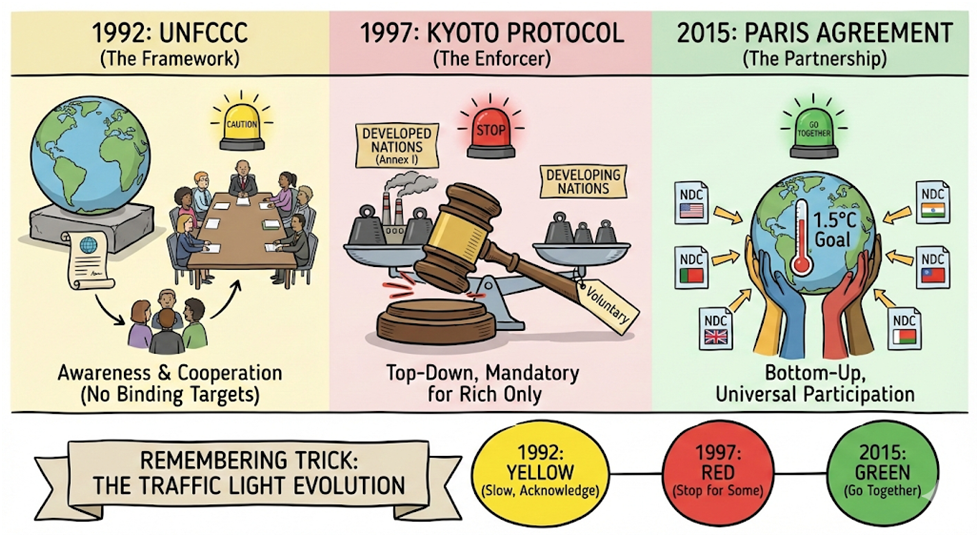
The Evolution Timeline
UNFCCC (1992) "The Framework"
KYOTO (1997) "The Legal Hammer" (Top-Down)
PARIS (2015) "The Universal Handshake" (Bottom-Up)
💡 How do they work?
- 1992 is the Brain: Awareness and naming the issue.
- 1997 is the Rulebook: Strict laws for a few people (Developed countries).
- 2015 is the Team: A common goal where everyone chooses their own path (NDCs).
TOPIC 12: 1998 AARHUS CONVENTION
The Aarhus Convention, adopted on June 25, 1998, in the Danish city of Aarhus, is a landmark international treaty that links environmental rights with human rights. It is based on the principle that sustainable development can only be achieved through the involvement of all stakeholders.
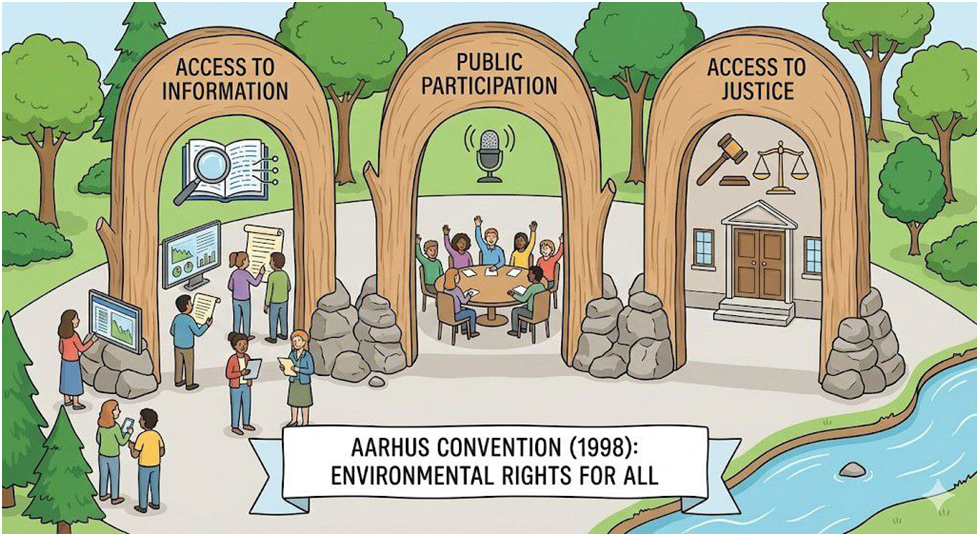
The convention is built upon three fundamental pillars, which grant the public specific rights and impose obligations on public authorities.
1. Access to Environmental Information
This pillar ensures that citizens have the right to know about the state of the environment and any activities that might affect it.
Right to Request: Any person can request environmental information from public authorities without having to prove a specific interest.
Active Dissemination: Public authorities are required to proactively collect and publish information (such as reports on the state of the environment) to the public.
Timeframes: Information must generally be provided within one month of the request.
2. Public Participation in Decision-Making
This pillar focuses on involving the public in the formation of laws, policies, and specific projects that impact the environment.
Early Involvement: Participation must occur when "all options are open," meaning before a final decision is made.
Scope: This applies to decisions on specific activities (like building a power plant), as well as the drafting of environmental plans, programmes, and executive regulations.
Due Account: Authorities must demonstrate that they have taken the outcomes of public participation into "due account" when making the final decision.
3. Access to Justice
The third pillar provides a "safety net" to ensure that the first two pillars are respected and enforced. It grants the public the right to challenge decisions in court.
Review Procedures: Citizens and NGOs have the right to seek a review before a court of law or another independent body if they feel their request for information was ignored or if a decision-making process was flawed.
Standard of Access: The procedures must be fair, equitable, timely, and not prohibitively expensive, ensuring that cost is not a barrier to environmental justice.
Core Objectives and Significance
The Aarhus Convention is unique because it goes beyond traditional environmental law. It focuses on procedural rights—the how of environmental protection—rather than just the what.
Accountability: It makes governments more transparent and accountable to their citizens.
The "Compliance Committee": The convention established a unique "Compliance Committee" where members of the public can bring "communications" (complaints) directly against a party (country) if they believe the treaty is being violated.
Global Influence: While it originated within the United Nations Economic Commission for Europe (UNECE), it is an "open" convention, meaning any UN member state can join. It served as the direct inspiration for the Escazú Agreement in Latin America and the Caribbean.
layman's terms, the Aarhus Convention is essentially a "Bill of Rights" for the environment. It tells governments: "You cannot make decisions about nature in secret; you must include the people who live there."
Think of it as a bridge between human rights and environmental protection.
The Three Pillars (The "How-To" of the Treaty)
1. The Right to Know (Access to Information)
If you want to know how polluted the river in your town is, or if a factory is leaking chemicals, the government must tell you. You don't need a "legal reason" to ask; you just have the right to the facts.
2. The Right to Speak (Public Participation)
If the government plans to build a massive highway or a dam, they can't just start digging. They must tell the public early on, listen to their concerns, and actually consider those opinions before making the final decision.
3. The Right to Sue (Access to Justice)
If the government hides information (Pillar 1) or ignores the public's voice (Pillar 2), you have the right to go to court. This "pillar" ensures that the first two aren't just empty promises.
Trick to remember I.P.J.
I Information "Tell me what's happening."
P Participation "Let me have a say."
J Justice "Hold them accountable if they break the rules."
TOPIC 13: Johannesburg conference 2002
The Johannesburg Conference 2002, officially known as the World Summit on Sustainable Development (WSSD), was a major United Nations gathering held ten years after the famous 1992 Rio Earth Summit.
While Rio was about creating the "blueprints" (like Agenda 21), Johannesburg was about action and implementation—moving from talk to results.
The Key Focus: "The Three Pillars"
The summit reinforced that sustainable development isn't just about the environment; it is a balance of three things:
- Economic Development: Making sure people have jobs and money.
- Social Development: Ensuring health, education, and equality.
- Environmental Protection: Keeping the planet healthy for the future.
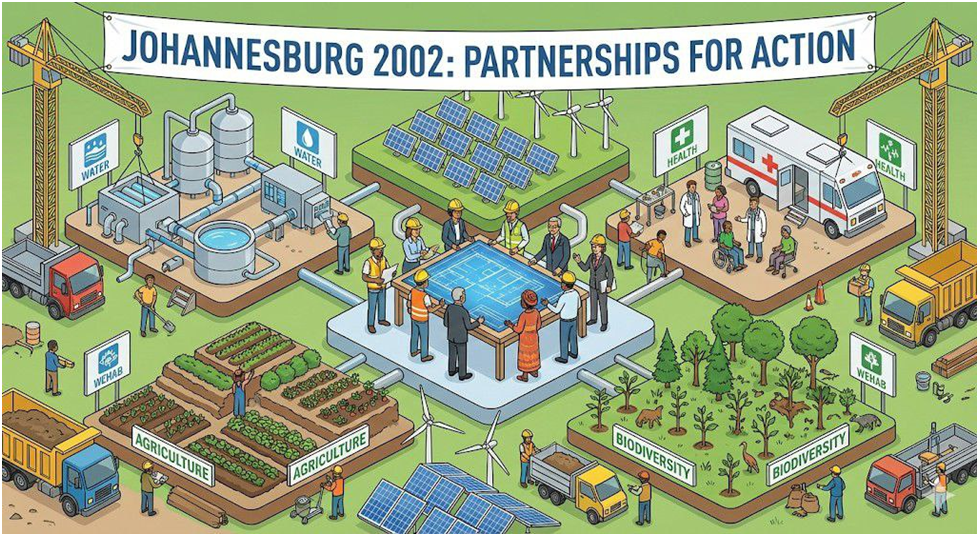
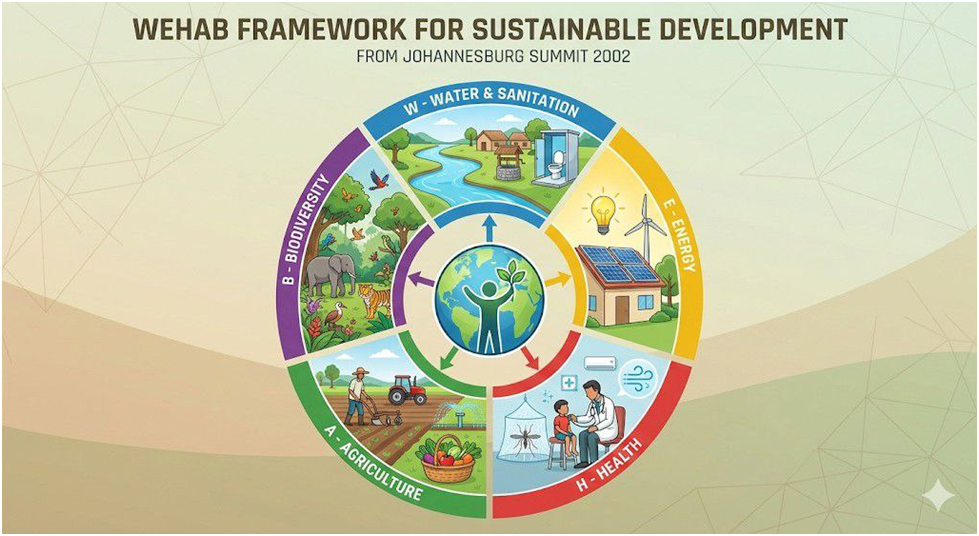
Major Outcomes: The "Big Five" (WEHAB)
To make the goals easier to manage, the UN Secretary-General at the time (Kofi Annan) focused the summit on five key areas known by the acronym WEHAB:
W - Water and Sanitation: Aiming to halve the proportion of people without access to clean water and basic toilets by 2015.
E - Energy: Increasing access to modern energy services and promoting renewable energy.
H - Health: Addressing the effects of environmental pollution and improving healthcare for the poor.
A - Agriculture: Improving land productivity and food security to fight hunger.
B - Biodiversity: Reducing the rate at which plant and animal species are going extinct.
Johannesburg Declaration & Plan of Implementation
The conference resulted in two main documents:
The Johannesburg Declaration: A political statement where world leaders reaffirmed their commitment to sustainable development.
The Plan of Implementation (JPOI): A massive "to-do list" with specific targets and deadlines for countries to follow.
In Layman's Terms:
Think of Johannesburg 2002 as a "Sustainability Progress Report." After 10 years of planning, world leaders met to say, "Okay, we have the plans, now how do we actually fix poverty and the planet at the same time?" It was less about new laws and more about partnerships between governments, businesses, and regular people.
The Trick to Remember: "The J-O-B"
Since it was held in Johannesburg, think of it as a "JOB" for the world:
J — Join forces: It was the first time governments and private businesses teamed up (called "Partnerships").
O — Outcomes: They stopped talking about why and started talking about how to get results.
B — Basic Needs: They focused on the WEHAB list (Water, Energy, etc.).
The Memory Bridge: "Rio Plans, Jo'burg Does"
Rio (The Planner): Think of Rio as a group of people sitting in a room drawing a map. They are deciding where the road should go (this is Agenda 21).
Johannesburg (The Worker): Think of Johannesburg as the construction crew arriving 10 years later with trucks and tools. They are focused on the JOB of building that road and making sure the people living nearby have W.E.H.A.B. (Water, Energy, Health, etc.).
Summary Checklist for Both
Rio (1992): Focus on the Environment. It gave us the Climate Change Convention (UNFCCC) and the Biodiversity Convention.
Johannesburg (2002): Focus on People + Environment. It linked saving the planet with ending poverty and improving human health.
TOPIC 14: Rio+20 Conference(2012)
The Rio+20 Conference, officially the United Nations Conference on Sustainable Development (UNCSD), was held in Rio de Janeiro, Brazil, in 2012.
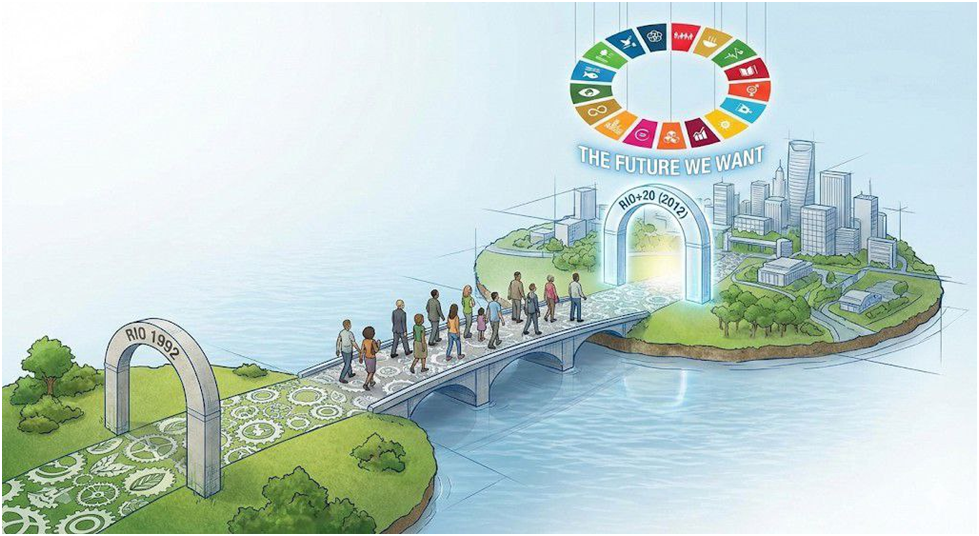
As the name suggests, it happened exactly 20 years after the original 1992 Earth Summit. While Rio 1992 was about planning, Rio+20 was about re-energizing the world's commitment to those plans.
1. The Big Goal: "The Future We Want"
The most famous outcome of Rio+20 was a document titled "The Future We Want." In this document, world leaders agreed that poverty eradication is the greatest global challenge today.
Two Main Themes:
Green Economy: Finding a way to grow the economy (create jobs/money) without destroying the environment.
Institutional Framework: Improving how the UN and governments work together to manage environmental issues (like making the UN Environment Programme, or UNEP, stronger).
2. The Birth of the SDGs
Before 2012, the world followed the "Millennium Development Goals" (MDGs). At Rio+20, leaders decided they needed a more modern, inclusive set of goals.
This led to the creation of the 17 Sustainable Development Goals (SDGs) that we follow today (like Zero Hunger, Clean Energy, and Climate Action).
Layman's Terms: "The 20-Year Check-up"
Imagine you started a massive garden in 1992 (The Earth Summit).
In 2002 (Johannesburg), you checked if the tools were working.
In 2012 (Rio+20), you realized the garden needs to be much bigger and the old rules aren't enough. You decide to write a new, modern handbook ("The Future We Want") and set 17 specific targets to make the garden thrive (The SDGs).
💡 The Trick to Remember: "R-I-O"
To remember the specifics of Rio+20, use the letters in R-I-O:
R Renewed Commitment They "Renewed" the promises made 20 years ago.
I Institutional Change They decided to make UN bodies (like UNEP) stronger.
O Our Future The outcome document was "The Future We Want" (Our vision).
Summary
✓Rio Earth Summit 1992: The Blueprint Agenda 21
✓Johannesburg 2002 :The Action W.E.H.A.B.
✓Rio+20 2012: The Modernization/ the future we want
TOPIC 15: Human right to healthy environment
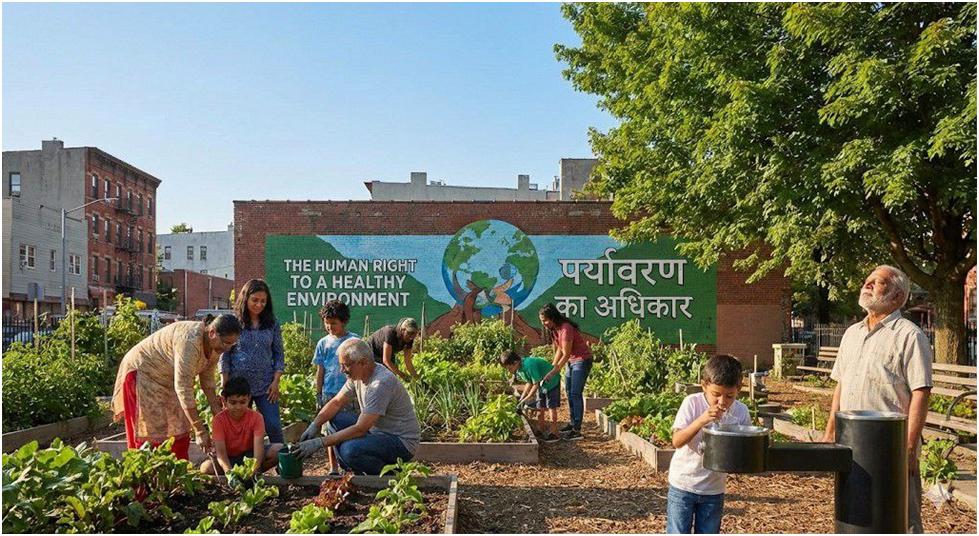
The Human Right to a Healthy Environment is the legal recognition that everyone has the right to live in an environment that is clean, safe, and sustainable. For decades, this was just a "good idea," but it has recently become a formal pillar of international law.
1. The Global Breakthrough (2022)
For a long time, human rights were mostly about things like free speech or the right to a fair trial. However, on July 28, 2022, the United Nations General Assembly passed a historic resolution declaring that:
"Access to a clean, healthy, and sustainable environment is a universal human right."
While this resolution is not legally binding in the same way a treaty is, it serves as a powerful "catalyst" that pushes countries to change their own national constitutions and laws.
2. What Does This Right Include?
This is more than just "planting trees." It is generally divided into two categories:
Substantive Elements: The actual quality of the environment (Clean air, safe climate, access to safe water, and healthy food).
Procedural Elements: Your rights to participate in the process (The right to information about pollution, the right to participate in environmental decisions, and the right to seek justice in court if the environment is harmed).
3. Layman’s Terms: "The Right to Life 2.0"
Think of it this way: You have a "Right to Life." But if the air you breathe is toxic, or the water you drink makes you sick, is that right really being protected?
The Old View: We protect the environment to save the planet.
The New View: We protect the environment because humans cannot survive without it. It treats environmental damage as a violation of your personal dignity and safety.
4. Implementation in India
India has been a global pioneer in this area, even before the UN resolution. The Indian legal system "discovered" this right through judicial interpretation:
Article 21 (The Right to Life): The Supreme Court of India has ruled in multiple cases (such as M.C. Mehta vs. Union of India) that the "Right to Life" is meaningless without the right to a "wholesome environment."
Constitutional Duties: * Article 48A: Directs the State to protect and improve the environment.
Article 51A(g): Makes it a fundamental duty of every citizen to protect the natural environment, including forests and lakes.
The National Green Tribunal (NGT): India is one of the few countries with a dedicated "Environmental Court" specifically designed to handle cases involving this right.
5. Why it is Different from "Climate Change" Laws
While the Paris Agreement focuses on the planet’s temperature, the Right to a Healthy Environment focuses on the individual person.
Climate Laws: Focus on CO_2 levels and global targets.
Human Right: Focuses on a specific person’s right to not have a coal plant or a toxic waste dump built next to their home.
TOPIC 16: Topic 1 cases( ENV. LAW)
1. Trail Smelter Arbitration (US vs. Canada)
Citation: 3 U.N. Rep. Int'l Arb. Awards 1905 (1938/1941)
🟢 Layman’s Terms
Imagine we have a neighbor who loves to barbecue. He sets up a massive grill right next to your fence. The smoke is so toxic that it drifts into our yard and kills all our prize-winning roses and apple trees. We ask him to stop, but he says, "I'm grilling on my property, so it's fine." The court steps in and says, "Even if it's your property, you can't use it to destroy your neighbor's property."
⚖️ Facts
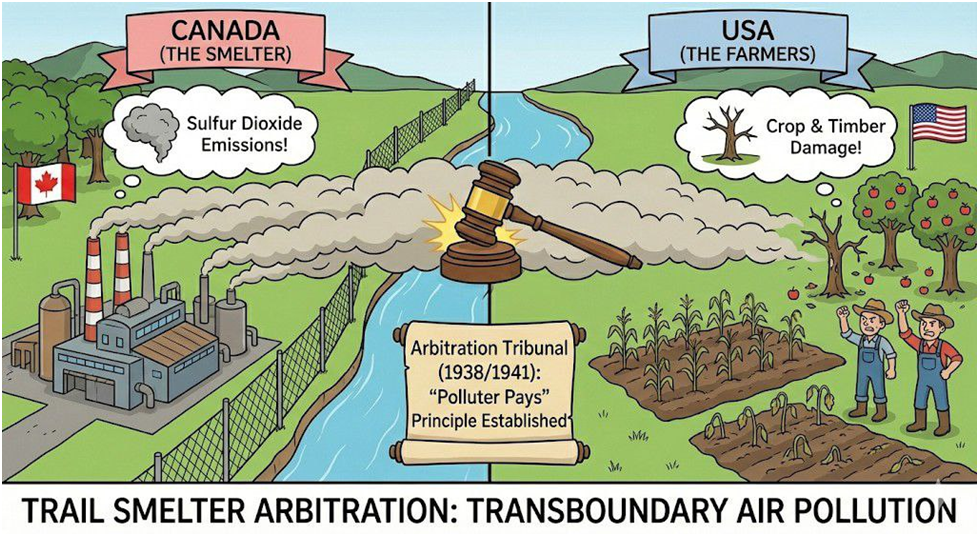
The Smelter: A Canadian company operated a zinc and lead smelter in Trail, British Columbia, just 7 miles from the US border.
The Damage: The smelting process released massive amounts of sulfur dioxide (fumes). These fumes drifted south across the border into the State of Washington (US).
The Consequence: The fumes caused significant damage to crops, timber, and farmland in the US. The US government sued Canada for damages.
❓ Issue
Does a state (Canada) have a responsibility for environmental damage caused by private companies within its borders that affects another state (US)?
Does the state have to pay for the damage?
📜 Ratio (The Legal Principle)
The Tribunal established the "No Harm Principle" (or Transboundary Harm Principle).
The Core Rule: Sic utere tuo ut alienum non laedas (Use your own property in such a way that you do not injure others).
The Ruling: Under international law, no state has the right to use or permit the use of its territory in such a manner as to cause injury by fumes in or to the territory of another, when the case is of serious consequence and the injury is established by clear and convincing evidence.
🔨 Judgement
Liability: Canada was held responsible under international law.
Remedy: Canada had to pay compensation (damages) to the US.
Prevention: The smelter was required to refrain from causing further damage (injunction).
🧠 Trick to Remember
"The Smelter Smell."
Think: The Smell from the Smelter didn't stop at the border.
(If the smell crosses the line, you pay the fine.)
2. Gabčíkovo-Nagymaros Project (Hungary vs. Slovakia)
Citation: ICJ Reports 1997
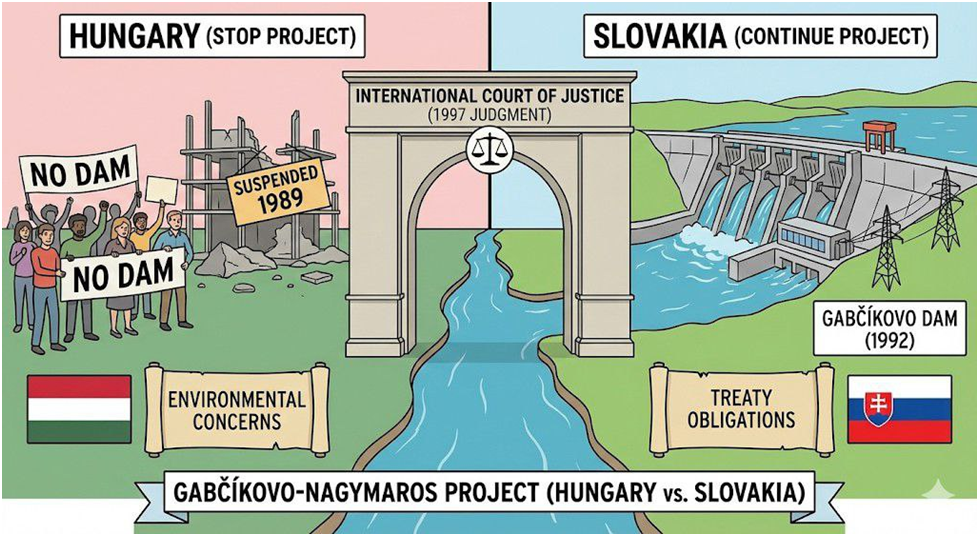
🟢 Layman’s Terms
Two friends (Hungary and Slovakia) sign a contract to build a massive water dam system together. Halfway through, Hungary gets cold feet because they are worried it will ruin the environment, so they stop working. Slovakia gets angry and decides to finish their part of the project alone, but in a way that steals most of the river's water. Both sue each other.
⚖️ Facts
The Treaty: In 1977, Hungary and Czechoslovakia (later Slovakia) signed a treaty to build a system of locks/dams on the Danube River for electricity and flood control.
The Breakup: In 1989, Hungary suspended work due to intense environmental pressure ("ecological necessity").
The Retaliation: Slovakia implemented "Variant C"—they unilaterally diverted the Danube river to keep the plant running, drastically reducing water flow to Hungary.
❓ Issue
Can a state abandon a treaty because of "environmental necessity"?
Can the other state retaliate by unilaterally changing the river's course?
📜 Ratio
Pacta Sunt Servanda: Agreements must be kept. Environmental concerns are important, but they do not automatically allow you to break a treaty unless the peril is "grave and imminent" (which Hungary couldn't prove sufficiently).
Sustainable Development: This case introduced the concept that economic development must be reconciled with environmental protection.
🔨 Judgement
Both were wrong.
Hungary: Was wrong to suspend the treaty unlawfully.
Slovakia: Was wrong to implement "Variant C" unlawfuly (because it took a shared resource—the river—and made it their own).
They were ordered to negotiate a settlement in good faith.
🧠 Trick to Remember
"Gabčí-GO vs. Gabčí-NO."
Slovakia said GO (keep building).
Hungary said NO (stop building).
The Court said: Both go back to the table.
3. Pulp Mills on the River Uruguay (Argentina vs. Uruguay)
Citation: ICJ Reports 2010
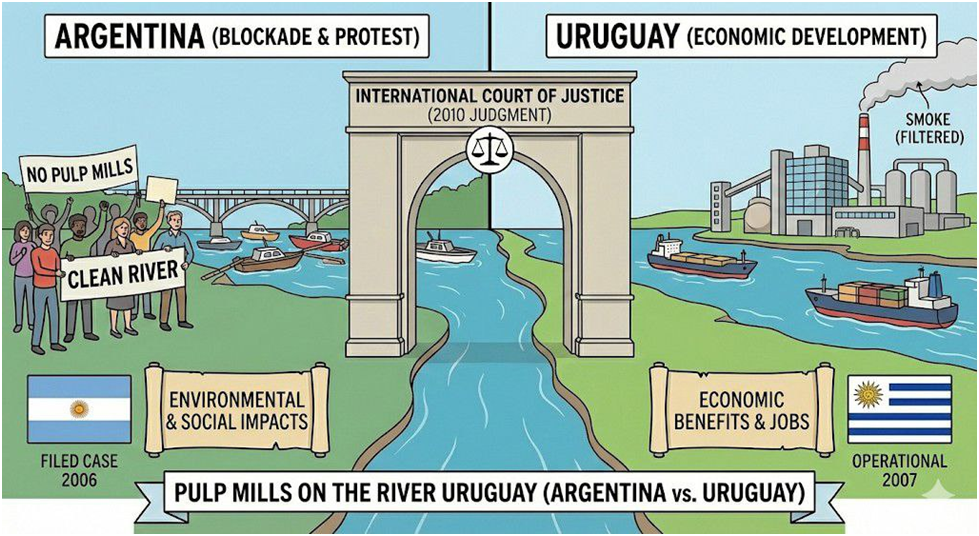
🟢 Layman’s Terms
Uruguay wanted to build paper mills (pulp mills) on a river it shares with Argentina. Argentina was terrified the mills would pollute the river and smell terrible. Argentina sued, claiming Uruguay didn't ask for permission properly. The court found that Uruguay was rude (didn't follow procedure) but the mills weren't actually dangerous.
⚖️ Facts
Uruguay authorized the construction of two pulp mills on the River Uruguay (the border).
Argentina claimed this violated a 1975 statute requiring joint consultation and that the mills would pollute the river.
❓ Issue
Did Uruguay violate procedural obligations (failing to inform Argentina)?
Did Uruguay violate substantive obligations (polluting the river)?
📜 Ratio
Procedural vs. Substantive: A state can be guilty of failing to inform its neighbor (procedural) even if they don't actually pollute the environment (substantive).
EIA Requirement: This case cemented that doing an Environmental Impact Assessment (EIA) is a requirement under general international law for transboundary projects.
🔨 Judgement
Procedural Breach: Uruguay did violate the treaty by not informing Argentina effectively before building.
No Substantive Breach: However, there was no proof the mills would actually pollute the river significantly.
Result: The mills were allowed to stay, but Uruguay was scolded for not communicating.
🧠 Trick to Remember
"Pulp Fiction."
It was a lot of drama (fiction) about pollution, but in the end, it was mostly a paperwork error.
Or remember: Bad manners (procedure), but clean water (substance).
4. Certain Activities / Construction of a Road (Costa Rica vs. Nicaragua)
Citation: ICJ Reports 2015 / Compensation Judgement 2018
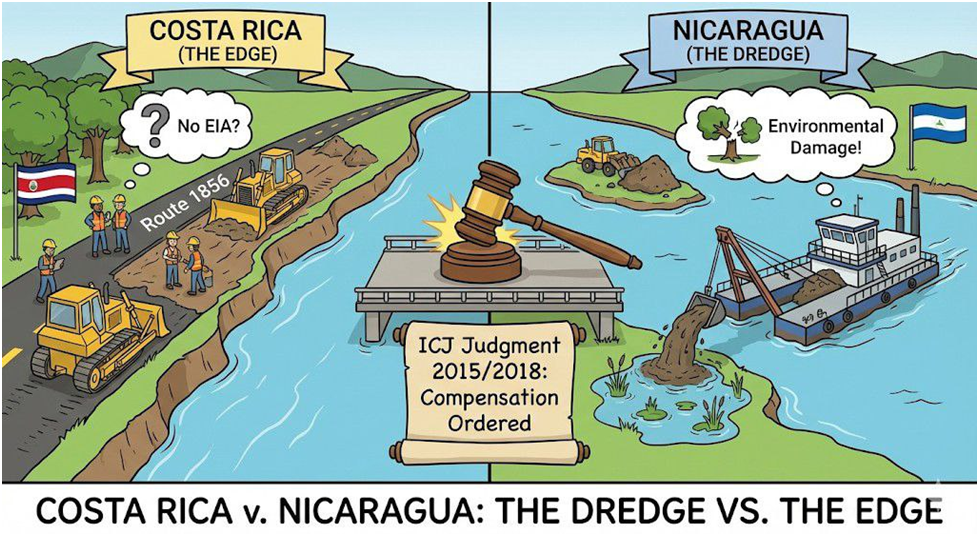
🟢 Layman’s Terms
Nicaragua dug channels in a border river (dredging) and cut down Costa Rica's trees. Costa Rica retaliated by building a road right next to the river, dumping dirt into it. It was a messy border fight. The unique thing here is that for the first time, the court put a price tag on the trees and nature destroyed.
⚖️ Facts
Case A: Nicaragua dredged the San Juan River and occupied a disputed wetland, cutting down trees.
Case B: Costa Rica built a road along the border which Nicaragua claimed caused erosion into the river.
❓ Issue
A)violation of sovereignty and environmental damage.
B)How do you calculate money for environmental damage?
📜 Ratio
Compensation for Nature: The Court ruled that compensation isn't just for commercial loss (like timber value) but for Ecosystem Services (the ability of nature to regenerate, provide air, habitat, etc.).
🔨 Judgement
Nicaragua violated Costa Rica's sovereignty and damaged the environment.
2018 Ruling: Nicaragua was ordered to pay ~$378,000 to Costa Rica specifically for environmental damage.

Aashutosh Khatana
Related Posts

UP RO/ARO Recruitment 2023: Resolving the Legal Quagmire Over Women’s Horizontal Reservation
2 min read
Service Matters of Unaided Private Educational Institutions: Amenability to Judicial Review under Article 226 of the Constitution
8 min read
Paying Less Than the Minimum Wage Is Tantamount to Bonded Labour: Supreme Court
3 min readComments
No comments yet.