
The Cockroach Rebellion: How India’s Youth Turned an Insult Into a Movement
The Cockroach Janta Party’s explosive rise — from a courtroom insult to 19 million followers in seven days — and the legal, political, and generational fault lines it has cracked wide open.
Table of Contents
- The Remark That Lit the Match
- The Birth of the CJP
- The Numbers That Cannot Be Ignored
- A Manifesto Written in Anger
- The Structural Crisis Beneath the Satire
- The Legal Dimension: Section 69A, Free Speech & the Constitution
- The Crackdown: X Account Blocked, Death Threats Received
- A Global Tradition of Satirical Dissent
- What Comes Next
There is something quietly devastating about the moment a joke stops being a joke. On May 16, 2026, a 30-year-old communications student in Boston posted something satirical about Indian politics. Within 72 hours, he had barely slept — and by the end of the week, he was receiving death threats. This is the story of the Cockroach Janta Party.
Section 01 · Origin
The Remark That Lit the Match
Every rebellion needs a spark. In this case, it came from the highest court in the land — and it was a single, ill-chosen word.
On May 15, 2026, Chief Justice of India Surya Kant was presiding over a Supreme Court hearing concerning fake professional credentials. In the course of his remarks from the bench, he said something that would travel far beyond that courtroom. He described unemployed young Indians as “cockroaches” and “parasites of society” — people who, unable to find work, turn instead to social media activism and start “attacking everyone.”
The Chief Justice later offered a clarification: his remarks were aimed specifically at individuals exploiting fake legal degrees, not at unemployed youth as a whole. But the clarification arrived too late, and in a climate too charged to absorb it calmly. For millions of young Indians already grappling with unemployment, failed examinations, and the constant suspicion that institutions did not have their interests at heart, the words landed differently.
They heard themselves being called vermin. So they decided to become vermin. Loudly. Proudly. With a logo, a manifesto, and a party headquarters on the internet.
There are youngsters like cockroaches, they don’t get any employment, they don’t have any place in the profession. Some of them become social media activists and start attacking everyone.
— Chief Justice Surya Kant, Supreme Court of India, May 15, 2026
Section 02 · Founding
The Birth of the Cockroach Janta Party
The man who caught the spark was Abhijeet Dipke — a 30-year-old digital media strategist originally from Aurangabad, Maharashtra, at the time completing a master’s in public relations at Boston University. He had previously worked on social media strategy for the Aam Aadmi Party during the 2020 Delhi elections, so he understood, perhaps better than most, how political energy travels through digital channels.
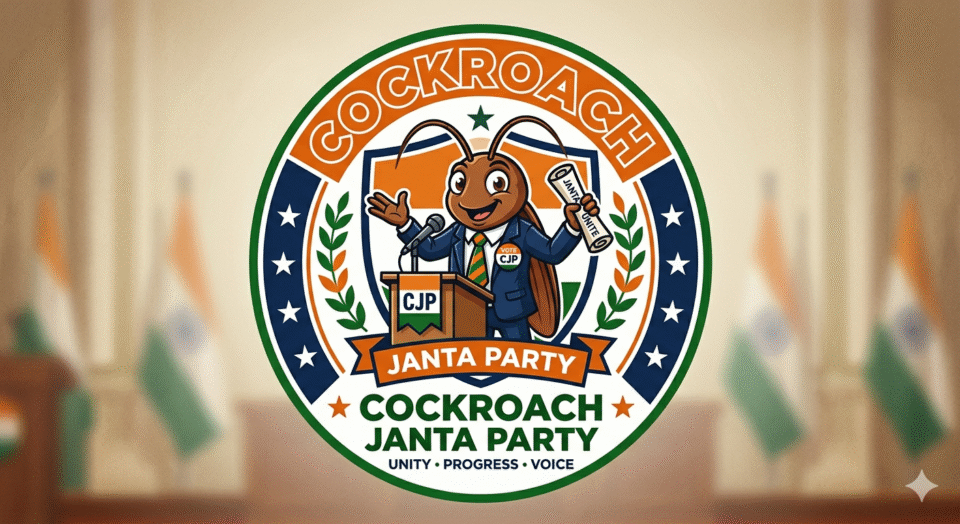
Within 24 hours of the Chief Justice’s remarks going viral, Dipke had registered a name, built a website, written a manifesto, and launched the Cockroach Janta Party — or CJP. The name is a deliberate play on words. “Janta” means “people” in Hindi. The BJP, the ruling Bharatiya Janata Party, translates as the “Indian People’s Party.” The CJP positioned itself as the party of a different kind of people: the ones the system forgot to count.
He used AI tools to assemble the look and language of the party quickly, channelling the anger of an entire generation into something with structure, demands, and identity. The cockroach symbol was not incidental — it was the heart of the message. The cockroach survives everything. It adapts. It cannot be permanently eliminated. If the establishment wanted to call India’s youth cockroaches, then fine: cockroaches it was.
The party declared itself “Secular, Socialist, Democratic, and Lazy” — that last word doing heavy lifting, reclaiming the accusation of laziness and wearing it as a badge of survival rather than shame.
Section 03 · Scale
The Numbers That Cannot Be Ignored
Satire ages fast on the internet. It trends on a Tuesday and is forgotten by Thursday. What happened with the CJP was structurally different.
19M+Instagram FollowersSurpassed the government’s own audience in under a week
350K+Sign-upsRegistered members in days of founding
200K+X FollowersBefore the account was blocked by the government
8M+Graduates/YearIndia produces — but cannot absorb into employment
These are not the numbers of a passing meme. They are the numbers of something that touched a nerve so raw, so long-ignored, that people could not scroll past it. The eligibility criteria were deliberately satirical — applicants were required to be “unemployed, by force, by choice, or by principle.” The sign-up numbers were not satirical at all.
Perhaps the most striking data point: the CJP amassed more Instagram followers in its first week than the official government account had accumulated over years. In the competition for the attention of young India, the cockroaches were winning.
Section 04 · Policy
A Manifesto Written in Anger
What separates the CJP from thousands of viral political jokes is that it arrived with a document — a five-point manifesto that, beneath the sarcasm, contained substantive and pointed demands.
- NEET Accountability: A full independent inquiry into the NEET-UG paper leak, the immediate resignation of the Education Minister, and an end to CBSE’s fee for rechecking answer sheets. Student suicides linked to exam fraud are cited directly. The party also released a protest song — “Haan Main Hoon Cockroach” — specifically referencing the examination crisis.
- Media Independence: Cancellation of broadcast licenses held by media houses owned by Mukesh Ambani and Gautam Adani, on grounds that these outlets operate as organs of government rather than independent journalism, suppressing accountability reporting.
- Judicial Integrity: A ban on any Chief Justice of India being granted a Rajya Sabha seat as a post-retirement benefit — targeting what critics describe as a system of rewarding compliant judges with political positions once they leave the bench.
- Public Financial Accountability: A transparent accounting of public funds — specifically rejecting what the manifesto pointedly calls “strategic spending,” a satirical euphemism for corruption.
- Youth Political Representation: Structural inclusion of young Indians in formal political processes — not tokenism, but institutional design that gives an entire generation a genuine seat at the table.
These demands are not outlandish. Several have been articulated by mainstream opposition parties, civil society groups, and constitutional experts for years. What the CJP did was package them in a language that 22-year-olds recognised as their own.
Section 05 · Context
The Structural Crisis Beneath the Satire
The CJP did not emerge in a vacuum. It arrived at the intersection of several crises that had been building, quietly and then not so quietly, for years.
Graduate unemployment in India stands at 29.1% — nine times higher than the unemployment rate among people who never attended school. The country produces more than 8 million graduates annually, but the economy has not created the volume or quality of jobs needed to absorb them. Young men and women emerge from colleges with degrees that cost their families everything, and find the doors they were promised are locked.
In the week before the CJP was founded, nationwide protests had already erupted over the cancellation of the NEET-UG examination following a paper leak. The exam — taken by more than 22 lakh students annually seeking admission to medical colleges — was rescheduled to June 21, 2026. For years of preparation reduced to a scandal and a rescheduling notice, students had no formal recourse. Their anger had nowhere to go.
Into this atmosphere, the Chief Justice’s remarks fell like a lit match into a room full of gas. The remark did not create the anger — it revealed it, named it, and gave it a shape.
Section 06 · Legal Analysis
The Legal Dimension: Section 69A, Free Speech & the Constitution
The most significant dimension of the CJP story — and the one with the deepest long-term implications — is not satirical. It is constitutional. The government’s decision to block the party’s X account raises serious and unresolved questions about the scope of the state’s digital censorship powers and the robustness of India’s free speech protections in the online space.
Key Legal Provision
Section 69A, Information Technology Act, 2000 grants the Central Government the power to direct blocking of public access to any online content in the interest of the sovereignty and integrity of India, defence, security of the State, friendly relations with foreign States, public order, or for preventing incitement to the commission of any cognisable offence.
The government invoked this provision against a satirical political party’s social media account — a deployment of national security law that legal scholars are already scrutinising closely.
Constitutional Framework: Article 19 vs. Section 69A
Article 19(1)(a) of the Indian Constitution guarantees every citizen the right to freedom of speech and expression. This right is not absolute — Article 19(2) permits “reasonable restrictions” in the interests of sovereignty, security, public order, and related grounds. The question, always, is whether a restriction is reasonable.
Section 69A was judicially upheld in the landmark Shreya Singhal v. Union of India (2015) ruling, which simultaneously struck down Section 66A of the same Act for being unconstitutionally overbroad. The Supreme Court’s endorsement of Section 69A rested on its assessment that the provision was “narrowly drafted” and contained “inbuilt safeguards” — including the requirement of a review committee and, at least in theory, an opportunity to be heard before content is blocked.
However, legal scholars have consistently noted that in practice, these safeguards are routinely bypassed. Blocking orders are classified as confidential. Affected parties are often not informed. Judicial review is difficult when the affected party cannot see the grounds for the order. As one constitutional analysis noted in March 2026, the confidentiality clause in the Blocking Rules “essentially bypass[es] these safeguards by blocking judicial oversight over executive orders.”
The blocking of the CJP account fits this pattern precisely. The grounds — “national security” concerns about a satirical account’s popularity among young people — have not been made public, cannot be challenged by the party in question, and reveal no specific incitement to violence or unlawful act. The Supreme Court itself has issued notice to the Central Government on a petition challenging Rule 16 and Rule 9 of the IT Blocking Rules 2009, filed in March 2025.
The proportionality question is also critical. Even where a legitimate ground exists for restriction, constitutional law requires that the restriction be proportionate — the least invasive means necessary to achieve the legitimate aim. Blocking an entire social media account of a satirical movement, rather than individual posts, would face serious scrutiny under any proportionality analysis.
The legal community’s concern is sharpened by context. The stated reason for the blocking — that the account’s content was “gaining traction among young people” — is, on its face, a description of successful political speech, not a statement of harm. If popularity among youth constitutes a national security threat, the definition of national security has expanded to encompass political inconvenience.
X (formerly Twitter) had previously challenged blocking orders in the Karnataka High Court, arguing they violated procedural safeguards. That case established important precedent: the Supreme Court had already stated that blocking orders must be reasoned and subject to judicial review. The CJP blocking now sits in that unresolved legal landscape, where the law says one thing and the government’s practice often does another.
Beyond the blocking order, the broader legal terrain intersects with freedom of assembly, the right to form political associations under Article 19(1)(c), and the Election Commission’s power to register or deny registration to political parties. The CJP is not currently a registered political party — but its potential candidacy in the Bankipur Assembly by-election in Bihar suggests it may test the registration process. The Election Commission’s criteria, and whether they can be applied to deny registration to a satirically framed political formation with a genuine policy platform, will be worth watching closely.
Death Threats: Criminal Law Dimension
Abhijeet Dipke, the CJP’s founder, publicly shared screenshots of WhatsApp messages allegedly received from unknown numbers threatening to kill him unless he joined the BJP — including threats that extended to his location in the United States. These messages, if authentic, constitute criminal offences under Indian law.
Under Section 506 of the Indian Penal Code (now the Bharatiya Nyaya Sanhita, 2023), criminal intimidation — threatening another person with injury to their person, reputation, or property — is punishable with imprisonment of up to two years, or up to seven years where the threat is to cause death or grievous hurt. The cross-border element, with threats directed at a person on US soil, would also potentially engage mutual legal assistance treaty (MLAT) mechanisms between India and the United States, though such mechanisms are slow and rarely invoked for individual threat cases.
The failure to publicly announce investigation of these threats, at the same time as the government moved swiftly to block the party’s social media account, has not gone unnoticed by press freedom advocates.
Section 07 · State Response
The Crackdown: A Blocked Account and a Louder Swarm
A satirical internet party built around cockroach imagery should, in theory, be easy to ignore. That the government chose not to ignore it is itself part of the story.
The Ministry of Electronics and Information Technology invoked Section 69A of the IT Act to issue a blocking order against the CJP’s X account. According to Indian Express reporting, the Intelligence Bureau had flagged the account for allegedly “inflammatory content” posing a threat to India’s sovereignty and integrity. X withheld the account in India, displaying the message that the handle had been “withheld in India in response to a legal demand.”
A senior government official, quoted on condition of anonymity, said the IB’s concern stemmed in particular from the fact that the account “was gaining traction among young people.” The statement is worth reading carefully. It identifies the audience, not the content, as the threat.
The blocking did not kill the movement. Every blocked post became a rallying cry. Every act of censorship was, for the CJP’s supporters, evidence that the joke had become something real — that the establishment was paying attention, and that paying attention was something it could not afford to do casually.
Dipke launched a new X account. The cockroaches scattered, and then reassembled.
The concern stemmed from the fact that the account’s content was gaining traction among young people.
— Senior Government Official (anonymous), quoted in Indian Express, May 2026
Section 08 · Perspective
A Global Tradition of Satirical Dissent
The CJP does not exist without precedent. It belongs to a long, rich, and occasionally world-changing tradition of political satire used as a vehicle for genuine grievance.
In Poland in the 1980s, the Orange Alternative movement used absurdist street theatre — people dressed as gnomes — to mock Soviet-era bureaucracy in a way that was simultaneously impossible to take seriously and impossible to ignore. In Iceland after the 2008 financial crash, the Best Party — a deliberately comedic political formation — won the Reykjavik mayoral election. In Italy, Beppe Grillo’s Five Star Movement began as stand-up comedy before becoming a parliamentary force that, at its peak, became the country’s largest single party.
The pattern is consistent: when formal institutions fail to absorb legitimate grievance, people find unconventional containers for it. Satire works because it cannot be easily delegitimised — you cannot arrest a joke, cannot imprison an irony. But what the CJP demonstrates is that satire, once it finds its target, can evolve quickly into something with harder edges and real demands.
Section 09 · Conclusion
What Comes Next for the Cockroach Janta Party
What the Cockroach Janta Party has done, at its best, is hold a mirror to a society that has been selling its young people a particular story — study hard, clear the exam, earn the degree, get the job — while quietly making that story impossible to live.
When the Chief Justice of India compares unemployed youth to cockroaches in open court, he does not create the anger. He reveals it. The CJP is simply the shape that anger took when it finally found a language everyone could understand.
The legal questions — whether the blocking of the account was constitutional, whether the proportionality standard was met, whether the state can deploy national security law against satirical political speech — will take time to resolve through courts. But the social question is already being answered in real time, by the millions of young Indians who saw the word “cockroach” and said: yes, that is us — and we are not going anywhere.
Whether the CJP registers as a formal party, contests elections, fades into a footnote, or transforms into something else entirely remains to be seen. Movements born from humiliation have a complicated history. They can be co-opted, they can fragment, and they can sometimes be crushed — at least temporarily.
But the conditions that created the CJP — 29% graduate unemployment, compromised examinations, media consolidation, and a judiciary perceived as insufficiently independent — have not changed. The cockroaches were not going away before the Chief Justice said that word. They are certainly not going anywhere now.
✦ ✦ ✦

