
LB:6033:Election Law: Syllabus (Important Topics)
Topic 1: Introduction to Election Disputes
*Pertaining to Elections to Parliament & State Legislatures
A. Meaning of Candidates:
•Candidate’s definition [ sec. 79(b) RPA,1951]
•Contesting Candidate [Sec. 38 RPA, 1951]
•Returned Candidate [Sec. 79(f) RPA, 1951]
B. Meaning of “Election” [Article 329(b)]:
Cases:
•N.P. Ponnuswami vs. Returning Officer(1952)
•M.S. Gill vs. Chief Election Commissioner (1978)
C. Election Petition (Presentation & Meaning)[ sec. 81 read with sec. 86(1) RPA]- 45 days limit
Cases:
•Manohar Joshi vs. Nitin Bhaurao Patil(1996)
•Raj Kumar Yadav vs. Samir Kumar Mahaseth(2005)- Filing valid till midnight.
D. Contents of Election Petition:
Must contain material facts and particulars [Sec. 83 RPA].
Cases:
•Udhav Singh vs. Madhav Rao Scindia(1976)
•Virender Nath Gautam vs. Satpal Singh( 2007)- Material facts ≠ Particulars
E. Parties to Election Petition:
[Sec. 82, read with Sec. 84, 86 RPA]
Cases:
•Jyoti Basu vs. Debi Ghosal(1982)
•K.Venkateswara Rao v. Bekkam Narasimha Reddi (1969)
F. Recriminatory Petition:Statutory counter to seat-claim
[Sec. 97, RPA 1951]
Landmark Cases:
•Jabar Singh vs. Genda Lal( 1964)- Section 97 is mandatory. / Recriminatory petition strictly required
•Inamati Mallappa Basappa vs. Basavaraj Ayyappa(1958)
Topic 2: Composition of Parliament, State Legislatures & Presidential Elections
A. Composition of Parliament & State Legislatures:
*The Parliament of India (Article 79)
- Composition of Council of States / Rajya Sabha (Article 80)
- Composition of House of People / Lok Sabha (Article 81)
- Dissolution of Lok Sabha vs. Rajya Sabha (Permanent body) [Articles 83(1) & 83(2)]
*State Legislatures (Article 168)
•Composition of Legislative Council (Article 171) & Legislative Assembly (Article 170)
•Dissolution of Legislative Assembly [Articles 172 & 174]
B. Delimitation of Constituencies (Meaning & Objectives):
•Article 81 (Composition of Lok Sabha) & •Article 82 (Readjustment )
•Articles 330 & 332 (Reservation of seats)
•Article 329(a) (Bar to interference by courts)
•RPA 1950 (Sec. 3-13: Allocation of seats in LS & Rajya Sabha)
•Delimitation Acts of 1952, 1962, 1971, 2002
Amendments to Note:
•42nd CAA, 1976 (The Freeze)
•84th CAA, 2001 & 87th CAA, 2003
•Nari Shakti Vandan Adhiniyam, 2023 (106th CAA / 128th CAB)
Case:
•Meghraj Kothari vs. Delimitation Commission(1967)- Bar on delimitation review
C. Election of President and Vice-President:
•Articles 52, 55 (Electoral College formula), and 62(1) (Election of the President)
•Article 56(1)(c) (President continues to hold office even after completion of his tenure until successor enters)
•Article 62(2) (Vacancies due to death, resignation, or removal)
•President (Discharge of Functions) Act, 1969 (Line of succession)
•Election Disputes (Prez & VP): * Procedure under Article 71(1) and Article 145 + Presidential and Vice-Presidential Elections Act, 1952 (Sec. 14 & Sec. 18 for challenges).
Cases & References:
•Issue of Dissolved Assemblies (Special Reference No. 1 of 1974)
•Charan Lal Sahu vs. Giani Zail Singh (1984)
Topic 3: The Election Commission (EC)
A. Composition of the Election Commission:
•Article 324(2)
•Evolution from a single-member body to a multi-member body(1950-89>1989-1990>1993-Now)
•The Chief Election Commissioner and other Election Commissioners (Appointment, Conditions of Service and Term of Office) Act, 2023.
Cases:
•Anoop Baranwal Judgement, 2023 (Appointment of ECs by PM + LOP + CJI panel)
•S.S. Dhanoa vs. UOI (1991)
•T.N. Seshan (CEC) vs. UOI (1995)
B. Powers and Functions of EC (3 Broad Categories):
*Derived from Article 324.
1. Administrative Powers: Polling and conduct of elections.
2. Advisory Functions: Sec. 103(2) & 192(2): Advice to President and Governor in post-election matters.The President/Governor is bound to act according to EC’s advice.
3. Quasi-Judicial Functions:
•Registration and Deregistration of political parties.
•The Election Symbols (Reservation and Allotment) Order, 1968.
Statutory Limits: EC cannot act in contravention of laws validly made by Parliament under Article 327.
Cases:
•Mohinder Singh Gill vs. Chief Election Commissioner (Article 324 scope)
•Indian National Congress (I) vs. Institute of Social Welfare (Quasi-judicial powers)
•Kanhaiyalal Omar vs. R.K. Trivedi (1985) (Symbols order)
•A.C. Joshi vs. Sivan Pillai (Statutory limits)
Topic 4: Qualification & Disqualifications of Candidates
A. Qualifications:
•Constitutional provisions: Article 84 (Parliament), Article 173 (State Legislatures).
•Qualifications under RPA 1951 : Sec. 3 (Rajya Sabha), Sec. 4 (Lok Sabha), Sec. 5 (State Legislative Assembly), Sec. 6 (Legislative Council).
B. Disqualification for Holding an Office of Profit:
•Articles 102(1)(a) & 191(1)(a)
•Sec. 10 RPA 1951 & Parliament (Prevention of Disqualification) Act, 1959.
Cases:
•Jaya Bachchan vs. UOI
•Sonia Gandhi (2006) -> NAC Chairman Case
•Pranab Mukherjee (2012) -> ISI Kolkata Chairman Case
•Guru Gobind Basu vs. Sankari Prasad(1964)
•Joti Prasad Upadhyaya vs. Kalka Prasad Bhatnagar(1962)
•Ashok Kumar Bhattacharya vs. Ajoy Biswas
•Biharilal Dobray vs. Roshanlal Dobray(1984)- Govt. Primary teacher case
•Consumer Education & Research Society vs. UOI
•Kuldip Nayar vs. UOI (2006)
C. Disqualification for Government Contracts:
Article 299, Sec. 9A RPA.
Cases:
•Konappa Rudrappa Nadgouda vs. Vishwanath Reddy (1969)
•Smt. Aslhing vs. L.S. John(1984)
D. Disqualification on Conviction for Certain Offences [Sec. 8 RPA]:
•Sec. 8(1): Specific grave offences.
•Sec. 8(2): Economic/social offences.
•Sec. 8(3): General offences (Imprisonment of not less than 2 years). Disqualified from conviction until 6 years after release.
•Sec. 8(4): Exception for sitting members (Struck down).
•Sec. 389(1) CrPC / Sec. 430 BNSS (Suspension of sentence).
•Sec. 482 CrPC / Sec. 528 BNSS (HC’s inherent powers).
Cases:
•Lily Thomas vs. UOI (2013) (Struck down Sec 8(4))
•Rahul Gandhi vs. Purnesh Ishwarbhai Modi & Anr.(2023)
•Navjot Singh Sidhu vs. State of Punjab(2007)
•K. Prabhakaran vs. P. Jayarajan (2005)
•Chief Election Commissioner vs. Jan Chaukidar(2013)
•B.R. Kapur vs. State of T.N.(2001)
•Public Interest Foundation vs. UOI(2019)
Topic 5: Anti-Defection Law (10th Schedule)
A. Historical Context:
•Chavan Committee
•52nd CAA, 1985 (Added 10th Schedule)
•91st CAA, 2003 (Removed “split” provision & imposed 15% limit on ministerial appointments)
B. Key Constitutional Provisions:
•Vacations of seats and Disqualifications from Membership: Articles 101(3) & 102(2) for MPs; Articles 190(3) & 191(2) for State Legislators.
•Restrictions (Post-Defection): Articles 75(1A) & 164(1A) (Cap on council of ministers). Articles 75(1B) & 164(1B) (Bar on ministership for defectors). Article 361B (Bar on remunerative political posts).
C. Breakdown of the 10th Schedule:
•Para 2(1): Grounds for disqualification (Voluntarily giving up membership, voting contrary to whip).
**Para 2 also applies to political party members, independent members (if they join a party), and nominated members (if they join a party after 6 months after taking seat).
•Para 3: The “Split” exception (Omitted by 91st CAA).
•Para 4: The “Merger” exception (If 2/3rd members merge with another party).
•Para 6: Deciding authority is the Speaker/Chairman.
•Para 7: Bar on judicial interference (Struck down as unconstitutional by SC).
•Para 8: Rulemaking power of Speaker/Chairman.
•••”Unattached members”: Not a terminology formally used in the 10th Schedule.
•••”Real Party(Name and Symbols related disputes):fall under the”Election Symbols (Reservation and Allotment) Order, 1968,where EC has the power.
D. Cases on Anti-Defection:
•Kihoto Hollohan vs. Zachillhu (1993) (Struck down Para 7- X th schedule; upheld Speaker’s decision subject to judicial review)
•Ravi S. Naik vs. UOI (1994) (“Voluntarily giving up” doesn’t just mean formal resignation)
•Shrimanth Balasaheb Patil vs. Hon’ble Speaker, Karnataka Leg. Assembly (2020)
•Rajendra Singh Rana vs. Swami Prasad Maurya(2007)
•Subhash Desai vs. Principal Secretary, Governor of Maharashtra (2023)
•Sudhakar vs. D.N. Jeevaraju (2012)
Topic 6: Nominations
A. Requirements for Valid Nomination (Sec. 33-39 RPA):• Procedure for filing, number of proposers (Sec. 33), security deposit (Sec. 34), notice of nominations (Sec. 35), scrutiny of papers (Sec. 36), withdrawal (Sec. 37), publication of list of contesting candidates (Sec. 38),Nominations at Other Elections (Rajya Sabha, Legislative Council – Sec. 39)
• Grounds for rejection of nomination papers (Sec. 36(2) RPA) – [Lack of qualification or disqualification (Articles 84,173,102,191), Non-compliance with Section 33/34, Fraudulent Signatures]
Case: Rangilal Choudhary vs. Dahu Sao (1962)
B. Consequences of Improper Rejection/Acceptance:
[Sec. 100(1)(c) & Sec. 100(1)(d)(i) RPA]
Cases:
•N.T. Veluswami vs. Raja Nainar
•Vashist Narain Sharma vs. Dev Chandra
•Chhedi Ram vs. Jhilmit Ram
•Ramphal Kundu vs. Kamal Sharma
Topic 7: Corrupt Practices
•Corrupt practices vs. Electoral Offences
A. Bribery [Sec. 123(1) RPA]:
Cases:
•H.V. Kamath vs. Ch. Nitiraj(1970)
•Ghasi Ram vs. Dal Singh(1968)
B. Undue Influence [Sec. 123(2) RPA]:
Cases:
•Narbada Prasad vs. Chhaganlal(1969)
•Manubhai Nandlal vs. Popatlal Manilal (1969)
C. Appeal on Grounds of Religion, Race, Caste, etc. [Sec. 123(3) RPA]
Promotion of enmity and hatred between classes of citizens.[sec. 123(3A) RPA]
Cases:
•Kultar Singh vs. Mukhtiar Singh (1965)
•S. Harcharan Singh vs. Sajjan Singh (1985)
•Manohar Joshi vs. Nitin Bhaurao Patil (1996)
•Dr. Ramesh Yeshwant Prabhoo vs. Prabhakar Kashinath Kunte (1996)
Topic 8: Voters’ Right to Know Candidate Antecedents
A. Statutory Provisions & Committees:
•RP Act, 1951: Sections 33A, 33B, 125A.
•Goswami Committee(1990)
•Vohra Committee.(1993)
•Law Commission of India (170th Report on Reform of Electoral Laws) (1999)
•Representation of the People (Third Amendment) Act, 2002 ( added sec. 33A and 33B)
B. Landmark Cases:
•UOI vs. Association for Democratic Reforms (ADR)
•People’s Union for Civil Liberties (PUCL) vs. UOI (2003)
•Lok Prahari vs. UOI
_________________________________________________________________________________________________________________
Topic – 1: Introduction: Meaning of election and disputes regarding elections to parliament and state legislatures
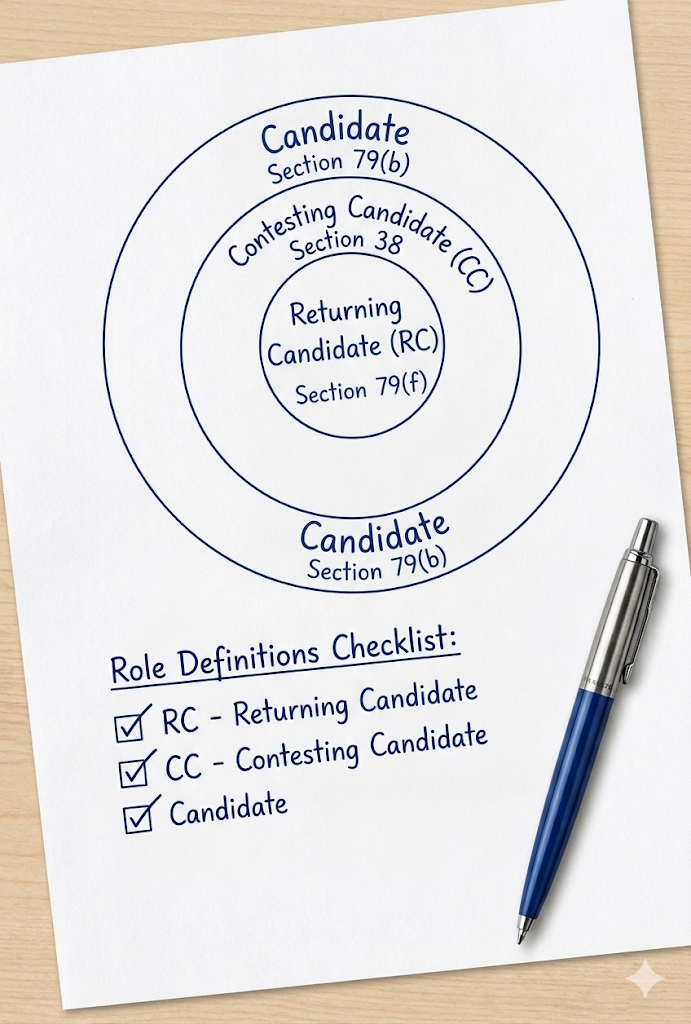
1. Meaning of a ”Candidate”, ”Contesting Candidate”, and the ”Returned Candidate”
(A) The Candidate
Sec. 79(b) of the RPA, 1951 defines a candidate as —
“a person who has been or claims to have been duly nominated as a candidate at any election.”
•Claims to have been duly nominated: If the Returning Officer (RO) improperly rejects a person’s nomination papers during scrutiny (Section 36, RPA), that person never makes it to the ballot. However, because they claim they were duly nominated, the law still recognizes them as a “candidate”.
•Sec. 81 (RPA, 1951): An election petition can be filed by “any candidate” or “any elector”. Because of the wide definition in Sec. 79(b), the person whose nomination was improperly rejected has the locus standi (right to approach the court) to file an Election Petition challenging the election.
(B) The Contesting Candidate
(Sec. 38 of the RPA, 1951)
The term represents the final filtered list of people who are actually fighting the election on polling day.
•Process of becoming the contesting candidate
(a) A person “Vishakha Vijaybhai” files a nomination under sec. 32, RPA (Candidate)
(b) The RO scrutinizes the nominations. Those rejected are filtered out (sec. 36, RPA,1951)
The person “Vishakha Vijaybhai” is left with validly nominated candidates after scrutiny.
(c) Withdrawal period (Sec.37, RPA,1951)
Some validly nominated candidates will choose to withdraw.
(d)The people who remain — those who were validly nominated and did not withdraw — are the Contesting Candidates (including person “Vishakha Vijaybhai” if she is validly nominated and did not withdraw).
Under Sec. 38, RPA, the RO publishes a formal list of these contesting candidates.
These are the names that will actually appear on the EVM or ballot paper.
Legal Significance
•Election Petitions: Under Sec. 82(a) of the RPA, 1951, if an election petitioner is asking the High Court to declare the winning candidate’s election void and also asking to be declared the winner themselves, they are legally mandated to join all contesting candidates as respondents in the petition.
•Election Expenses: Under Section 77, RPA, 1951, every contesting candidate must maintain a correct account of all election-related expenditures.
•Security Deposit: If a contesting candidate fails to secure a minimum of one-sixth (1/6th) of the total valid votes, their security deposit is forfeited to the government under Section 158, RPA,1951.
(C) The “Returned Candidate”
This is the statutory term for the winner of the election.
Under Sec. 79(f) of the RPA, 1951:
“Returned candidate” means a candidate whose name has been published under Sec. 67 as duly elected.
Important provisions
•Under Sec. 66, RPA, the RO declares the result.
•Under Sec. 67, the result is officially published in the Official Gazette.
The moment that publication happens, the person officially assumes the legal status of the “Returned Candidate.”
•Under Section 82(a)
If a petitioner is only asking the High Court to declare the election void (essentially asking for a “reset” or re-election), they only need to make the returned candidate a party to the suit.
Hierarchy:
Returned Candidate ⊂ Contesting Candidate ⊂ Candidate
(Every Returned Candidate is a Contesting Candidate, and every Contesting Candidate is a Candidate.)
2. Meaning of election
- Article 329(b) of the constitution states that, “no election to either House of Parliament or to the House or either House of the legislature of a state shall be called in question except by an election petition.”
- In this way, Article 329(b) of the constitution bars the courts from interfering in electoral matters except through an “Election petition”
- Therefore, whatever falls within the definition of election is “immune” from immediate judicial review under Article 32 or 226.
The Constitutional Meaning
- Interestingly, the constitution does not define the word “election” within its definition clause (Article 366).
- Instead its meaning has been established through landmark judicial interpretations, primarily to determine the jurisdiction of courts in electoral disputes.
CASE: N.P. Ponnuswami VS Returning officer (1952)
Facts:
- In this case, a candidate’s nomination was rejected by the Returning officer (RO).
- Instead of waiting for the election to finish he directly approached the High Court (MADRAS) under Article 226.
- The Madras HC dismissed the petition because of Article 329(b), which barred the election matters from judicial interference during the process.
- This led to an appeal to the SC.
Issue: Can courts interfere in election matters before the election process is completed?
Judgement: SC held: *NO judicial interference is allowed during the election process.
- upheld the HC’s decision
- courts cannot interfere mid election
- Remedy lies only through an election petition after completion.
- Article 329(b) bars courts from interfering in election matters except through election petitions.
- the term “election” includes the entire process (from notification to result).
In N.P. Ponnuswami,
- Narrow Meaning of election: Just the poling day and declaration of the result.
- Wide Meaning of election: The word used in Article 329(b) is used in wider sense. It embraces the entire continuous process consisting of several stages from notification to declaration of the returned candidate.
CASE: M.S. Gill V. Chief Election Commissioner (1978)
- Election to the punjab leg. Assembly (1977) was held.
- During polling large scale violence, booth capturing & malpractices were reported.
- The Returning officer declared results, but soon after, the Election Commission intervened.
- The Election Commission (EC) cancelled the entire election and ordered fresh polling under Article 324 of the constitution.
- M.S. Gill (a candidate) challenged this decision, arguing:
- EC had no authority to cancel elections after polling
- The order lacked proper reasons and violated Natural Justice.
Issues:
- Whether the EC has wide discretionary powers under Article 324
- Can the EC cancel an election process after completion of polling?
- Whether administrative orders must be supported by reasons at the time of issuance.
Judgement:
- SC : upheld the powers of ECI under Article 324 (Broad and residual powers of ECI)
- EC can cancel elections if the process is vitiated by —
- Violence
- Fraud
- Electoral malpractice
- This case further solidified the Ponnuswami doctrine.
- Justice Krishna Iyer famously noted that the “election is a long, continuous process, and the EC’s powers under Article 324 cover this entire spectrum.”
- Under the Constitution, “election” is a timeline, not an event.
Exception: In ECI v. Ashok Kumar, the SC, while upholding Article 329(b), also permitted Article 226 if it smoothens, facilitates, or subserves the election process rather than thwarting it.
The statutory meaning of word “election”
- The Representation of the People Act, 1951 defines the word election as — “an election to fill a seat or seats in either House of Parliament or in the House or either House of the Legislature of a state.”
- Under the Representation of People Act,1951, the “election” comprises these specific statutory steps. If any of these steps are happening, the “election” is ongoing:
- Issuance of Notification: sec 14 (Lok Sabha) and 15 (state Assembly). This officially triggers the election process.
- Filing of Nominations: sec 33
- Scrutiny of Nominations: sec 36 (The Returning officer accepts or rejects)
- Withdrawal of Candidature: sec 37
- polling: The actual voting process.
- Declaration of Results: sec 66. This is the terminal point of the election.
The Remedy: Because the constitution (Article 329(b)) says that Court can not interrupt the “election”, the RPA, 1951 provides the only post election remedy.
- section 80: Dictates that no election shall be called in question except by an election petition.
- section 100: provides the exhaustive grounds (like corrupt practices or improper rejection of nomination) on which the High Court can declare the election void after it is entirely complete.
3. Election petition: presentation, grounds and relief that may be claimed by the petitioner
- Election petition: Once the “election” timeline concludes with the declaration of the Returned Candidate, the constitutional embargo lifts, and the statutory remedy of the election petition activates.
Meaning of election petition: An election petition is the sole, exclusive legal mechanism available to challenge the validity of a parliamentary or state Legislature election in India.
- Article 329(b) of the constitution mandates that no election shall be called in question except by an election petition.
- sec. 80 of RPA, 1951 : states that no election shall be called in question except by an election petition presented in accordance with the provisions of part VI of the RPA, 1951.
- Under sec. 80 (RPA, 1951), the petition must be filed directly before the High Court.
Presentation By : Who can file? sec 81 of the RPA, 1951, an election petition can be presented by —
- Any Candidate: sec. 79(b); anyone who was validly nominated and anyone who simply claims to have been duly nominated for an election rejected by the Returning officer.
- An elector: Defined in sec. 81 of RPA, 1951 -> as a person who was entitled to vote at the election to which the petition relates. (regardless of whether they actually cast their vote or not).
Limitation period: sec. 81 mandates that the petition must be filed within 45 days from the date of the election of the returned candidate (the result declaration Date). This 45-day timeline is absolute. The Limitation Act does not apply here to condone delays. If someone files it on 46th day, the petition is dismissed in limine (at the threshold) under section 86(1).
CASE LAW: Manohar Joshi V. Nitin Bhaurao Patil (1996)
The Core issue: Can an election petition be dismissed in limine (at the threshold) under section 86(1) for failing to comply with strict pleading requirements of section 83?
The Ratio and Judgement: The Supreme court held that section 86(1) strictly and exhaustively lists the grounds for threshold dismissal :
- Non-compliance with sec. 81 (Presentation)
- Sec. 82 (parties to the petition) or sec. 117 (security for costs).
It means –
(i)Section 81: You filed it late or did not provide enough proper copies.
(ii) Section 82: You forgot to include a mandatory party (like a rival candidate).
(iii) Section 117: You did not deposit the required security money.
- The respondent in this case argued that their petition is poorly written and lacks the “material facts” required by sec. 83. Throw it out!
- SC: held that the respondents cannot use sec. 86(1) to summarily dismiss a petition just b/c the pleading under sec. 83 are defective. You cannot dismiss the petition in limine (at the threshold) under that specific section.
CASE LAW: Raj Kumar Yadav Vs. Samir Kumar Mahaseth
Facts: Sec. 81(1) of the R.P.A., 1951, gives a party exactly 45 days from the election results to file their petition.
- In this case, on the 45th and final day, the petitioner filed the petition late in the afternoon (around 4:25 PM), which was after the High court registry’s official working hours had ended (usually around 4:00 PM).
- The High Court threw the case out saying it was time-barred.
SC’s Answer/Reasoning:
- SC held that the High Court was wrong. The word ‘day’ in law means a full calendar day of 24 hours, ending at exactly midnight.
- Parliament gave the petitioner a substantive right to 45 full days.
- The High Court’s office hours are just administrative rules for the convenience of its staff.
- An administrative rule cannot eat away a substantive statutory right.
- Therefore, handing the petition to the designated officer on the 45th day, even after the office officially “closed” but before midnight, is a perfectly valid filing.
4.Contents of Election Petition: Material Facts and Particulars
(Sec. 83, R.P.A., 1951)
•An election petition is not a common law remedy, nor is it an action in equity; it is a purely statutory proceeding governed strictly by the RPA, 1951.
•The courts have consistently held that the statutory requirements of election law must be strictly observed.
•Under the RPA, 1951, Sec. 83 lays down the mandatory rules for the contents of an election petition.
•Sec. 83, RPA, 1951: Section 83(1) of the Act lays down 3 mandatory requirements for the drafting of an election petition:
(a) Sec. 83(1)(a) — Material Facts
The petition shall contain a concise statement of the material facts on which the petitioner relies.
(b) Sec. 83(1)(b) — Particulars
The petition shall set forth full particulars of any corrupt practice that the petitioner alleges, including the names of the parties alleged to have committed such practice, and the date and place of its commission.
(c) Sec. 83(1)(c) — Verification
The petition shall be signed by the petitioner and verified in the manner laid down in the CPC, 1908.
#Proviso (Affidavit for Corrupt Practices)
Where the petitioner alleges any corrupt practice, the petition must also be accompanied by a sworn affidavit in the prescribed format (Form 25) supporting the allegation and its particulars.
#Distinction between Material Facts and Particulars
(i) Material Facts [Sec. 83(1)(a)]
- These are the primary, basic facts which constitute the cause of action.
- These are the foundational skeleton of the case.
- Material facts must be pleaded comprehensively. If a petitioner fails to allege a material fact, he cannot prove it during the trial.
- If a petition does not disclose a cause of action, it will be dismissed at the threshold under Order VII Rule 11 of the CPC.
- A new material fact cannot be added later via amendment after the limitation period for filing the petition has expired.
Example
Under Sec. 123(1) of the RPA, bribery is a corrupt practice.
A pleading stating:
“The winning candidate, Ms. Hridhya, committed the corrupt practice of bribery by distributing money to voters to induce them to vote for him.”
This is the material fact. It establishes the statutory ground for challenging the election. If a petitioner omits this sentence entirely, he has no “cause of action”, and the petition will be dismissed immediately.
(ii) Particulars [Sec. 83(1)(b)]
- These are the details that flesh out the material facts and give the opposite party fair notice of the case they have to meet.
- They are the flesh and blood that complete the picture.
- Particulars must be pleaded as fully as possible, especially when alleging corrupt practices.
- These are not immediately fatal. The court may direct the petitioner to supply the missing particulars or allow an amendment to cure the defect.
- Particulars can be amended or amplified later with the permission of the Court under Section 86(5) of the RPA.
Example
A pleading stating:
“On April 5th, 2026, at 5:00 PM, Mr. Sumit Sonall and his election agent, Markanday Raj, visited the village square of Ramgarh and distributed ₹2000 each in cash to a group of 50 agricultural workers.”
These are particulars. This gives the opposite party fair notice of the exact incident they need to defend against. If these details are missing, the petition is not thrown out immediately; the Judge will simply order the petitioner to provide these missing details before the trial proceeds.
Case Laws
A. Udhav Singh v. Madhav Rao Scindia (1977)
Facts: Udhav Singh (petitioner) challenged the validity of Madhav Rao Scindia’s election.
Allegations were made that corrupt practices were committed during the election campaign.
The petition, however, contained general and vague allegations without clearly stating specific acts, dates, places, and names of persons involved.
Issues:
Whether an election petition with vague and general allegations of corrupt practices is maintainable.
Whether material facts and full particulars must be clearly pleaded in an election petition.
Judgment:
The Supreme Court dismissed the petition.
It held that:
*Allegations of corrupt practices must be precise, specific, and detailed.
*A petition lacking material facts is liable to be dismissed at the threshold.
*Material facts are every fact which primarily form the cause of action.
B. Virender Nath Gautam v. Satpal Singh
In this case, the Court reaffirmed the distinction between material facts and particulars.
The Court held that an election petition cannot be dismissed at the initial stage merely because some particulars are lacking, so long as the foundational material facts are present.
5. Parties to Election Petition
(Sec. 82 read with Sections 84 & 86, RPA, 1951)
*An election petition is not a common-law civil suit; it is a strict statutory proceeding governed entirely by the RPA, 1951.
*There is no concept of a “proper party” in an election petition as one might find under Order I Rule 10 of the CPC.
These are only “necessary parties”, and these are strictly defined by the RPA, 1951.
Who is a Necessary Party?
(Sec. 82 read with Sec. 84)
*To determine who must be a party, we must look at Sec. 84, which dictates the relief the petitioner is asking for.
*Sec. 82(a) divides this into two specific scenarios:
Scenario A: The Simple Claim
Relief claimed (Sec. 84)
The petitioner only asks the Court to declare the winning candidate’s election void.
Necessary Party [Sec. 82(a)]
Only the Returned Candidate (the winner) needs to be made a respondent.
Scenario B: The Additional Claim
*Relief claimed (Sec. 84)
The petitioner asks the Court to void the Returned Candidate’s election and asks to be declared the winner themselves (or asks for another candidate to be declared the winner).
*Necessary Party [Sec. 82(a)]
All contesting candidates must be made respondents (or necessary parties).
The Mandatory Exception: Corrupt Practice [Sec. 82(b)]
*If the petition alleges a corrupt practice against any candidate (even a candidate who withdrew their nomination), that specific candidate must be joined as a party.
Consequence of Non-joinder [Sec. 86(1)]
*Under Sec. 86(1) of the RPA, 1951, if the petitioner fails to join a necessary party as required by Section 82, the High Court shall dismiss the petition.
*The word “shall” leaves the Court with no discretion. A petitioner cannot use Order I Rule 10 of the CPC, 1908 to add the missing party after the 45-day limitation period for filing the petition has expired. The defect is fatal.
Voluntary Joinder [Sec. 86(4)]
*There is a small window for candidates who were not made parties to join voluntarily.
*Any candidate can apply to the High Court to be added as a respondent.
*Condition: They must apply within 14 days of the trial commencing and provide security for costs.
Landmark Case Laws
- Jyoti Basu v. Debi Ghosal (1982)
Facts
The election of Jyoti Basu (former CM, West Bengal) to the West Bengal Legislative Assembly was challenged by Debi Ghosal through an election petition under the RPA, 1951.
The petitioner sought to implead a person who was not a candidate as a party to the election petition.
The core issue revolved around who can be made a party to an election petition.
Issues
Whether a person who is not a candidate in the election can be impleaded as a party in an election petition.
Whether courts have inherent powers to add parties beyond those specified in the statute.
Legal Provisions Involved
Sec. 82, RPA → specifies necessary parties to an election petition.
Sec. 86, RPA → dismissal of petitions for non-compliance.
Judgment
*Election law is a complete and self-contained code.
*The right to contest an election is not a fundamental right but a statutory right.
*Only those persons specifically mentioned in Sec. 82 (RPA, 1951) can be made parties.
Election Commission, Returning Officers, or political parties cannot be made respondents.
Courts do not have inherent powers to add parties in election petitions. - Mohan Raj v. Surendra Kumar Taparia
*The Court held that if a candidate against whom corrupt practices are alleged [Sec. 82(b)] is not joined, the petition must be dismissed under Section 86(1) of the RPA, 1951.
*The Court cannot allow the petitioner to strike out the allegations of corrupt practices to save the petition from dismissal.
3. K. Venkateswara Rao v. B. Narasimha Reddi (1969)
The Court ruled that the RPA is a “self-contained code” requiring strict procedural compliance.
*Under Sec. 82(b), any candidate accused of corrupt practices must be joined as a party to an election petition within the 45-day limitation period.
*The Court held that Sec. 5 of the Limitation Act does not apply here, meaning Judges cannot excuse a delay in adding a necessary party; failure to comply results in the mandatory dismissal of the petition under Sec. 86 RPA.
6) Recriminatory Petition
(Sec. 97, R.P.A., 1951)
A recriminatory petition is essentially a “counter-attack”. If an election petitioner wants the Court to declare them the winner instead of the returned candidate, the returned candidate can use Section 97 to prove that the petitioner themselves committed electoral offences and therefore does not deserve the seat.
Meaning:
In general terms, “recrimination” means making a counter-charge.
In election law, it allows the returned candidate (or any other party) to lead evidence proving that the election of the person claiming the seat would have been void if they had won and a petition had been filed against them.
Object:
The fundamental principle is equity:
“He who seeks equity must come with clean hands.”
If a petitioner is asking the court for the seat, they must be free from electoral malpractices.
When Does the Right to Recriminate Arise?
Section 97 cannot be invoked in every election petition. It is entirely dependent on the relief claimed by the petitioner under Section 84.
When it cannot be used:
If the petitioner only asks the High Court to declare the winning candidate’s election void, the returned candidate cannot file a recriminatory petition.
When it can be used:
The right under Sec. 97 only arises when the petitioner makes an additional claim under Section 84 — specifically asking the Court to declare that the petitioner (or any other candidate) has been duly elected.
Statutory Requirements for Filing a Recriminatory Petition
(Section 97(1) & (2))
To file a valid recriminatory petition, the returned candidate must strictly comply with the following procedural mandates:
(i) The returned candidate must give a formal notice to the High Court stating their intention to lead such evidence.
(ii) The notice must be given within 14 days from the date fixed for the respondents to appear before the High Court to answer the claim.
(iii) The notice must be accompanied by a security deposit and a further deposit for costs.
(iv) Statement of Particulars [Sec. 97(2)]:
The notice must contain a full statement of material facts and particulars of the corrupt practices alleged against the petitioner.
It must be drafted and verified in the exact same manner as an original election petition under Section 83.
#Consequences of Not Filing a Recriminatory Petition
*If a returned candidate fails to file a recriminatory petition (or fails to comply with the 14-day rule or security deposit), he:
is completely barred from leading any evidence to show that the petitioner’s election would have been void.
cannot attack the petitioner’s claim to the seat.
Landmark Cases
- Jabar Singh v. Genda Lal (1964)
Supreme Court held:
*Section 97 is mandatory.
If the returned candidate does not file a recriminatory petition following the strict procedure of Sec. 97, RPA, 1951, the High Court cannot look into any electoral misconduct of the petitioner.
*The returned candidate cannot simply bring up these allegations during regular cross-examination without having filed the formal recriminatory notice. - Inamati Mallappa Basappa v. Basavaraj Ayyappa (1958)
Supreme Court held:
*An election petitioner cannot partially withdraw their claim for the seat to escape a counter-attack (recriminatory petition) from the winning (returned) candidate.
*Elections are public business, not private property.
*In normal civil courts, a petitioner is allowed to drop his/her case or change their mind whenever they want. *The Court said election law does not allow this.
*Once a person starts the legal fight under election law, they are locked into its strict rules.
______________________________________________________________________________________________________
Topic -2: Composition of parliament and Election of President and Vice President of India
Part I
1. The Parliament of India [Article 79]
[A] Composition of the Council of States (Rajya Sabha)
- Article 80
- Max. 250 members (238 elected + 12 nominated for expertise in literature, art, science and social science)
- Indirect Elections by elected members of Legislative Assemblies
- The allocation of seats to each state is governed by the Fourth Schedule of the constitution
- Election Formula: proportional representation by means of single Transferable vote
[B] Composition of the House of the People (Lok Sabha)
- Article 81 (Population is the basis)
- Max. strength 550 members (Up to 530 from States + Up to 20 from UTs)
- RPA, 1950 – allocates the exact no. of Lok Sabha seats to each state (Sec. 3 & 4 of RPA, 1950)
[C] Dissolution of Lok Sabha and Rajya Sabha
- Rajya Sabha not subject to dissolution (Permanent)
- However 1/3 rd of its members retire every second year
- Lok Sabha (Article 83(2)) : has a fixed normal tenure of 5 years from the date appointed for its first meeting. (However Under Article 85(2)(b), the president may dissolve the Lok Sabha earlier (usually on the binding advice of PM))
2. State Legislatures (Article 168)
[A] Composition of the Legislative Council
*Only 6 states in India have a Legislative Council (UP, Bihar, Maharashtra, Karnataka, Telangana and Andhra Pradesh)
- Article 171
- Total number of members cannot exceed one-third of the total members in the state’s legislative Assembly, but cannot be less than 40.
- Section 10 and 3rd schedule [RPA, 1950] allocates the exact no. of seats for the Legislative Councils (in 6 states)
- Permanent House not subject to dissolution
- 1/3 rd members retire every second year (Article 83(1))
*Electoral Composition [Article 171(3)]
- 1/3 rd elected by local authorities (municipalities, Distt. Boards)
- 1/12 th elected by university graduates of 3-year standing.
- 1/12 th by teachers of 3 years’ standing.
- 1/3 rd elected by the respective MLAs
- 1/6 th nominated by Governor
[B] Composition of the Legislative Assembly (Vidhan Sabha)
- Article 170
- Direct election
- Max. 500 members, minimum 60 (exceptions: Goa, Sikkim)
- Section 7 and 2nd schedule, RPA, 1950, declares the total no. of seats in the Legislative assemblies
Dissolution: Article 172(1)
- Normal tenure -> 5 years
- Article 174(2)(b) -> The governor may dissolve the Assembly earlier (usually on the advice of CM.)
3. Delimitation of Constituencies
Delimitation: It is the act or process of fixing limits or boundaries of territorial constituencies in a country or a province (state) having a legislative body
- Objective: To ensure the principle of “One vote, One value” by ensuring that all constituencies have roughly the same population.
- It also involves identifying seats reserved for SC/STs.
- Authority: Under Article 82 of the constitution parliament enacts a Delimitation Act, after every census, establishing an independent high powered body known as the “Delimitation Commission”.
#Constitutional Framework
(i) Article 82 (Readjustment after each census)
Mandates that upon the completion of each census, the allocation of seats in the Lok sabha to the states and the division of each state into territorial constituencies shall be readjusted by such authority as Parliament may determine. (i.e. the delimitation commission)
Seats are allocated to each state based primarily on population
(ii) Article 81 (Composition of the Lok Sabha)
Dictates the max. number of seats in the Lok Sabha; and states the ratio b/w the population of a constituency and the no. of seats allotted to it must remain the same throughout the state.
(iii) Article 170 (Composition of Legislative Assemblies)
The state equivalent to Article 81
It mandates the division of each state into territorial constituencies so that the population ratio per constituency is uniform across the state.
(iv) Article 330 & 332 (Reservation of Seats)
Article 330: Deals with the reservation of seats for SCs and STs in the Lok Sabha based on their population proportion.
Article 332: Deals with the reservation of seats for SCs/STs in state Leg. Assemblies.
The Delimitation commission decides which specific constituencies will be reserved based on these articles.
(v) Article 329(a) : (Bar to interference by courts)
This is the most crucial Article, which states that the validity of any law relating to the delimitation of constituencies or the allotment of seats, made under Article 327 or 328, shall not be called in question in any court.
#Statutory Framework
To execute the constitutional mandate, parliament enacted the following laws —
(i) RPA, 1950 (Sec. 3-13): These sections provide the basic statutory framework for the allocation of seats in the Lok Sabha and state Legislative Assemblies, and the initial creation of constituencies.
(ii) The Delimitation Acts (1952, 1962, 1971, 2002)
Article 82 mandates that after every census a delimitation commission must be established by an Act of parliament to readjust constituencies based on the new population data.
The parliament strictly followed Article 82 by passing the Delimitation Acts of 1952, 1962 and 1971, each corresponding to the census of the preceding year (1951, 1961, 1971).
These commissions actively redraw boundaries and altered the no. of seats allocated to states to maintain the “one Vote, one Value” principles.
Landmark Case: Meghraj Kothari VS Delimitation Commission
Facts: The Delimitation commission readjusted the constituencies in Madhya Pradesh
A voter, Meghraj Kothari, objected to the notification declaring Ujjain as a reserved constituency for SCs
After his objections were rejected by the commission, he challenged the commission’s notification in the High Court U/A 226, arguing the delimitation was arbitrary.
Issue: Can the High Court or Supreme Court entertain a petition challenging the delimitation of constituencies or does Article 329(a) completely bar judicial intervention?
Judgement: The SC dismissed the petition, ruling that Article 329(a) creates an absolute Bar on judicial interference.
The court noted that under the Delimitation Act, once the commission publishes its orders in the Gazette of India, those orders take the effect of a full-fledged law made by parliament itself.
The court provided a practical reason: If delimitation orders could be challenged in courts, any voter could file a writ petition, delaying the finalisation of constituencies. This could completely derail the democratic process and elections could be postponed indefinitely.
(iii) The 42nd Constitutional Amendment Act, 1976 (The Freeze)
By the 1970s, India was heavily promoting family planning. States that successfully controlled their population (mostly in South India) were being “punished” by losing Lok Sabha seats to states with booming populations.
The 42nd CAA, 1976, amended Articles 81, 82, 170 to suspend delimitation. It froze the allocation of seats at the 1971 census level until the year 2000. It effectively paused Article 82 for 25 years to encourage population control without political penalty.
(iv) 84th Constitutional Amendment Act, 2001
When the year 2000 arrived, parliament decided to extend the freeze on the total no. of seats for another 25 yrs. (until the first census after 2026).
However, because populations had shifted dramatically within states, it allowed the territorial boundaries of constituencies to be redrawn internally based on the 1991 census.
(v) The Delimitation Act, 2002
This Act constituted the latest Delimitation commission (chaired by Justice Kuldip Singh) to readjust constituencies based on the 2001 census.
The orders of the Delimitation commission have the force of law and cannot be challenged in any court. Copies of its orders are laid before the Lok Sabha and State legislative Assembly concerned, but no modifications are permitted by them.
(vi) 87th CAA, 2003
This amendment slightly tweaked the 84th CAA. It dictated that the internal redrawing of constituencies should be based on the more recent 2001 census instead of 1991.
(vii) Jammu and Kashmir Reorganisation Act, 2019
This Act mandated a fresh delimitation process specifically for the newly formed Union Territory of Jammu & Kashmir, increasing its assembly seats & readjusting boundaries based on the 2011 census.
(viii) Nari Shakti Vandan Adhiniyam, 2023
- This Constitutional (106th Amendment) Act, 2023, introduced 33% reservation for women in the Lok Sabha, state Legislative Assemblies, and the Delhi Assembly (inserting Articles 330A, 332A, and 239AA in the constitution)
- The Act specifically tied the implementation of this quota to the completion of the first census conducted after the Act’s passage and the subsequent delimitation exercise.
- Because the 2021 Census was severely delayed, adhering to the original terms of the 106th Constitutional Amendment Act, 2023, meant that a new census and the following delimitation might not be finished before 2029 elections, delaying the women’s quota indefinitely.
(ix) The April 2026 updates
- To fast-track the reservation for the 2029 General elections, the Union Cabinet has recently proposed 131st Constitutional Amendment & Delimitation Bill, 2026.
- Under this 131st constitutional Amendment & Delimitation Bill, 2026, the proposal is to delink the implementation of women’s reservation from the requirement of a fresh future census.
- Instead of waiting for a new census to be completed, the proposed delimitation and seat expansion will be conducted based on the existing 2011 census data.
The 131st constitutional Amendment draft bill Delimitation Bill, 2026, proposes a uniform 50% rise in legislative seats. For e.g.
Lok Sabha’s proposes strength: 816 seats from 543 (current)—-33% (273 seats) will be reserved for women.
- State Assemblies will see a similar proportional expansion.
- However, the Constitution (131st Amendment) Bill, 2026 failed to pass the Lok Sabha in April 2026 after falling short of the required two-thirds majority.
- As a result, the proposed expansion of legislative seats and the fast-tracking of the women’s reservation quota have been indefinitely halted.
Part II
# Election of the President and Vice-President of India
(i) Constitutional Foundation & ECI
Article 52: Mandates that there shall be a President of India.
Article 55: Electoral college consists of:
a) Elected MPs of Lok Sabha
b) Elected MPs of Rajya Sabha
c) Elected MLAs of States
d) Elected MLAs of Delhi and Puducherry
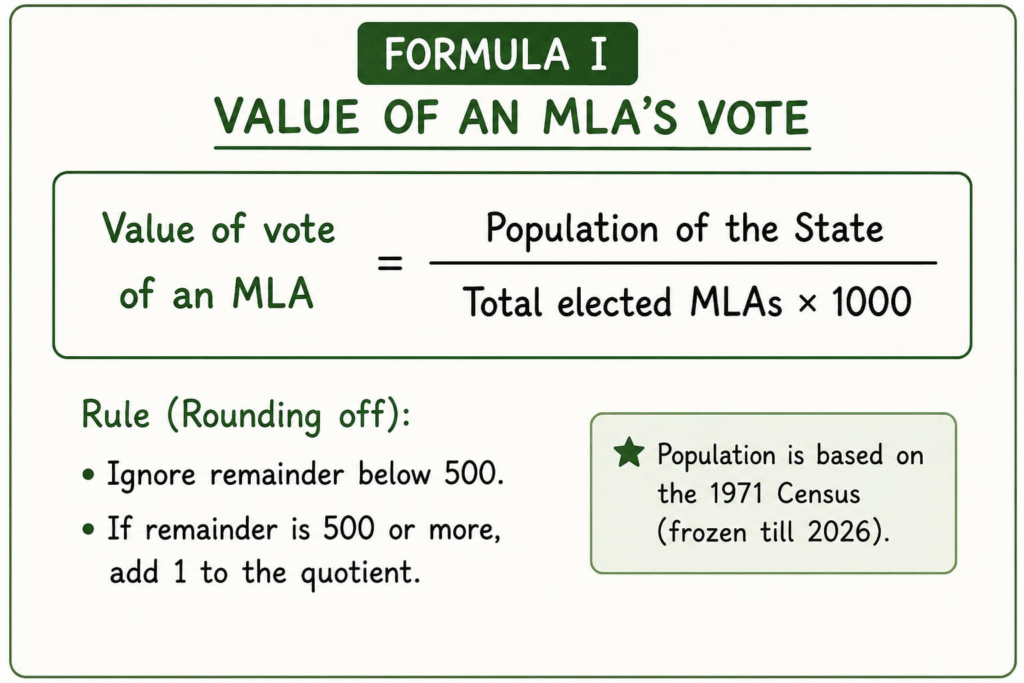
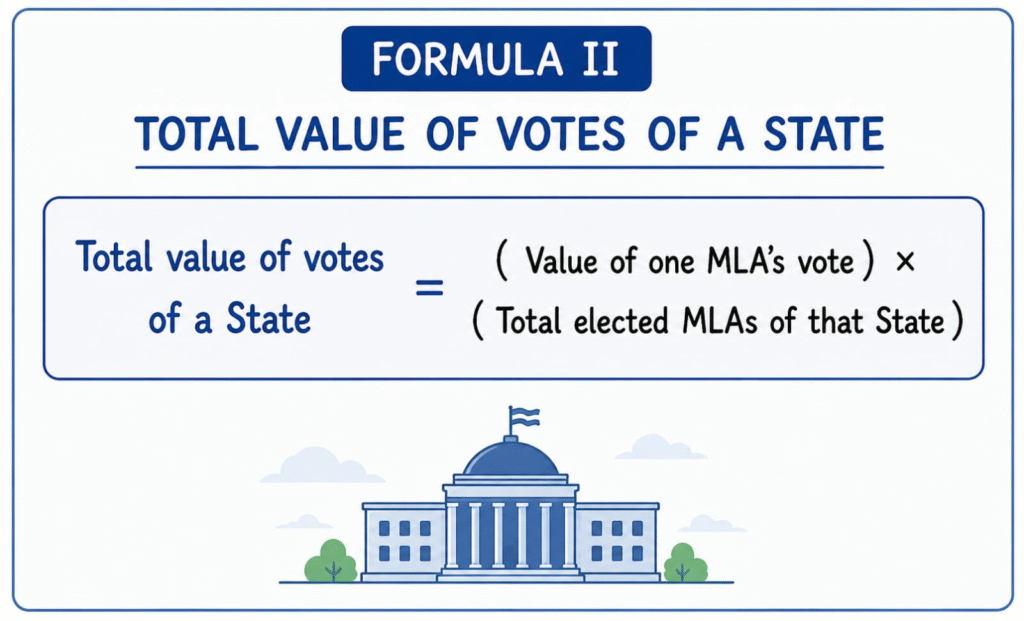
Electoral College formula:
Article 55 provides for uniformity in the scale of representation of different states and parity between states and the union in the election of the President.
Population is presently based on the 1971 census (Frozen till 2026 under the 84th Constitutional Act)
Formula I :
Formula II :
Formula III :
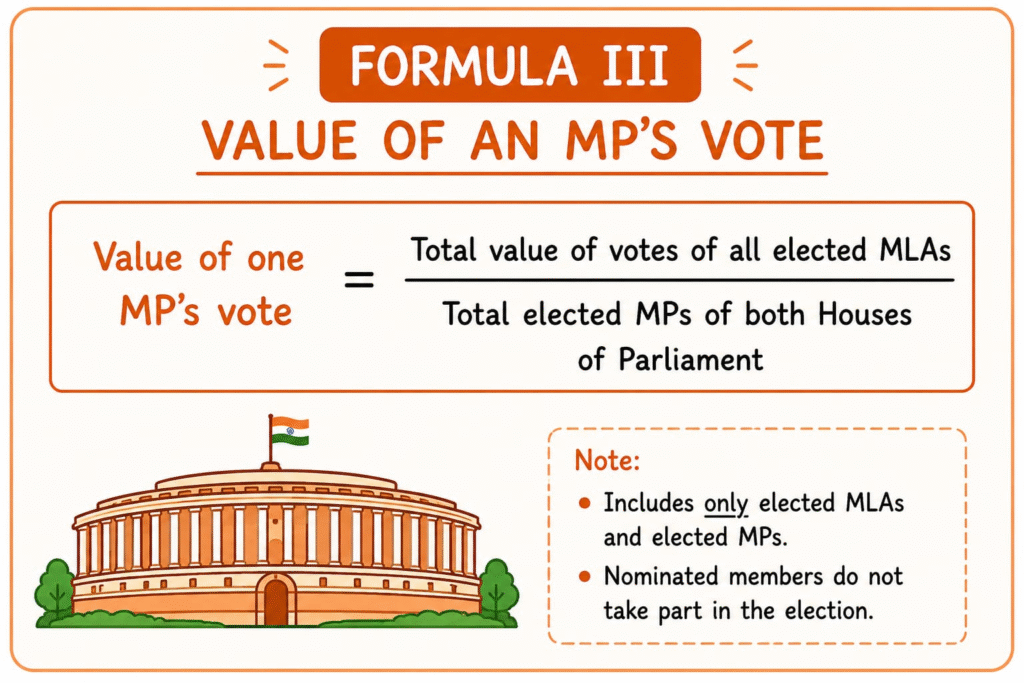
Article 56: Defines the term of office as 5 years from the date they enter office. The President continues to hold office until a successor enters.
Qualifications (Article 58): A candidate must be qualified to be a member of the Lok Sabha (among other criteria mentioned under Article 58 such as—(a) is a citizen of India(b) has completed the age of 35 years(c) does not hold any office of profit under the govt. of India or the state govt. or other authority subject to the control of any of the said governments)
Election of the President [Article 62(1)]
- Article 62(1) explicitly states that an election to fill a vacancy caused by the expiration of the President’s term must be completed before the expiration of the term.
- The President is elected by Proportional representation through the single transferable vote system and voting is by secret ballot.
Issue of Dissolved Assemblies [Special reference No. 1 of 1974]
Context: In 1974, the Gujarat Assembly was dissolved. A doubt arose: Could the Presidential election be held if an assembly, which forms part of the electoral college, is dissolved?
Supreme Court Ruling: In its landmark advisory opinion, the Supreme Court held that the election to the office of the President must be held before expiry of the term, regardless of whether a state Assembly is dissolved.
Reasoning: The “electoral college” under Article 54 consists only of the elected members who exists at the time of the election. Furthermore, Article 71(4) states that the election of a President cannot be questioned on the ground of any vacancy in the electoral college.
The Safety Net : Article 56(1)(c) & Statutory Succession
Article 56(1)(c): Even if the 5-year expires, the outgoing president continues to hold office until the successor enters upon their office. This ensures there is never a “vaccum” in the highest office of the state.
Article 62(2): Deals with vacancies due to death, resignation, or removal.
President (Discharge of functions) Act, 1969: If there is a sudden vaccum, the line of succession is:
President → Vice President → Chief Justice of India → Senior most judge of the Supreme Court after CJI
Procedure For Election Disputes
Disputes regarding these elections are handled with strict exclusivity.
- Jurisdiction [Article 71(1) & Article 145]All doubts and disputes arising out of the election of the President or Vice-President are inquired into and decided exclusively by the Supreme Court.
- Statutory Law: The President and Vice-President Elections Act, 1952
- Section 14: Mandates that no election be called into question except by an election petition presented to the Supreme Court.
- Who can file? (section 13(a) & 14(a))Only a candidate or specific electors.For the President, an election petition can be filed by any candidate OR by 20 or more electors joined together as petitioners. [sec…For Vice-President: By 10 or more electors joined together as petitioner OR any candidate
- Security Deposits (sec. 5C): Increased from ₹2500 to ₹15000 to deter frivolous petitions.
- Limitation period: The petition must be filed within 30 days from the date of the declaration of the result.
- Judicial Procedure: Guided by the Supreme Court Rules, 2013 [Order 46 (XLVI)]
Challenge to the Election of a person to the office of President of India
(A) Constitutional Qualifications
- Article 58 only requires a candidate to be a citizen of India, 35 years of minimum age, and qualified to be a member of the Lok Sabha.
- There is no educational constitutional requirement for educational qualification means, the election cannot be challenged on the ground that the candidate is illiterate.
- Unsuitability or “illiteracy” is neither a constitutional disqualification nor a recog[nized] statutory ground under sec. 18 of the “Presidential or Vice-Presidential Elections Act, 1952.”
(B) Statutory grounds (sec. 18, 1952 Act)
- Under sec. 18(1) of the Presidential and Vice-Presidential Elections Act, 1952, election can only be declared void on specific, enumerated grounds, such as —
- The offense of bribery or undue influence
- Improper reception or rejection of a vote that materially affects the result.
- The returned candidate not fulfilling qualifications under Article 58.
(C) Landmark Precedent
Charan Lal Sahu vs Giani Zail Singh (1984)
Facts: The election of Giani Zail Singh was challenged on several unique grounds, including allegations regarding his suitability for the office.
Held: The SC dismissed the petition. It established a firm rule that the election of President can only be challenged on the specific legal grounds mentioned in sect 18 of the President and Vice-Presidential Elections Act, 1952.
_____________________________________________________________________________
Topic -3: Composition, Powers and functions of the Election Commission
Part I
Composition of the Election Commission
Article 324:
- The Superintendence, direction and control of elections are to be vested in an Election Commission.
- This Article is the source of the ECI’s plenary (Absolute/unqualified) powers.
- Election commission is an independent & an autonomous constitutional authority responsible for administering free and fair elections in the country.
Article 324(2): The composition of the EC
- This clause under Article 324 explains who makes up the commission.
- It consists of a Chief Election Commissioner (CEC) and any no. of other Election Commissioners that the president decides. (Appointments are subject to any law made by parliament)
Evolution of the Election Commission
(i) The Single-Member Era (1950 – 1989): From January 25, 1950, until October 1989, the EC functioned as a single-member body Chief Election Commissioner (CEC).
(ii) The First Transition (1989): On October 16, 1989, the president appointed two additional Election Commissioners.
The Reason: The voting age was lowered from 21 to 18 (by the 61st Amendment Act) which significantly increased the work of the commission.
But it was short lived. The positions of two additional Election Commissioners were abolished in Jan 1990, and it reverted to a single-member body.
(iii) Permanent Multi-member Body (1993 – Present)
- On October 1993, the President appointed two more Election Commissioners again.
- Since then, the EC has remained a three-member (1 CEC + 2 ECs) body.
(iv) How the multi-member system works
-The Election Commission (Conditions of Service of ECs and transaction of Business) Amendment Act, 1993 was enacted to ensure fairness within the multi-member commission.
-The 1993 Act established specific rules for how the 3 members interact:
- Equal Power: The CEC and the 2 other Election Commissioners have equal salaries and powers(equivalent to a Judge of the Supreme Court)
- Decision making: In case of a difference of opinion, the matter is decided by the commission by a majority vote.
- Tenure: They hold office for a term of 6-year or until they reach the age of 65, whichever comes first.
*The 1993 Act was challenged in T.N. Seshan,CEC vs UOI (1995), But the SC upheld this Act.
(v) “Anoop Baranwal vs. UOI” judgement, 2023
For decades, the President (on the advice of the Prime Minister) directly appointed the CEC and ECs.
In this case, the SC ruled that:
(a) Since Article 324(2) says appointments are “subject to any law made by Parliament”, and Parliament had never made such a law, there was a “Constitutional Vacuum”.
(b) To ensure independence, the court ordered that a committee of the PM, the CJI, and the LOP in Lok Sabha should pick the ECs until parliament passed its own law.
(vi) Fulfilling the Constitutional Mandate
After Anoop Baranwal v. UOI (2023), the govt. introduced the 2023 Act, which is known as “The Chief Election Commissioner and other Election Commissioners (Appointment, Conditions of service and term of office) Act, 2023”.
By passing this law, the parliament reclaimed its appointment power from the temporary arrangement set by the Supreme Court.
One of the most controversial reasons the Act came was to replace the Chief Justice of India in the selection process.
Provisions of the 2023 Act:
- Section 3 (Composition): The EC shall consist of a CEC and such other no. of ECs as the President may fix from time to time.
- Section 4 : Appointment of the CEC and ECs by the President.
- Section 5 (Qualification): Must have held post equivalent to the rank of Secretary to the Govt. of India.
- Section 7 (Selection Committee): The selection committee consists of:
(a) The Prime Minister of India (Chairperson)
(b) A Union Cabinet Minister (nominated by the PM)
(c) The leader of opposition or leader of the largest opposition Party in the Lok Sabha
- Section 9 (Term of office): serves for a term of 6 years or until attaining the age of 65 years.
CASE LAWS
1. S.S. Dhanoa VS UOI (1991)
Facts: Just before the 1989 general elections, the President under the Rajiv Gandhi govt exercised powers under Article 324(2) to convert the ECI into a multi-member body by appointing 2 new Election Commissioners (S.S. Dhanoa and V.S. Seigell).
Soon after, a new govt. (under V.P. Singh) came to power and issued a notification rescinding the previous order, abolishing the two posts, and reverting the ECI to a single member body.
Dhanoa challenged this removal, arguing it violated the independence of the ECI and his security of tenure.
Issue:
- Does the president have the power to abolish the posts of Election Commissioners once created?
- Does the abolition of the post amount to “removal” under Article 324(5) which requires the recommendation of the CEC?
Judgement:
- The SC upheld the govt’s notification.
- It ruled that the creation and abolition of the posts of Election Commissioners is a prerogative of the President.
- The Court distinguished between “Removal from a Post” and “Abolition of a Post”.
- Abolishing a post does not attract the protection of Article 324(5) (which requires the CEC’s recommendation for removal).
2. T.N. Seshan, Chief Election Commissioner Vs. Union of India (1995)
Facts:
- The parliament passed the Chief Election Commissioner and other Election Commissioners (Conditions of Service) Amendment Act, 1993.
- This Act permanently made the ECI a multi-member body (CEC + 2 ECs).
- Crucially, Sec. 10 of the Act provided that the CEC and ECs would have equal powers and in case of a difference of opinion, the matter would be decided by a majority vote.
- T.N. Seshan, the then CEC challenged the Act, arguing that the constitution made the CEC supreme and that giving equal voting rights to ECs destroyed the CEC’s constitutional pre-eminence.
Issues:
- Is the 1993 Act constitutionally valid?
- Does the special protection against removal granted to the CEC under Article 324(5) make the CEC superior to the other ECs?
Judgement:
- The SC unanimously upheld the validity of the 1993 Act cementing the multi-member structure and the rule of majority decision-making.
- The court rejected the argument that the CEC is the “master” or “superior” to the ECs.
- The CEC is merely “primus inter pares” (First among equals).
- Regarding 324(5), the Court clarified that the stringent removal procedure for the CEC (like a Supreme Court judge) is designated to protect the institution of the Election Commission as a whole, ensuring its independence from the executive. It was not intended to elevate the CEC’s decision-making status above the other commissioners.
3. Anoop Baranwal Vs. UOI (2023)
Facts: For decades, the appointment of the CEC & ECs under Article 324(2) was made entirely by the president on the binding advice of the executive (COM).
Multiple PILs were filed arguing that leaving such critical appointments solely in the hands of the ruling govt. compromised the institutional independence of the ECI, thereby threatening the “Basic structure” of the constitution.
Issue: In the absence of a specific law enacted by parliament U/A 324(2), can the Supreme Court intervene to mandate an independent collegium system for appointing the ECI?
Judgement:
- The Constitutional Bench noted the glaring legislative vacuum.
- It emphasized that an independent EC is non-negotiable for a healthy democracy.
- Invoking its extraordinary powers under Article 142, the SC stepped in to fill the void. It ordered the creation of a High-powered selection committee to advise the President on appointments.
- The Mandated Collegium: The court ruled that until parliament enacts a law, appointments must be made on the advice of a committee comprising —(1) The PM (2) The CJI (3) The LOP in Lok Sabha
- This judgement prompted parliament to enact the CEC and other ECs (Appointment, conditions of service and Term of office) Act, 2023.
PART II
Powers and Functions of the Election Commission
- The Election Commission (EC) is a permanent, independent, and constitutional body established under Article 324 of the Constitution of India.
- Its primary mandate is to ensure the conduct of free and fair elections, which the Supreme Court has repeatedly recognized as a part of the “Basic Structure” of the Constitution.
Core Functions of the Election Commission
The practical day-to-day functions of the ECI are primarily derived from the Constitution, the RPA, 1950, and the RPA, 1951.
(i) Preparation and Revision of Electoral Rolls
Under Article 324(1) and the RPA, 1950, the EC functions to ensure that electoral rolls are up to date, preventing the disenfranchisement of eligible voters and the inclusion of bogus voters.
(ii) Delimitation of Constituencies
The ECI is involved in the territorial demarcation of constituencies and works with the Delimitation Commission Act, ensuring that the principle of “one person, one vote” is maintained.
(iii) Enforcement of the Model Code of Conduct (MCC)
A crucial function during the election period is enforcing the MCC to ensure a level playing field among all political parties and candidates.
It prevents the misuse of official machinery.
(iv) Scrutiny of Election Expenses
Under Sections 77 and 78 of the RPA, 1951, the EC functions as a strict regulator of election expenditure.
Candidates are required to keep a separate and correct account of all expenditures and lodge this account with the District Election Officer within 30 days of the election result.
(v) Appointment of Election Officials
The EC functions to deploy Chief Electoral Officers, District Election Officers, Returning Officers, and independent observers to monitor the polling and counting process.
Election Commission’s Powers/Functions
The Constitutional “Reservoir of Power” — Article 324
Article 324(1) vests the “superintendence, direction, and control” of the preparation of electoral rolls and the conduct of all elections to Parliament and State Legislatures, as well as the offices of the President and Vice-President in the ECI.
The Mohinder Singh Gill Principle
The absolute and plenary nature of Article 324 was established in the landmark case of:
Mohinder Singh Gill vs Chief Election Commissioner (1978)
Context
The ECI cancelled an entire constituency’s poll in Punjab due to mob violence without giving candidates a prior hearing, relying purely on Article 324.
Supreme Court’s Ruling
The SC upheld the EC’s action, ruling that Article 324 acts as a reservoir of power.
Where statutory laws (like RPA, 1951) are silent or make insufficient provisions to deal with an emergency during the election process, the EC can draw upon Article 324 to issue necessary orders.
The EC’s powers are broadly classified into 3 categories:
A) Administrative and Regulatory powers/functions
B) Advisory Powers/Functions
C) Quasi-Judicial Powers/functions
A) Administrative and Regulatory powers/functions of EC
The ECI draws its administrative powers both from the Constitution and the RPA, 1951.
(i) Scheduling and Conduct of Elections
The EC has the absolute authority to assess ground realities and schedule elections.
CASE LAW: Special Reference No. 1 of 2002 (Gujarat Assembly Election Matter)
Facts: In 2002, the Gujarat Legislative Assembly was dissolved prematurely after communal disturbances.
The ECI decided not to conduct elections immediately citing:
- Law and order issues
- Displacement of people
However, Article 174(1) of the Constitution requires that there must not be more than 6 months gap between two sessions of the Assembly.
This created a constitutional dilemma: Whether elections must be held within 6 months of the last session.
The President of India referred the matter to the SC under Article 143 (Advisory Jurisdiction).
Issues
Whether Article 174(1) applies after dissolution of Assembly?
Whether elections must be held within 6 months?
Whether the Election Commission has independent authority in deciding election timing?
Judgment
The SC held:
Article 174 does not apply after dissolution because there is no Assembly in existence.
The EC has the final authority under Article 324 to decide when elections should be conducted.
Free and fair elections are more important than strict timelines.
(ii) Allotment of Symbols
The ECI regulates political parties through the Election Symbols (Reservation and Allotment) Order, 1968.
It governs the allocation and reservation of electoral symbols to recognized and unrecognized parties.
CASE LAW: Kanhaiyalal Omar vs R.K. Trivedi (1986)
In this case, the SC confirmed that the 1968 Order is constitutionally valid and derives its authority directly from the plenary power of Article 324, not merely from rules framed under the RPA.
The Statutory Limits on Article 324
While Article 324 is a reservoir of powers, it is not a license to override existing statutes.
The ECI cannot act in contravention of laws validly made by Parliament under Article 327.
CASE LAW: A.C. Jose vs Sivan Pillai (1984)
Facts
The EC introduced EVMs in a few constituencies during the 1982 Kerala Legislative Assembly elections using its Article 324 powers.
This was India’s first attempt to use EVMs in actual elections.
However, the RPA, 1951 explicitly mandated the use of ballot papers and there was no legal provision allowing EVMs under the Act.
Sivan Pillai, a candidate from Parur constituency, challenged this move.
Judgment
The SC set aside the election result and held:
The EC cannot use its constitutional powers under Article 324 to bypass or rewrite an explicit statutory provision.
The EC cannot introduce EVMs without statutory backing.
Article 324 is supplementary, not supreme over law.
The EC can act only in areas where the law is silent.
B) Advisory Functions of the EC
Under the Constitution, the ECI acts as an advisory body in matters concerning post-election disqualification of sitting members.
Articles 103(2) and 192(2)
If a question arises whether a sitting MP or MLA has become subject to any disqualification (e.g., holding an office of profit), the matter is referred to the President or Governor respectively.
The President/Governor must obtain the opinion of the ECI and is constitutionally bound to act according to that advice.
The EC also advises on the removal of disqualifications for corrupt practices under Sections 8A and 11 of the RPA, 1951.
C) Quasi-Judicial Functions: Registration & Deregistration
Under Section 29A of the RPA, 1951, the EC registers associations or bodies as political parties.
However, a major legal dispute existed regarding the EC’s power to deregister them.
The Deregistration Rule
CASE LAW: Indian National Congress (I) vs Institute of Social Welfare (2002)
The Supreme Court laid down the definitive law on this function:
1. The Court held that while registering a party under Section 29A, the EC exercises a quasi-judicial function.
2. Because the RPA, 1951 does not explicitly grant the power of review, the ECI cannot deregister a party merely for violating the Model Code of Conduct (MCC) or calling for illegal strikes.
3. The Three Exceptions:The EC can only deregister a party if:
a)Registration was obtained by fraud or forgery.
b)The party amends its constitution to explicitly abandon the Constitution of India, socialism, secularism, or democracy.
c) A competent court declares the registration invalid.
Conclusion
The EC occupies a unique constitutional space. Through judicial interpretation, its powers under Article 324 have been recognized as expansive enough to handle an electoral crisis (as seen in the Mohinder Singh Gill case), yet carefully bounded by the rule of law to prevent executive overreach (as seen in A.C. Jose and Institute of Social Welfare cases).
This delicate balance ensures that the ECI remains the ultimate independent guardian of Indian democracy.
_________________________________________________________________________________________________________________
Topic- 4: Qualifications and Disqualification of Candidates
Part I
1) Qualification vs Disqualification
(A) Qualification:
It refers to the essential eligibility conditions that a person must satisfy to contest elections to become a member of Parliament or State Legislature.
RPA Sections (RPA, 1951)
Sec. 3: Qualification for Rajya Sabha
A person must be:
An elector in India for a parliamentary constituency.
Meaning: To be eligible for Rajya Sabha membership, a candidate must be registered as a voter in any parliamentary constituency across India.
Sec. 4: Qualification for Lok Sabha
A person must be:
An elector for any parliamentary constituency in India.
For SC/ST reserved seats, the candidate must be an elector and a member of a Scheduled Caste/Scheduled Tribe respectively.
Elector Definition:
An elector means a person whose name is entered in the electoral roll of a constituency and who is not subject to any disqualifications under the Constitution or the RPA, 1951.
Only registered voters can contest Lok Sabha elections.
Citizenship of India and enrollment in the electoral rolls are mandatory.
Disqualifications can bar eligibility.
Section 5: Qualification for State Legislative Assembly
A person must be:
An elector in any Assembly constituency within the State to be eligible to contest election to that Legislative Assembly.
Here elector means a person whose name is entered in the electoral roll of a constituency and who is not subject to disqualifications under the Constitution or the RPA.
For SC/ST seats: Candidate must be an elector in the State and member of SC/ST.
For ST in Autonomous District seats: Candidate must be an elector in that particular constituency.
Sec. 6: Qualification for Legislative Council
A person must be:
An elector for an Assembly constituency in that State.
Special Category of Seats (Additional Qualifications)
Graduates’ Constituency:
Must be a graduate of a recognized university for at least 3 years.
Teachers’ Constituency:
Must have been engaged in teaching for at least 3 years in recognized institutions not lower than Secondary School.
Local Authorities Constituency:
Must be an elector in the relevant local authority area.
Assembly Members’ Constituency:
Must be an elector in the State Assembly constituency.
Constitutional Provisions Regarding Qualification
Article 84: Qualifications for Membership of Parliament
Applies to both Lok Sabha and Rajya Sabha.
Key Requirements:
Must be citizen of India.
Must make and subscribe an oath/affirmation before an authorized person (Election Commission).
Age Criteria:
25 years (Lok Sabha) – minimum
30 years (Rajya Sabha) – minimum
Must possess other qualifications prescribed by Parliament (RPA, 1951).
Article 173: Qualifications for Membership of State Legislatures
Applies to Legislative Assembly and Legislative Council of States.
Key Requirements:
Must be a citizen of India.
Must make and subscribe an oath/affirmation before an authorized person (Election Commission).
Age Criteria:
25 years (Legislative Assembly) – minimum
30 years (Legislative Council) – minimum
Must possess other qualifications required by Parliament (RPA, 1951).
B. Disqualification for Membership (Article 102 & 191)
Meaning:
Disqualification means the state or act of being found not allowed or ineligible to take part in something, usually because a rule has been broken or a required condition is not met.
In Indian Constitution and electoral law, disqualification means the legal removal of a person’s eligibility to be chosen as, or to continue being, a member of Parliament or State Legislature.
This happens either under the Constitution (Article 102 and 191) or under the Representation of the People Act, 1951 (RPA) — Sections 8, 8A, 9, 9A, 10, 10A.
CASE: Kuldip Nayar vs Union of India (2006)
Facts:
The petitioner, veteran journalist Kuldip Nayar, challenged two specific changes:
1.Removal of Domicile Requirement
The 2003 amendment removed the condition that a candidate for Rajya Sabha must be an elector (resident) of the specific State they represent.
Now a person only needs to be an elector in any parliamentary constituency in India.
Argument:
This violated the principle of federalism (part of the Basic Structure), as the Rajya Sabha is meant to represent the interests of specific States.
2.Introduction of Open Ballot System
The amendment introduced an “open ballot” for Rajya Sabha elections to curb cross-voting and corruption (horse-trading).
Argument:
This violated the principle of “secrecy of ballot”, which the petitioner argued was essential for free and fair elections and part of freedom of expression under Article 19(1)(a).
Judgment
(1) On Federalism and Domicile:
The Supreme Court upheld the removal of the domicile requirement.
Reasoning:
While federalism is part of the Basic Structure, its application in India is “quasi-federal”.
There is no constitutional requirement in Article 80(4) that a representative must belong to the State represented.
The qualification of being a “representative” is a statutory right created by Parliament under Article 84.
Parliament has the power to change these qualifications.
(2) On Open Ballot and Secrecy
The Court upheld the open ballot system for Rajya Sabha elections.
Reasoning:
The Court distinguished between:
(i) General elections (where secrecy is paramount)
(ii) Indirect elections (like Rajya Sabha elections)
Secrecy of ballot is a statutory right, not a constitutional right or part of the Basic Structure.
Open ballot was considered necessary to ensure party discipline and prevent corruption and cross-voting.
The anti-defection law does not strictly apply to voting in these elections (under Articles 102 & 191), therefore open ballot was introduced as a practical alternative to maintain party integrity.
# RPA, 1951 Based Sections Related to Disqualification
(i) Sec. 8
Disqualifies a person convicted of certain offences such as:
Promoting enmity
Bribery
Electoral offences
(ii) Sec. 8A
Disqualification for corrupt practices during elections.
(iii) Sec. 9, 9A, 10, 10A
Deal with disqualification for:
Failure to lodge election expenditure accounts
Resignation from one House to contest another
Other procedural violations.
Part II
Disqualification for Holding an Office of Profit
Relevant Provisions:
- Article 102(1)(a) and Article 191(1)(a)
- RPA, 1951 → Section 10
- Parliament (Prevention of Disqualification) Act, 1959
Disqualification for Membership (Articles 102 & 191)
These provisions outline the attributes that bar a person from being chosen or continuing as a member.
[A] Office of Profit [Article 102(1)(a) & 191(1)(a)]
Holding an office of profit under:
1.The Government of India, or
2.The Government of any State
-disqualifies a person unless the office is exempted by law [for example, Parliament (Prevention of Disqualification) Act, 1959]
Core Principle
There must be a conflict between duty and interest.
If profit is receivable (even if not actually drawn), it is deemed an office of profit.
Meaning of “Office of Profit”
*The term “office of profit” is not defined in the Constitution.
*Courts determine it by factors such as:
1.Control of appointment/removal
2.Remuneration
3.Whether the office can be used for patronage
*Both clauses [102(1)(a) & 191(1)(a)] embody the principle of separation between legislature and executive and prevent legislators from holding posts that may make them financially dependent on or under the control of the Executive.
[B] Sec. 10 (RPA, 1951): Disqualification for Office under Government Company
A person shall be disqualified if, and for so long as, he is:
*a managing agent,
*manager, or
*secretary
— of any company or corporation (other than a cooperative society)
in the capital of which the appropriate Government has not less than 25% share (≥ 25%).
Here, Government company/corporation is mentioned. It is also defined under Section 2(45) of the Companies Act, 2013. But the definition under the Companies Act, 2013 is not applicable here because it puts the shareholding threshold at ≥ 51%.
Purpose of Sec. 10 (RPA, 1951)
It prevents MPs/MLAs from being in key managerial positions of Government-owned companies, which may involve conflict of interest.
[C] Parliament (Prevention of Disqualification) Act, 1959
*Because a literal reading of “office of profit” would disqualify even many sincere or low-paid posts necessary for governance, Parliament enacted the Parliament (Prevention of Disqualification) Act, 1959.
*It declares that certain specified offices of profit under the Central or State Government shall not disqualify their holders for being elected or being members of Parliament or State Legislature.
*These exempted posts are listed in the Schedule to the 1959 Act.
Examples of Exempted Posts:
- Ministers & Deputy Ministers
- Parliamentary Secretaries
- Whips & Deputy Whips
- Leaders & Deputy Leaders of recognized parties in the Legislatures
- Chairperson/Vice-Chairpersons of certain statutory bodies e.g., Planning Commission Chairperson, Chairperson of National Advisory Council (NAC)
- Vice-Chancellors of Universities
- Officers of National Cadet Corps (NCC) and Territorial Army
- Trustees of Public Trusts
- Various statutory body posts
- Members/Chairpersons of Commissions, Councils, Boards, etc.[Inserted through amendments (1960, 1992, 1993, 2006, 2013)]
High Profile Cases
1.Jaya Bachchan v. UOI Case (2006)
Issue
Jaya Bachchan was disqualified from the Rajya Sabha because she held the post of Chairperson of the UP Film Development Council, which was treated as an office of profit under the government.
The case involved:
Article 102(1)(a) — disqualification for holding an office of profit.
Article 103(2) — the President decides questions of MP disqualification after obtaining the opinion of the Election Commission.
The Election Commission advised that the post was an office of profit, and the President disqualified her under Article 103(2)
judgement:The Supreme Court upheld the decision and held that:
Actual salary is not necessary.
Even the possibility of financial gain or perks is enough to amount to an office of profit.
Key Principle
2.Parliamentary Secretaries in Delhi (2018)
Issue
The Delhi Government appointed 20 MLAs as Parliamentary Secretaries to various ministers, giving them office, staff, and perks.
Outcome
The Election Commission held that this was an office of profit under the Government of India/State Government and recommended disqualification.
The President accepted the recommendation and disqualified 20 MLAs.
Legal Point
The case reinforced that any Government-created post with remuneration, power, and control can be an office of profit even if labelled “Parliamentary Secretary”.
3. Sonia Gandhi and National Advisory Council (2006)
Sonia Gandhi was questioned for holding the chairmanship of the National Advisory Council (NAC), alleged to be an office of profit.
Later, a Joint Parliamentary Committee gave her a clean chit, holding that advisory posts like NAC should not be treated as offices of profit.
4. Pranab Mukherjee Case (2012)
Chairman of the Indian Statistical Institute (ISI), Kolkata
During the 2012 Presidential Election, Pranab Mukherjee (the UPA-backed candidate) was challenged by rival candidate P.A. Sangma in the Supreme Court.
Allegation
Sangma alleged that on the date of filing nomination, Mukherjee held an office of profit as ISI Chairman, which is a body substantially funded by the Central Government.
He relied on Article 58(2)(b) of the Constitution, which disqualifies a person for election as President if he holds any office of profit under the Government of India or any State.
Supreme Court Decision
The Supreme Court rejected the petition and held that:
Mukherjee had resigned from the ISI Chairmanship before filing his nomination.
The post (even if fee-based or honorary) was not, on the relevant facts of that case, an office of profit within the strict meaning applicable to the Presidential election context.
*Important Point
Once a person resigns or ceases to hold the office of profit, the disqualification ceases immediately.
Therefore, they can contest the very next election.
Articles 102(1)(a) and 191(1)(a) do not impose a fixed six-year disqualification period as mentioned under sec.8,RPA, 1951.
Landmark Cases
1) Guru Gobind Basu vs Sankari Prasad Ghosal (1964)
Facts:
The appellant, G.G. Basu, was a chartered accountant and a partner of the firm of auditors of certain companies and corporations (such as LIC, Durgapur Project Ltd. and Hindustan Steel Ltd.) on payment of certain remuneration.
The appellant was also a director of the West Bengal Financial Corporation having been nominated or appointed as such by the W.B. State Government.
The appointment carried with it the right to receive fee or remuneration as director of the said corporation.
In Feb–March, 1962, the appellant was elected to the House of People from Burdwan Parliamentary Constituency.
The election was challenged by two voters of the said constituency on two grounds:
That the appellant was the holder of offices of profit under GOI and W.B. Government and this disqualified him from standing for election under Article 102(1)(a) of the Constitution.
That he was guilty of certain corrupt practices which vitiated his election.
The Election Tribunal held that the appellant was a holder of offices of profit both under the GOI and the State Government of W. Bengal, and was therefore disqualified from standing for election under Article 102(1)(a) of the Constitution.
On appeal before the High Court under Section 116-A of the RPA, 1951, the HC dismissed the appeal, but granted a certificate of fitness under Article 133(1)(c) of the Constitution.
Issue:
Does an auditor of a 100% government company hold an “office of profit” under the government for the purpose of Article 102(1)(a)?
Judgment:
The Supreme Court laid down the primary tests for determining whether an office is under the government. The factors include whether the authority has the power to:
1.Make the appointment to the office
2.Remove or dismiss the holder of office
3.Pay the remuneration
4.Control and give directions regarding the performance of duties
5.Determine what functions the holder performs and whether he performs them for the government
The Court finally held that not all these factors need to co-exist.
The decisive factor is the element of control.
Since the Comptroller and Auditor General of India (CAG) and Central Government controlled his appointment, removal and functions, he was held to be holding an office of profit under the government.
2) Joti Prasad Upadhyaya vs Kalka Prasad Bhatnagar (1962)
Facts:
Kalka Prasad Bhatnagar’s election to the U.P. Legislative Council was challenged on the ground that he held an office of profit because he was the Vice-Chancellor (V.C.) of Agra University.
Issue:
Does the position of Vice-Chancellor of an autonomous university constitute an office of profit under the State Government?
Judgment:
The Allahabad High Court distinguished between an office under the direct control of the State versus an office under an autonomous statutory body (like a university).
Even though the Chancellor of the University (who appoints the Vice-Chancellor) is the Governor of the State, the Governor acts in a distinct statutory capacity as Chancellor, not in the executive capacity as the head of the State Government.
Ultimately, the Court held that a Vice-Chancellor does not hold an office of profit under the State Government, preserving the institutional autonomy of the university.
His election was upheld.
3) Ashok Kumar Bhattacharya vs Ajoy Biswas (1985)
Facts:
The respondent, Ajoy Biswas, was an accountant-in-charge in the Agartala Municipality.
He contested and won an election.
His election was challenged on the premise that as a municipal employee, he held an office of profit under the State Government [Article 191(1)(a)].
Issue:
Is an employee of a local municipal authority considered to be holding an office of profit under the government?
Judgment and Ratio:
The Supreme Court drew a strict line between an office under the government and an office under a local authority.
A local authority (like a municipality) is a distinct legal and corporate entity.
The power to appoint, dismiss and control the municipal staff lies with the municipality, not the State Government.
Thus, a municipal servant is not a government servant.
Therefore, Biswas was not disqualified from contesting the election.
4) Bihari Lal Dobray vs Roshan Lal Dobray
Facts:
Roshan Lal Dobray filed his nomination papers to contest an election to the U.P. Legislative Assembly.
At the time, he was employed as an Assistant Teacher in a Basic Primary School run by the U.P. Board of Basic Education.
The returning officer rejected his nomination, stating he held an “office of profit under the State Government”.
Bihari Lal Dobray subsequently won the election.
Roshan Lal challenged the rejection, arguing the Board was an independent statutory body, not the government.
Issue:
Does an Assistant Teacher employed by the U.P. Board of Basic Education hold an office of profit under the State Government within the meaning of Article 191(1)(a) of the Constitution?
Judgment and Ratio:
The Supreme Court examined the U.P. Basic Education Act to determine the true nature of the Board.
The Court noted that the core object of Article 191(1)(a) is to ensure legislators are free to carry out their duties fearlessly without government pressure or conflict of interest.
Simply because a body is incorporated as a statutory corporation does not automatically mean it is independent of the government.
The Court applied the test of “deep and pervasive control”.
It found that the State Government had direct control over the Board’s finances, power to appoint and remove its members, and power to dissolve the Board entirely.
The SC ruled that because the government exercised such extensive control over the Board, an employee of the Board (Assistant Teacher) was holding an office of profit under the State Government.
Roshan Lal Dobray was rightly disqualified.
5) Consumer Education & Research Society vs Union of India (2009)
Facts:
Following the disqualification controversy in the Jaya Bachchan case, Parliament passed the Parliament (Prevention of Disqualification) Amendment Act, 2006.
This Act retrospectively exempted over 50 specific offices from being classified as “offices of profit”, saving several sitting MPs from disqualification.
The petitioners challenged the constitutional validity of this retrospective amendment.
Issue:
Can a legislature use retrospective legislation to exempt certain offices from the office of profit disqualification under Article 102(1)(a)?
Judgment and Ratio Decidendi:
The Supreme Court upheld the constitutional validity of the amendment Act.
The Court reasoned that Article 102(1)(a) explicitly grants Parliament the power to declare by law that certain offices will not disqualify their holders.
Legislative power can be exercised both prospectively and retrospectively.
Curing a defect or removing a disqualification retrospectively is a valid exercise of legislative power, provided it does not violate any other constitutional mandate or foundational democratic principles.
Part III
Disqualification for Government Contract
→ Article 299
→ Sec. 9A (R.P.A. 1951)
CASES:
Konappa Rudrappa Nadgouda vs Vishwanath Reddy (1969)
Smt. Ashing vs L.S. John (1984)
1) Disqualification for Government Contract:
The object and rationale:
The foundational purpose of this disqualification is to prevent a conflict of interest and maintain the purity of the legislature.
A representative cannot objectively scrutinize the executive if they are simultaneously profiting from government contracts.
2.The statutory framework: Sec. 9A of the RPA, 1951
Sec. 9A mandates disqualification if there is a “subsisting contract” entered into by the candidate with the government:
in the course of their trade or business with the appropriate government for:
a)supply of goods to the government
b)execution of any work undertaken by the government
(e.g., dams, roads, dispensaries)
#Here, “Appropriate Govt.” defined in Sec. 7(c), RPA:
For Parliamentary election: The Union Govt.
For State Legislature election: The respective State Govt.
Exception
“Appropriate Govt.” strictly means the Government and its direct departments.
Local authorities and other statutory authorities are not covered. Therefore, a contract with a municipal corporation or a separate statutory body will not trigger disqualification under Sec. 9A.
“Subsisting Contract”
A contract is “subsisting” as long as both sides still have duties to perform.
If the contract is fully executed and discharged, it no longer subsists.
“In the Course of Trade or Business”
The contract must be in the candidate’s personal commercial capacity.
Exception:
If a Mukhiya or Pradhan enters into a contract with the government on behalf of the Panchayat, they are not disqualified. They are acting in a representative/official capacity, not in their personal trade or business.
Similarly, a government officer acting officially is not disqualified.
For example, a toll officer (covered under Entry 59, List-II, State List) while collecting tolls is not disqualified.
3) Article 299 of the Constitution
This Article requires that all contracts made by the Central or State Government be explicitly:
expressed in the name of the President or the Governor respectively, and
executed by authorized persons in an authorized manner.
→ When determining if a “subsisting contract” exists for Section 9A, RPA, 1951, courts often look at whether a legally binding contract was validly formed under the strict formalities of Article 299.
Imp.: Article 300: Government may sue or be sued by the name of Union of India or the State.
4) Landmark Judicial Pronouncements
(A) Konappa Rudrappa Nadgouda vs Vishwanath Reddy (1969)
Facts:
Vishwanath Reddy won the election to the Mysore Legislative Assembly. The runner-up, Nadgouda, challenged Vishwanath Reddy’s election on the grounds that Reddy had an ongoing contract with the State Government for road construction at the time of filing his nomination. Reddy’s nomination had been accepted despite objections.
Issue:
Whether the contract was legally subsisting at the date of nomination, thereby disqualifying the returned candidate under Sec. 9A, RPA, 1951.
Judgment and Ratio:
The Supreme Court examined the evidence and held that the contractual obligations between Reddy and the government had not been fully discharged; the contract was indeed subsisting.
Consequently, the Court strictly enforced Sec. 9A, RPA, 1951 and declared Reddy’s election void.
Furthermore, because Nadgouda was the only other contesting candidate remaining, the Court applied the “votes thrown away” doctrine and declared Nadgouda as the duly elected candidate.
(B) Smt. Ashing vs L.S. John (1984)
Facts:
•L.S. John was a contractor engaged in widening a public road for the government. Just before the last date for filing his election nomination, he wrote a letter to the Executive Engineer explicitly stating he was closing the contract and resigning from the contractor’s list.
•The opposite party argued that because the government had not formally accepted this letter or resignation, the contract was technically still alive and subsisting.
Issue:
Does a government contract continue to subsist under Section 9A until the government formally accepts the contractor’s unilateral termination?
Judgment and Ratio:
- The Supreme Court rejected the argument that formal acceptance was required.
- The Court held that through the letter, the contractor had unilaterally put an end to the contract by breach.
- Acceptance of the letter by the authorities was deemed unnecessary to terminate the contract for the specific purpose of Sec. 9A (RPA, 1951).
- While the unilateral breach might give the government a cause of action to sue the contractor for damages, the contract itself was no longer subsisting.
- Therefore, the candidate was free from disqualification.
Part IV
Disqualification on Conviction for Certain Offences
→ Sec. 8, R.P. Act, 1951
→ Articles 84 & 173
→ Articles 102(1)(e) & 191(1)(e)
→ Articles 75(5) & 164(4)
→ Section 389 Cr.P.C. / Sec. 430 BNSS, 2023
→ Section 482 Cr.P.C. / 528 BNSS, 2023
CASE LAWS
Chief Election Commissioner vs Jan Chaukidar (People’s Watch) & ors (2013)
B.R. Kapur vs State of Tamil Nadu
Lily Thomas vs UOI (2013)
K. Prabhakaran vs P. Jayarajan (2005)
Navjot Singh Sidhu vs State of Punjab (2007)
Public Interest Foundation vs UOI (2019)
Rambabu Singh Thakur vs Sunil Arora (2020)
1.Sec. 8, R.P.A., 1951
This section prevents individuals convicted of specific crimes from contesting elections or continuing as sitting MPs/MLAs.
The Statutory Framework: Section 8 Breakdown
(i) Sec. 8(1): Specific Grave Offences
Conviction for offences like:
- promoting enmity
- bribery
- undue influence
- rape
- cruelty to women
- terrorism etc.
Penalty:
Immediate disqualification
(A) If fined only:
Disqualified for 6 years from the date of conviction.
(B) If imprisoned:
Disqualified from conviction until 6 years after release.
(ii) Sec. 8(2): Economic/Social Offences
Conviction under laws like:
- Essential Commodities Act
- Dowry Prohibition Act etc.
- resulting in a sentence of at least 6 months of imprisonment.
Penalty:
Disqualified from conviction until 6 years after release( prison time + 6 years)
(iii) Sec. 8(3): General Offences
Conviction for any other offence (not already listed in sections 8(1) and 8(2)) resulting in imprisonment of not less than 2 years.
Penalty:
Disqualified from conviction until 6 years after release.
Example:
In Rahul Gandhi vs Purnesh Ishwarbhai Modi & Anr.
(Defamation Case: 2 years in jail + 6 years post release = 8 years disqualification)
(iv) Sec. 8(4)
Previously protected sitting MPs/MLAs from immediate disqualification if they filed an appeal against their conviction within 3 months.
This Sec. 8(4) was struck down by the Supreme Court in Lily Thomas vs UOI (2013) case.
→ Disqualification is now immediate upon conviction.
2) The Constitutional Nexus & Adjudication
(i) Articles 84 & 173
These Articles lay down the basic qualifications:
citizenship,
age,
oath, etc.
to be an MP/MLA.
Clause (C) of both Articles states that a candidate must possess such other qualifications as may be prescribed by Parliament.
This gives Parliament the power to enact laws like the RPA, 1951, to govern the electoral process.
(ii) The Bridge (Articles 102 & 191)
Article 102(1)(e) [Parliament] and Article 191(1)(e) [State] state that a person is disqualified if they are so disqualified “by or under any law made by Parliament”.
Sec. 8, RPA, 1951 is that specific law.
(iii) The Adjudicatory Mechanism (Articles 103 & 192)
-If a question arises regarding the disqualification of a sitting member under Articles 102(1) & 191(1), the question is referred to:
the President (under Article 103)
the Governor (under Article 192)
-Under Articles 103 & 192, the President or the Governor must obtain the opinion of the Election Commission of India and act according to that opinion.
-This is the procedural route through which a convicted MP/MLA officially loses their seat post Lily Thomas vs UOI judgment (2013)
-The President/Governor must obtain the binding opinion of the Election Commission before officially declaring the seat vacant.
3) Loopholes, Criminal Procedure & Supreme Court Rulings
(A) The Ministerial Loophole (B.R. Kapur vs State of Tamil Nadu)
The loophole:
Articles 75(5) and 164(4) allow a non-member to be a Minister/CM/PM for 6 months without being elected.
J. Jayalalithaa (convicted & sentenced to 3 years) tried using this to become CM despite being disqualified under Sec. 8(3).
Supreme Court Ruling:
The Supreme Court struck down the move.
The Court ruled that Article 164(4) only applies to someone legally capable of being elected.
You cannot bypass RPA, Sec. 8 using executive appointment powers.
(B) The Criminal Procedure Interplay
(How to halt disqualification?)
(i) Sec. 389 Cr.P.C. / Sec. 430 BNSS, 2023 (Suspension of Sentence)
This allows an appellate court to suspend the execution of the sentence
(i.e. grant bail and keep them out on bail).
However, simply getting bail or suspending the sentence does not wipe out the conviction.
In Navjot Singh Sidhu v. State of Punjab (2007) case, and Rahul Gandhi v. Purnesh Ishwarbhai Modi & Anr. case:
The Apex Court stayed (suspended) the convictions of both Rahul Gandhi & Navjot Singh Sidhu in their cases under Sec. 389(1), Cr.P.C./ Sec.430 BNSS,2023, which is granted only in highly exceptional circumstances.
Both Rahul Gandhi & Navjot Singh Sidhu (however voluntarily resigned from Lok Sabha on Moral grounds) escaped the disqualification under Section 8(3) of the RPA, 1951.
(ii) Sec. 482 Cr.P.C. / Sec. 528 BNSS, 2023 (High Court’s Inherent Powers)
A politician may seek to completely quash the FIR/proceedings.
If the High Court quashes the case under Sec. 482 Cr.P.C. (Sec. 528 BNSS), the foundation for the RPA disqualification vanishes entirely.
4) The Undertrial Threat & the 2013 Amendment
Case:
Chief Election Commissioner vs Jan Chaukidar (2013)
Issue:
Can an undertrial locked in jail (not yet convicted) contest an election?
Supreme Court’s Ruling:
(i) Sec. 62(5) RPA: If you are in jail/police custody, you lose your right to vote.
(ii) If you cannot vote, you cease to be an elector under the law.
(iii) Sec. 4 & 5, RPA, 1951: To contest an election, you must be an elector.
Verdict:
A person in lawful custody cannot contest election.
#The Political Threat
- The ruling government could theoretically register a fake FIR and throw a strong rival into police custody right before nomination day to disqualify them.
- Therefore, Parliament quickly passed the Representation of the People (Amendment and Validation) Act, 2013.
- It added a proviso to Sec. 62(5) of RPA, 1951 stating: “A person does not cease to be an elector simply because their right to vote is temporarily suspended due to being in prison/custody.”
Current Law
Undertrials and persons in police custody can file nominations and contest elections, provided they have not been officially convicted and disqualified under Sec. 8 of the RPA.
CASE LAWS
1) B.R. Kapur vs State of Tamil Nadu
Facts:
- J. Jayalalithaa was convicted in the TANSI land deal case under the Prevention of Corruption Act and the IPC.
- She was sentenced to 3 years of rigorous imprisonment.
- She filed an appeal in the Madras High Court. The HC under Sec. 389 Cr.P.C. suspended her sentence but did not stay her conviction.
- For the 2001 Tamil Nadu Assembly election, she filed nomination papers from 4 constituencies. All were rejected by the returning officer because she was disqualified under Sec. 8(3) of RPA, 1951 and other sections.
- Despite not contesting, her party won an absolute majority. The Governor of Tamil Nadu invited her to form the government and swore her in as Chief Minister invoking Article 164(4) of the Constitution (which allows a non-member to be a Minister/CM for a period of 6 months).
- A writ of Quo-Warranto was filed in the Supreme Court challenging her appointment.
Issues:
Can a person who is fundamentally disqualified to contest an election be appointed as a Minister/CM under Article 164(4)?
Does the suspension of a sentence by an appellate court wipe out the disqualification under Section 8(3) of the RPA, 1951?
Is the Governor’s decision to appoint a CM immune from judicial review under Article 361?
Judgment and Ratio:
On Article 164(4):
The Supreme Court held that Article 164(4) is not a standalone power. It must be read with:
Article 173 (Qualifications)
Article 191 (Disqualifications)
A person appointed as Minister for 6 months must be legally capable of becoming a member.
Since Jayalalithaa was disqualified under Article 191(1)(e) read with Section 8(3) of the RPA, she could not use Article 164(4) as a backdoor to executive power.
On Suspension of Sentence:
The Court clarified a critical difference in criminal procedure:
Suspending a sentence only releases the individual from physical custody. It does not erase the conviction.
Because the conviction stood, the disqualification remained active.
On Governor’s Immunity:
Article 361 grants immunity to the Governor for the exercise of official duties, but it does not protect unconstitutional action itself.
The Court can strike down an unconstitutional appointment.
Conclusion:
The appointment of J. Jayalalithaa as CM was struck down as unconstitutional, and a writ of Quo-Warranto was issued.
2) Lily Thomas vs UOI (2013)
Facts:
- A PIL was filed by Lily Thomas and the NGO Lok Prahari challenging the constitutional validity of Sec. 8(4) of the RPA, 1951.
- Sec. 8(4) stated that if a sitting member of Parliament/State Legislature is convicted of an offence falling under Sec. 8(1), 8(2), or 8(3), the disqualification would not take effect for 3 months.
- If they filed an appeal or revision within those 3 months, the disqualification could be stayed until the appellate court disposed of the matter.
- Essentially, it allowed convicted politicians to remain in power for years while their appeals dragged on.
Issues:
Does Parliament have the legislative competence to enact Sec. 8(4) and create an exception for sitting lawmakers?
Does Sec. 8(4) violate Article 14 (Right to Equality) by creating an arbitrary classification between ordinary candidates (who are disqualified instantly) and sitting members?
Does Sec. 8(4) violate Article 101(3)(a) and Article 190(3)(a) of the Constitution?
Judgment and Ratio:
1.The Constitutional Mandate:
- The Supreme Court relied heavily on Articles 101(3)(a) and 190(3)(a).
- These Articles state that if a member of a House becomes subject to any of the disqualifications mentioned in Articles 102/191, their seat shall thereupon become vacant.
- The Court interpreted the word “thereupon” to mean immediately.
- The Constitution commands that the moment a disqualification occurs (i.e., conviction and sentencing), the seat falls vacant instantly.
2.Ultra Vires:
Because the Constitution mandates immediate vacancy, Parliament cannot pass a law like Section 8(4) that delays or defers this constitutional consequence.
Therefore, Sec. 8(4) was struck down as ultra vires the Constitution.
3. Legislative Incompetence:
Parliament lacks the legislative competence to defer the date from which the disqualification comes into effect.
4. Prospective Operation:
To prevent chaos, the Court applied the judgment prospectively (from the date of judgment onwards).
Thus:
The Court in Lily Thomas case ruled that Parliament lacked legislative competence to create this special exception for sitting members because Articles 102(1) and 191(1) demand absolute parity.
3) K. Prabhakaran vs P. Jayarajan (2005)
(Calculation of Sentence Case)
Facts:
This was a landmark Constitutional Bench judgment clarifying various technicalities of Sec. 8.
A key appellant was convicted in multiple separate criminal cases.
In each individual case, the sentence was less than 2 years.
However, the trial court ordered the sentences to run consecutively one after the other.
The total duration of the consecutive sentences added up to more than 2 years.
The returning officer rejected his nomination under Section 8(3), calculating the total time he could spend in jail.
Issues:
If a person is convicted of multiple offences and given consecutive sentences, can those sentences be clubbed or aggregated together to reach the “not less than 2 years” threshold under Section 8(3) of the RPA, 1951?
What is the exact crucial date for determining whether a candidate is disqualified?
Judgment & Ratio:
A. On Clubbing of Sentences:
The Supreme Court strictly interpreted the language of Sec. 8(3).
The section reads: “A person convicted of any offence and sentenced to imprisonment for not less than 2 years.”
The Court held that the disqualification is tied to the sentence awarded for a single specific offence.
You cannot add up multiple smaller sentences
(e.g., 1 year + 1.5 years = 2.5 years) to trigger Sec. 8(3) of the RPA.
The conviction for at least one individual offence must carry a sentence of 2 years or more.
B.On the Crucial Date:
The Court definitively ruled that the crucial date for testing the qualifications or disqualifications of a candidate is the date of scrutiny of nomination papers by the returning officer.
It is not:
the date of polling, nor
the date of declaration of results.
If a person is disqualified on the date of scrutiny, their nomination must be rejected.
4) Navjot Singh Sidhu vs State of Punjab
Facts:
Navjot Singh Sidhu, a sitting MP, was convicted in a road rage case and sentenced to 3 years in prison.
He voluntarily resigned his seat on moral grounds.
Because the sentence was over 2 years, he was automatically disqualified from contesting future elections under Sec. 8(3) of the RPA, 1951.
He applied to the Supreme Court under Sec. 389(1) Cr.P.C. to stay his conviction so he could contest the upcoming by-election for his vacated seat.
Issue:
Does an appellate court have the power under Sec. 389(1) Cr.P.C. to suspend a conviction to prevent statutory disqualification under election law?
Judgment:
The Supreme Court held that an appellate court has the power under Sec. 389(1) Cr.P.C. to suspend a conviction.
The Court subsequently stayed the conviction.
The Court held that the phrase “order appealed against” in Sec. 389(1) Cr.P.C. includes the order of conviction, giving courts the power to stay it.
Staying a conviction is not the rule but a “rare and exceptional” remedy used to prevent irreversible harm.
Sidhu’s choice to resign instead of clinging to power showed political probity.
Barring him from the by-election could cause irreparable damage to his public life if he were ultimately acquitted on appeal.
5) Public Interest Foundation vs UOI
Facts:
A PIL sought to disqualify politicians from contesting elections the moment serious criminal charges are framed against them, rather than waiting years for a final conviction.
Issue:
Does the Supreme Court have the constitutional authority to disqualify candidates merely upon the framing of criminal charges?
Judgment: the Court held:
- NO, Creating new grounds for disqualification is the exclusive domain of Parliament.
- To combat the criminalisation of politics, the Court ordered that candidates and political parties must widely publicise any pending criminal cases in newspapers, television, and online to ensure voters make informed choices.
6) Rambabu Singh Thakur vs Sunil Arora (2020)
Facts:
- Contempt petitions were filed alleging that political parties were blatantly ignoring the Supreme Court’s 2018 guidelines (from the Public Interest Foundation case).
- The Court noted a continuous alarming rise in the percentage of parliamentarians with pending criminal cases being given election tickets.
Issue:
What stricter measures must be enforced to ensure political parties comply with mandated disclosures and are held accountable for fielding candidates with criminal backgrounds?
Judgment:
The Supreme Court held:
- Political parties must publicly publish the specific reasons why they selected a candidate with a criminal background within 48 hours of their selection.
- Winnability cannot be the reason.
- If they fail to do so, the Election Commission must report them to the Supreme Court for Contempt of Court.
___________________________________________________________________________________________________________________
Topic 5: Anti-Defection Law
(A) Historical Context
The Anti-Defection Law was introduced to curb political opportunism and ensure government stability.
Chavan Committee
The foundational recommendations for an anti-defection framework were laid down by the Y.B. Chavan Committee (1967) after the “Aaya Ram Gaya Ram” episode (1967).
52nd Constitutional Amendment Act, 1985
A. Object & Reasons:
The objective was to cleanse the political system by combating the evil of political defections, which was seen as a matter of national concern.
B. Structural Changes to the Constitution
1.Insertion of the Tenth Schedule
A self-contained code detailing the specific grounds for disqualification, e.g.,:
voluntarily giving up membership,
defying a party whip.
2.Amendment of Articles 101, 102, 190 & 191
Articles 101(3) & 190(3):
A member’s seat becomes vacant if they are disqualified under the Tenth Schedule.
Articles 102(2) & 191(2):
A person shall be disqualified for being a member of either House of Parliament or a State Legislature if disqualified under the Tenth Schedule.
The Loophole: Paragraph 3 of the Tenth Schedule
(i) The “Split” Exception (Original Para 3)
Under the original 1985 law, disqualification did not apply if a “split” occurred in a political party.
A split was legally recognized if at least 1/3rd of the members of the legislative party formed a separate faction.
➡ This provision inadvertently legalized bulk defections.
NCRWC Report & 91st Constitutional Amendment
(i) NCRWC Report
The National Commission to Review the Working of the Constitution (NCRWC) severely criticized the functioning of the Tenth Schedule and recommended omission of Paragraph 3.
(ii) 91st Constitutional Amendment Act, 2003
Paragraph 3 (“split exception”) was deleted entirely.
Today, only merger (2/3rd majority) provides immunity from disqualification.
Additional Reforms Introduced
(iii) Barring Defectors from Ministership
Articles 75(1B) & 164(1B)
Any member disqualified under the Tenth Schedule shall also be disqualified from being appointed as a minister for:
the remainder of the term, or until re-elected, whichever is earlier.
(iv) Bar on Remunerative Political Posts
Article 361B
Disqualified defectors cannot hold any remunerative political post under the Union or State Government for the same duration.
(B) Key Constitutional Provisions
A holistic understanding of defection requires reading the Tenth Schedule alongside constitutional provisions governing membership and executive appointments.
(I) Disqualification from Membership
Parliament
Articles 101(3) & 102(2) deal with:
1.vacation of seats,
2.disqualifications for MPs.
State Legislature
Articles 190(3) & 191(2) deal with:
1.vacation of seats,
2.disqualifications for MLAs.
(II) Restrictions Post-Defection (Added by 91st CAA, 2003)
1.Cap on Council of Ministers
Articles 75(1A) & 164(1A)
The total number of ministers, including the PM/CM, shall not exceed 15% of the total strength of the Lower House (LS/VS).
2. Bar on Ministership
Articles 75(1B) & 164(1B)
A disqualified defector cannot be appointed as a minister.
3. Bar on Remunerative Political Posts
Article 361B
A disqualified member cannot hold any remunerative political office funded from public funds.
(III) Breakdown of the Tenth Schedule
The Tenth Schedule acts as the operational code for the Anti-Defection Law.
Paragraph 2(1): Grounds for Disqualification
A member is disqualified if they:
*voluntarily give up party membership,
*vote contrary to party whip.
It also applies to:
*independent members (if they join a party),
*nominated members (if they join a party after 6 months).
Paragraph 3: Split Exception (Omitted)
Originally:
1/3rd members of a party could form a separate group without disqualification.
➡ Omitted by the 91st Constitutional Amendment Act, 2003.
Paragraph 4: Merger Exception (Active)
Disqualification does not apply if:
the original political party merges with another party,
and at least 2/3rd of legislative party members agree.
Paragraph 6: Deciding Authority
The Speaker/Chairman is the deciding authority on disqualification questions.
Paragraph 7: Bar on Judicial Interference
Originally barred court jurisdiction.
Later struck down in Kihoto Hollohan case.
Paragraph 8: Rule-Making Power
Speaker/Chairman may frame rules to operationalize the Schedule.
# Unattached Members
The term “unattached member” (often discussed in the 1990s) is not a terminology used in the Act/Tenth Schedule.
#Disputes regarding the “real” political party are decided under the:
Election Symbols (Reservation and Allotment) Order, 1968
The Election Commission has authority in such disputes.
Landmark Judicial Pronouncements
(i) Kihoto Hollohan v. Zachillhu (1993)
Facts
The 52nd Constitutional Amendment Act, 1985 inserted the Tenth Schedule.
Paragraph 7 barred jurisdiction of courts regarding disqualification matters.
Issues
Is the Tenth Schedule constitutionally valid?
Does Para 7 violate the basic structure by excluding judicial review?
Is the Speaker acting as a tribunal subject to judicial review?
Judgment
By 3:2 majority, the Supreme Court upheld the constitutional validity of the Tenth Schedule.
However, Paragraph 7 was unanimously struck down because it brought about a change in the jurisdiction of the SC & HCs ( Under Articles 136,226,227)
Ratio
Under Tenth Schedule, while deciding a disqualification, Speaker/ Chairman acts as a statutory tribunal.
Speaker/ Chairman’s decisions are subject to judicial review on grounds of:
*mala fides,
*jurisdictional error,
*violation of constitutional mandates.
However, courts generally intervene only after the final decision.
(ii) Ravi S. Naik v. Union of India (1994)
Facts
Two MLAs of Maharashtrawadi Gomantak Party (MGP) in Goa were disqualified.
The MLAs argued that they had not formally resigned from their political party.
However, evidence showed that they had accompanied the leader of the opposition party to the Governor to show support for forming a rival govt.
Issue
1.What is the scope of the phrase “voluntarily giving up membership” of a Political Party under under Paragraph 2(1)(a) of the Tenth Schedule?
2.Does it strictly require a formal letter of resignation?
Judgment: The Court held:
*The expression “voluntarily giving up membership” is not synonymous with formal resignation.
Ratio
The expression has a much wider connotation.Even without a resignation letter, conduct inside or outside the legislature may indicate voluntary abandonment of party membership.
Verdict
SC upheld the speaker’s decision to disqualify the MLAs, agreeing that their actions amounted to giving up their party membership.
(iii) Shrimanth Balasaheb Patil v. Hon’ble Speaker, Karnataka Legislative Assembly (2019/2020)
Facts
- 15 rebel MLAs from Karnataka ruling INC-JD(s) coalition submitted their resignations to the Speaker.
- Disqualification petitions under Tenth Schedule were filed simultaneously.
- Speaker rejected their resignations, proceeded with disqualification petitions, and disqualified them.
- Speaker also barred them from contesting any election till the end of the term of the current legislative Assembly.
Issues
Can Speaker reject resignation during pending disqualification proceedings?
Does the Speaker have the power to bar disqualified members from contesting by-elections for the remainder of the Assembly’s term?
Judgment
The Supreme Court upheld the Speaker’s decision to disqualify the rebel MLAs. However, the Court struck down the portion of the Speaker’s order that barred them from contesting elections until the end of the Assembly’s term.
Ratio
Resignation vs Disqualification:
1.The pendency of a disqualification petition does not automatically render a resignation invalid, but a member cannot escape the consequences of defection simply by resigning before the Speaker passes an order.
2.The Speaker must only ascertain whether the resignation is “voluntary and genuine” [Article 190(3)(b)].
Scope of Speaker’s Power
The Speaker does not have inherent power under the 10th Schedule to dictate the duration of the disqualification or bar members from contesting future elections. Disqualification simply vacates the current seat.
Once disqualified, they are treated as ordinary citizens and are legally permitted to contest the subsequent by-elections
(iv) Rajendra Singh Rana v. Swami Prasad Maurya (2007)
Facts:
- 37 MLAs belonging to the BSP met the Governor of Uttar Pradesh and requested him to invite the leader of the opposition Samajwadi Party to form the government.
- A disqualification petition was filed against these MLAs.
- Instead of deciding on the disqualification, the Speaker accepted their claim of a “split” in the party (under Para 3 – now deleted) and recognized them as a separate group.
Issues:
- Does the act of MLAs meeting the Governor to support an opposition party’s bid to form a government amount to “voluntarily giving up” membership of their original party?
- Can the Speaker’s failure to decide the disqualification petition, and instead recognizing a split, be subject to judicial review?
Judgment:
The Supreme Court struck down the Speaker’s order that recognized the split and disqualified the 37 MLAs.
Ratio:
- The relevant point of time to determine defection is the exact moment when the act of defection was committed, not the subsequent date when the Speaker makes a decision.
- The Court held that if a Speaker fails to decide a disqualification petition within a reasonable time or acts with mala fide intent, the judiciary can intervene.
- By giving a letter to the Governor requesting the opposition leader to form the government, the MLAs had voluntarily given up the membership of their original party.
- The Speaker must only ascertain whether the resignation is “voluntary and genuine” [Article 190(3)(b)].
- The pendency of a disqualification petition does not automatically render a resignation invalid, but a member cannot escape the consequences of defection simply by resigning before the Speaker passes an order.
(v) Subhash Desai v. Principal Secretary, Governor of Maharashtra (2023)
Facts:
- A rebellion occurred within the ruling Shiv Sena party led by Eknath Shinde against CM Uddhav Thackeray.
- The rebel faction claimed to be the real Shiv Sena and appointed their own chief.
- Believing Thackeray had lost his majority due to the rebellion, the Governor called for a floor test.
- Thackeray resigned before the floor test could take place, and Shinde subsequently formed the government.
- The newly appointed Speaker then recognised the Shinde faction’s whip.
Issues:
- Was the Governor legally justified in calling for a floor test based on an intra-party rebellion?
- Does the power to appoint a whip vest in the “political party” or the “legislature party”?
Judgment:
- The Supreme Court held that the Governor erred in calling for a floor test and that the Speaker erred in recognising the Shinde faction’s whip.
- However, the Court could not reinstate Thackeray’s government because he had voluntarily resigned before facing the floor test.
Ratio:
- The Governor cannot use a floor test to resolve intra-party disputes or assess the internal strength of a party, as this falls outside their constitutional remit.
- The power to appoint a whip and leader of the legislature party rests solely with the political party, not merely the legislature party.
- The Speaker must independently determine which faction represents the original political party based on its constitution and organisational structure.
(vi) Sudhakar v. D.N. Jeevaraju (2012)
Facts
- Five independent Members of the Legislative Assembly (MLAs) in Karnataka extended their support to the BJP-led government and joined the Council of Ministers.
- Later, citing corruption, they withdrew their support.
- The Chief Whip of the BJP filed a disqualification petition against them under Paragraph 2(2) of the Tenth Schedule, alleging that as independent members they had effectively “joined” a political party.
Issues
- Does an independent legislator join a political party merely by extending support to a government and becoming a minister?
- Can procedural irregularities and undue haste by the Speaker invalidate a disqualification order?
Judgment
The Supreme Court quashed the Speaker’s disqualification order and set aside the High Court judgment that had previously upheld it.
Ratio
1.The Supreme Court ruled that under Paragraph 2(2) of the Tenth Schedule, merely extending outside support to a ruling party or joining the cabinet as an independent member is not sufficient evidence to conclude that the legislator has formally “joined” a political party.
2.Joining a party requires a more concrete affiliation.
3.The Court strongly reinforced procedural fairness, holding that:
*failure to provide adequate notice,
*ignoring anti-defection rules, and
*violation of principles of natural justice
-would vitiate disqualification proceedings.
_________________________________________________________________________________________________________________
TOPIC–6 : Nominations
A) Requirements for Valid Nomination
(1) Presentation of Nomination Paper (Sec. 33, RPA)
A candidate or a proposer must deliver the nomination paper to the Returning Officer (RO) at the specified time and place.
It must be in the prescribed form and signed by the candidate and the required number of electors as proposers
(usually one for recognised parties, ten for unrecognised/independent candidates).
Max. 4 nomination papers can be filed by a candidate and at max. 2 constituencies.
(2) Security Deposit (Sec. 34, RPA)
Candidates must deposit a prescribed sum of money which varies depending on the election:
Parliament: ₹25,000 (General) & ₹12,500 for SC/ST
State Assembly: ₹10,000 (General) & ₹5,000 for SC/ST
Failure to make this deposit renders the nomination invalid.
(3) Notice of Nominations (Sec. 35, RPA)
RO must publish a notice of the nominations received, detailing the candidates and their proposers, and specifying the date, time, and place for the scrutiny of these papers.
(4) Scrutiny of Nomination Papers (Sec. 36, RPA)
- This is a quasi-judicial function performed by the RO.
- The RO examines the nomination papers and hears objections on the date fixed for scrutiny. Candidates, their election agents, and one proposer per candidate may attend
The cut off date for age related matters will be the date of Scrutiny.
Sec. 36(2) → Grounds for Rejection
Section 36(4) → The RO shall not reject any nomination paper on the ground of any defect which is not of a substantial character.
Proviso to Sec. 36(5)
If any objection is raised against a nomination paper, the candidate must be given a reasonable opportunity to rebut or answer the objection.
The RO may allow time for rebuttal, but not later than the next day following the date fixed for scrutiny.
(5) Withdrawal and Publication (Sec. 37 & 38)
Sec. 37
Candidates have a specific window to withdraw their candidature by submitting a written notice.
(Before 3 PM on the final date fixed for withdrawal)
Sec. 38
After the withdrawal deadline passes, the RO publishes the final list of contesting candidates.
Sec. 38(2)
For listing names under sub-section (1), candidates shall be classified as:
1.Candidates of recognised political parties
2.Candidates of registered political parties (other than those mentioned in clause i)
3.Other candidates
(6) Nominations at Other Elections (Sec. 39)
*Lays down the procedure for elections to the Rajya Sabha & State Legislative Council, which follow similar principles but have different electoral colleges (Adopts rules from Sec. 33–38 with few exceptions).
*For Rajya Sabha & Legislative Council:
(i) Recognised Party Candidate: One proposer (MLA) of that state.
(ii) Independent or Unrecognised Party Candidate: 10 MLAs of that state or 10% of the total MLAs, whichever is less.
(iii) Candidate must be registered as a voter in any parliamentary constituency in India (Rajya Sabha) and in the concerned state (for Legislative Council).
B.Grounds for Rejection of Nomination Papers [Sec. 36(2) RPA,1951]
*The Returning Officer (RO) can reject a nomination paper only after conducting a summary inquiry initiated either:
suo motu (on its own motion), or
upon objections raised by rival candidates (or their authorised representatives)– establishing one of the following
Specific Grounds:
(i) Lack of Qualification / Disqualification
Candidate is not qualified or is disqualified under the Constitution:
Articles 84, 173, 102 & 191
Or under Part II of the RPA, 1951.
(ii) Non-Compliance with Sec. 33 or 34 (RPA, 1951)
*Failure to follow prescribed filing procedures and proposer requirements (Sec. 33)
*Failure to make mandatory security deposit (Sec. 34)
(iii) Fraudulent Signatures
Signature of candidate or proposer is not genuine or was obtained by fraud.
CASE LAW : Ranjitlal Choudhury vs Dahu Sao (1962)
Facts:
- A bye-election was held for Dhanbad Assembly constituency in Bihar.
- The RO rejected the nomination paper of candidate Dahu Sao.
- The Defect: The proposer made an error while filling out the form.
- Due to formatting mistake in the printed Hindi nomination form supplied by authorities, the layout was confusing.
- The proposer filled the blank space meant for the constituency with the name of the state (“Bihar”) instead of “Dhanbad”.
Issue
Did this clerical error amount to a defect of a “substantial character” under Sec. 36(4) of the RPA, 1951, thereby justifying rejection of the nomination paper?
Judgment & Principle
(i) Improper Rejection
The Supreme Court held that the RO was wrong to reject the nomination paper.
The rejection was set aside.
(ii) Not a Substantial Defect
The Court observed that the name of the constituency (Dhanbad) was already clearly printed at the heading of the nomination form.
(iii) Reasoning
Since the constituency was clear from the heading, the proposer’s mistake in the blank space did not create any genuine doubt or confusion regarding where the candidate was contesting from.
Furthermore, the mistake was a direct result of a poorly printed official form.
(iv) Key Takeaway
- A mere clerical, technical, or printing error — especially one that does not mislead anyone regarding the identity of the candidate or constituency — is not a defect of substantial character [Sec. 36(4) RPA].
- Returning Officers must not reject nomination papers on flimsy or hyper-technical grounds.
- Sec. 36(4) strictly protects candidates from being disqualified over trivial mistakes.
Part II
B) Consequences of Improper Rejection / Acceptance
[Sec. 100(1)(c) & Sec. 100(1)(d)(i) of RPA, 1951]
CASES:
1. N.T. Veluswami vs Raja Nainar
2. Vashist Narain Sharma vs Dev Chandra
3. Chhedi Ram vs Jhilmil Ram
4.Ramphal Kundu vs Kamal Sharma
*Under the RPA, 1951, the law draws a very strict distinction between the consequences of improperly rejecting a nomination paper and improperly accepting one. This is governed by Section 100, which dictates when a High Court can declare an election void.
(i) Improper Rejection of Nomination Papers [Sec. 100(1)(c)]
*This occurs when a Returning Officer wrongfully refuses to accept the nomination of a valid candidate, preventing them from contesting.
*Sec. 100(1)(c) of the RPA, 1951 states that if the High Court is of the opinion “that any nomination has been improperly rejected”, it shall declare the election of the returned candidate to be void.
Consequence
The election is automatically and mandatorily declared void.
Burden of Proof & Rationale
- The legal consequence here is absolute.
- The petitioner only has to prove that the rejection was wrongful.
- They do not have to prove that the rejection affected the final result.
- Courts presume that keeping a valid candidate out of the race disenfranchises the electorate who might have voted for them, fundamentally altering the entire election dynamic in ways that cannot be measured.
CASE LAW ON IMPROPER REJECTION
(1) N.T. Veluswami Thevar vs Raja Nainar
Facts
*During the election for the Legislative Assembly (Madras) from the Arangulam constituency, six people including:
N.T. Veluswami Thevar (appellant)
Chellapandian (second respondent)
Arunachalam (fourth respondent) filed their nominations.
*At the time of scrutiny, Chellapandian raised an objection to the nomination of Arunachalam on the ground that he was the Head Master of the National Training School, Tiruchendur, which was a government-aided school, and therefore he was disqualified under Section 7(d) of the RPA, 1951 as holding an “office of profit” under the government.
*The Returning Officer (RO) upheld this objection and rejected Arunachalam’s nomination paper.
The election took place with the remaining three candidates (after two candidates subsequently withdrew from the election). N.T. Veluswami Thevar secured the highest votes and was declared the returned candidate.
*G. Raja Nainar, the first respondent, who was not a candidate but a voter, filed an election petition challenging N.T. Veluswami Thevar’s victory under Section 100(1)(c) of the RPA, 1951, contending that Arunachalam’s nomination was improperly rejected by the RO.
*To defend his victory before the Election Tribunal, Veluswami Thevar introduced new grounds:
partner in a government contract
served as a teacher in Chittoor District Board
to justify why Arunachalam was disqualified.
These new grounds had never been raised before the RO.
*The High Court ruled that the Tribunal could only consider the original reason used by the RO.
Issue
In an election petition challenging a victory under Section 100(1)(c) on the ground that a nomination paper was improperly rejected, can the respondent defend the rejection by raising new grounds of disqualification against the rejected candidate that were not put forward before the RO during scrutiny?
Judgment
- The Supreme Court stated that “yes”, new grounds can be raised.
- The Court allowed Veluswami Thevar’s appeal.
- The Court held that an Election Tribunal is an original proceeding, not an appeal.
- Its job is to determine the true legal qualifications of a candidate.
- A rejection cannot be considered “improper” if the candidate was fundamentally disqualified by law at the time, even if the RO cited the wrong reason.
- Therefore, the winning candidate is allowed to bring up new evidence to prove the rejected candidate was legally disqualified.
Ratio Decidendi
In an election petition challenging rejection of nomination under Sec. 100(1)(c) of RPA, 1951, the Election Tribunal can consider all grounds of disqualification under Sec. 36(2), even if those grounds were not raised before the Returning Officer.
(ii) Improper Acceptance of Nomination Papers [Sec. 100(1)(d)(i)]
*Improper acceptance occurs when a Returning Officer accepts the nomination of a candidate who was actually disqualified or whose papers were invalid, allowing them to contest wrongfully.
*Sec. 100(1)(d)(i) of the RPA, 1951 states that if a nomination has been improperly accepted, the election is void only if the High Court is satisfied that the result of the election, insofar as it concerns the returned candidate, has been materially affected.
Consequence
The election is NOT automatically void.
The election will be set aside only if the petitioner successfully proves that the wrongly accepted candidate materially affected the winning candidate’s victory.
Example:
siphoning off votes that would otherwise have gone to the runner-up, altering who won
Burden of Proof & Rationale
The burden of proof rests entirely on the petitioner challenging the election.
The rationale is that voters still had their rightful choice on the ballot.
The presence of an extra candidate does not inherently destroy the democratic process unless that specific candidate changed the final outcome.
CASE LAWS
(1) Vashist Narain Sharma vs Dev Chandra (1954)
Facts
- During the U.P. Legislative Assembly election, eight candidates filed nominations, and after three withdrawals, five contested the election.
- V. Narayan Sharma won the election with 12,868 votes, and Vireshwar Nath Rai was runner-up with 10,996 votes.
- Another candidate, Dudh Nath, whose nomination was allegedly improperly accepted because he personated another voter, secured 1,983 votes.
- Three electors filed a petition under Sec. 81 of RPA, 1951 to set aside the election of the returned candidate.
- The Tribunal found that Dudh Nath’s nomination was improperly accepted and held that since his votes (1983) were greater than the winning margin (1872), the result was materially affected.
- Vashist Narain Sharma appealed to the Supreme Court.
Issue
Does the burden of proof lie upon the petitioner to show the result was “materially affected”, and is that burden discharged merely by showing that wasted votes are greater than the margin of victory?
Judgment
- The Supreme Court set aside the Tribunal’s order and upheld Vashist Narain Sharma’s election.
- The Court ruled that under Section 100(1)(d), the burden of proving that the result of the election had been materially affected lies entirely upon the objector (petitioner).
- The result should not be judged by mere mathematical possibilities.
- The petitioner must prove that the wasted votes could have been distributed in such a manner that it could have brought about the defeat of the returned candidate.
- The mere fact that wasted votes exceed the margin of victory does not automatically mean the result was materially affected.
- It is a question of fact that must be proved by positive evidence, not by speculation or conjectural possibilities.
- Since no such evidence was adduced, the election must stand.
(2) Chhedi Ram vs Jhilmil Ram (1984)
Facts
- In the 1979 General Election for a reserved (SC) constituency, Jhilmil Ram won with 17,822 votes, and Chhedi Ram secured 17,449 votes, resulting in a tiny margin of 373 votes.
- The nomination of another candidate, Moti Ram, was improperly accepted because he was a Kahar by caste and not entitled to contest the reserved seat.
- Moti Ram secured 6,710 votes.
- Chhedi Ram challenged the election.
- The Election Tribunal found the nomination was improperly accepted but dismissed the petition, concluding the result was not proven to have been materially affected.
Issue
Can the Court reasonably infer that the result of the election was materially affected when the votes secured by the improperly accepted candidate are disproportionately massive compared to a narrow margin of victory?
Judgment
- The Supreme Court allowed the appeal and set aside the election of Jhilmil Ram.
- While reaffirming that the burden of proof is on the petitioner, the Court noted that the answer must depend on the facts, circumstances, and reasonable probabilities of the case.
- The Court held that if the number of wasted votes is disproportionately large compared to the margin of victory, and bears a fairly high proportion to the successful candidate’s votes, the reasonable probability is that the result was materially affected.
- In this case, Moti Ram’s 6,710 votes were almost 20 times the winning margin of 373 votes, making it safe to conclude that the result was affected.
(3) Ramphal Kundu vs Kamal Sharma (2004)
Facts
- Ram Phal Kundu filed nomination for the Lok Dal party.
- Kamal Sharma and Bachan Singh both filed nominations claiming to be the official candidates for the Congress party.
- Kamal Sharma submitted Forms A and B at 12:20 PM.
- Bachan Singh submitted his Forms A and B at 2:50 PM, just before the 3:00 PM deadline.
- Bachan Singh’s Form B specifically stated that the earlier notice in favour of Kamal Sharma was rescinded, and it was signed in ink by the authorised person, Shri Hooda.
- The Returning Officer therefore accepted Bachan Singh and rejected Kamal Sharma.
- After the deadline, Kamal Sharma protested, and the Election Commission issued an order directing re-scrutiny, eventually leading the High Court to set aside Kundu’s victory.
Issue
- Who should be deemed the official candidate of a political party, and can extrinsic evidence submitted after the statutory deadline be considered to invalidate the statutorily required forms?
Judgment
- The Supreme Court allowed the appeal and upheld Ram Phal’s election.
- The Court ruled that the question of who is set up by a political party must be determined strictly in accordance with Paragraphs 13 and 13A of the Election Symbols Order, 1968.
- Since Bachan Singh submitted a revised Form B before the 3:00 PM deadline that clearly rescinded Kamal Sharma’s nomination and was signed in ink by the authorised person, he legally became the candidate of the Congress party.
- The Court held that extrinsic evidence (such as subsequent letters or affidavits) submitted after the deadline cannot be looked into.
- It also held that the lack of a party seal on Form B is not a defect of a substantial character.
- Furthermore, the Election Commission had no jurisdiction to issue an intermediate order directing re-scrutiny.
- The only remedy for a rejected nomination is an election petition.
__________________________________________________________________________________________________________________
Topic – 7: CORRUPT PRACTICES
* Corrupt Practices (vs) Electoral Offences
(i) Corrupt Practices: Sec.123, RPA
· Corrupt Practices are acts specifically designed to vitiate the purity of an election and unfairly influence the outcome.
· They are civil/quasi-criminal in nature in the context of election law.
· Corrupt practices are defined exhaustively under sec.123 of the RPA, 1951.
Kinds/ Types of Corrupt Practices :
· Bribery [Sec.123(1)]
· Undue Influence [Sec.123(2)]
· Appealing to vote or refrain from voting on the grounds of religion, race, caste, community, or language [Sec.123(3)]
· Publication of false statements regarding the personal character or conduct of a candidate[sec.123(4)].
· Hiring or procuring vehicles for the free conveyance of voters [Sec.123(5)].
Adjudication & Procedure:
Tried by the High Court through an Election Petition under sec. 80A of RPA, 1951.
· If the HC finds that a corrupt practice was committed by a returned candidate, their election agent, or any person with their consent, the election is declared void [sec. 100(1)(b)].
· A person found guilty of corrupt practices can be disqualified from voting or contesting elections for a period of 6 years (decided by the President on the binding advice of the EC) [Section 8A, RPA].
(ii) Electoral offences:
- Electoral offences are statutory crimes committed in connection with an election.
- They disrupt the public order, secrecy, and administrative machinery of the voting process.
- Electoral offences are covered under section 125 to 136 of the RPA, 1951. Some are also covered under BNS, 2023 as well.
Kinds/ Types of Electoral offences:
- Promoting enmity b/w classes in connection with an election (Sec. 125, RPA)
- Prohibition of public meetings during the period of 48 hrs. ending with the conclusion of the poll.
- Improper Maintenance of secrecy of voting (applies to officers, clerks, agents)
- Prohibition of canvassing in or near polling stations (within 100 meters)
- Breaches of official duty in connections with elections.
- Offences of booth capturing [Sec. 135A, RPA -> punishment with imprisonment from 1 to 3 years]
Adjudication and procedure:
- Tried by Regular Criminal Courts (Magistrates) under the BNSS, 2023.
- Criminal penalties: Imprisonment, fines, or both
- Sec. 8, RPA, 1951: If convicted of certain electoral offences (like Section 125, 135, or 135A) and sentenced to imprisonment, the person may face disqualification from contesting election.
# Differences one-by-one
(A) Statutory location:
- Corrupt practices: (Sec. 123, RPA, 1951)
- Electoral offences: (Sec. 125-136, RPA) and BNS sections (169-177, Chapter IX)
(B) Nature of wrongdoing
- Corrupt practices: Primarily a civil wrong that strikes at the root of a fair election mandate. It focuses on the Candidate’s unethical methods.
- Electoral offences: A purely criminal wrong that disrupts Public order and election administration. It focuses on maintaining the law & order of the process.
(C) Forum of Trial
- Corrupt Practice: Adjudicated only by the High Court of the respective state during an election petition.
- Electoral offences: Tried by an ordinary Criminal Court (Judicial Magistrate) like any other standard crime.
(D) Primary Penalty
- Corrupt practices: Leads to the invalidation of the election result (Sec. 100, RPA) and potential political disqualification (Sec. 8A, RPA).
- Electoral offences: leads directly to imprisonment or Monitory fines / both.
(E) Impact on the Election Result
- Corrupt Practice: Automatically vitiates the election – if committed by the winning candidate or their agent.
- Electoral offence: Does not automatically vitiate the election. The election is only declared void if it is proven under Sec. 100(1)(d)(iv) that the non-compliance with the Act materially affected the result of the returned candidate.
Who can be charged?
- Corrupt practice: Strictly candidate, their election agent, third party acting with the candidate’s consent.
- Electoral Offence: can be committed by absolutely anyone. Polling officers, police personnel, or an ordinary person.
(A) Bribery [Sec. 123(1), RPA,1951]
Sec. 123 of RPA, 1951 outlines what constitutes “corrupt practices” during elections in India. Sec. 123(1) specifically deals with the corrupt practice of Bribery.
- Definition: Bribery is defined as any gift, offer, or promise of “gratification” made by a candidate, their agent, or any other person with their consent.
- Objective: The purpose of this gratification must be to directly or indirectly induce:
- A person to stand, not stand, or withdraw from being a candidate.
- An elector to vote or refrain from voting at an election.
- Scope of Gratification: The term is broad. It is not restricted to monetary benefits (pecuniary gratification). It includes all forms of entertainment and employment for reward, but explicitly excludes bona fide election expenses incurred legally.
- The “Bargain” Principle: For a general promise or public welfare measure to cross the line into the corrupt practice of bribery, the courts look for a “bargain” or a “quid pro quo” — clear evidence that the benefit was offered specifically in exchange for votes.
CASE 1: H.V. Kamath Vs. Ch. Nitiraj Singh (1970)
Facts:
- During the 1967 election, H.V. Kamath (the appellant) contested against Ch. Nitiraj Singh (the returned candidate from the ruling party Congress).
- On the eve of the elections, the state govt issued an ordinance exempting certain agriculturists from paying land revenue and announced an enhanced dearness allowance for govt employees.
- Kamath filed an election petition arguing that these broad govt measures, announced just before voting, were intended to influence voters and thus constituted the corrupt practice of bribery by the ruling party candidate.
- The MP High Court dismissed the election petition, prompting Kamath to file an appeal before the SC.
Issue:
Whether general public policy measures — such as legislative ordinances exempting land revenue or an executive announcement increasing dearness allowance — promulgated by a state govt on the eve of an election amount to the corrupt practice of bribery under Sec. 123(1) by the candidate.
Judgement:
- The SC dismissed the appeal (with costs), upholding the High Court’s decision.
- The Court affirmed that broad govt policy measures and welfare benefits enacted through formal governmental processes do not constitute “gratification” or bribery under Sec. 123(1), RPA.
- The Court further held that the state govt or the Chief Minister acting in their official capacity cannot be considered the agent of a specific candidate.
- Because there was no evidence that the candidate made a specific personal bargain for votes using these state actions, the charge of bribery was not established.
CASE 2: Ghasi Ram Vs Dal Singh (1968)
Facts:
- Dal Singh was a cabinet Minister (irrigation and power) in the State Govt of Haryana and was contesting the 1967 assembly election from the Julana constituency.
- Shortly before the election, he utilized discretionary govt funds available to him as a Minister to issue grants for various public works in his constituency, such as constructing and repairing Dharmshalas for different communities and improving public utilities.
- The defeated candidate, Ghasi Ram, filed an election petition in the Punjab & Haryana High Court, alleging that the Minister deliberately distributed these discretionary funds on the eve of the election to bribe voters, thereby committing a corrupt practice.
- The HC dismissed the election petition, finding no direct evidence of bribery.
- Ghasi Ram then appealed this decision to the SC.
Issue:
Whether the use and distribution of a Minister’s discretionary funds for public works and community development in their constituency shortly before an election constitute the corrupt practice of bribery under Sec. 123(1) of the RPA.
Judgement:
- The SC dismissed the appeal, upholding the decision of the HC.
- For declaring an election void under Section 100(1)(b), there must be clear consent of candidate or election agent or any other person with the consent of the Returned Candidate.
- The Court drew a critical distinction between an “evil practice” and a “corrupt practice.”
- The Court noted that it is certainly an “evil practice” for a Minister to wait until the eve of an election to suddenly disburse public funds to gain popularity or an unfair advantage.
- However, it does not legally amount to a “corrupt practice” under Sec. 123(1) unless strict proof of a “direct bargain” is established.
- The Court held that redressing public grievances or allocating community funds does not constitute bribery unless there is clear evidence of a quid pro quo — meaning it must be proven that the money was given with the explicit condition and understanding that the recipients would vote for him in return.
(B) Undue Influence [Sec. 123(2), RPA,1951]
- Under Sec. 123(2) of the RPA, 1951, Undue Influence is defined as any direct or indirect interference or an attempt to interfere with the free exercise of any electoral right.
- This interference must be done by the candidate, their election agent, or any other person acting with the consent of the candidate or their agent.
Objective of Sec.123(2), RPA,1951:
(i) The primary goal is to ensure free and fair elections, which is a basic feature of the democratic process.
(ii) It aims to protect the voter’s mind from being overpowered by fear, coercion, or religious manipulation, ensuring they can cast their vote (or choose not to vote) based solely on their own free will and the political merits of the candidates.
Scope of Section 123(2):
The scope of Sec. 123(2) is exceptionally broad and encompasses various forms of coercion, extending far beyond physical threats:
(a) Threat of Injury:
Threatening a candidate or an elector (or anyone they are interested in) with injury of any kind.
This includes:
- Physical Injury → Threats of violence
- Social Injury → Threats of social boycott, ex-communication from a caste/community
- Economic Injury → Threats of loss of employment or business boycott.
(b) Spiritual Coercion (Divine Displeasure):
As seen in the Narbada Prasad case, including a belief that voting or not voting in a certain way will render the voter an object of divine displeasure or spiritual censure.
(e.g., threatening the sin of Go-hatya or Brahma-hatya)
(c) Fraudulent Devices:
Any deceptive methods used to impede or prevent the free exercise of the franchise.
Statutory Exceptions (What is NOT Undue Influence?)
- The proviso to Sec. 123(2) clearly outlines what action do not cross the line into corrupt practice.
- The following are legally protected form of democratic campaigning:
(a) Declaration of Public Policy:
A candidate or party outlining their political ideology or proposed policies.
(b) Promise of Public Action:
Promising to build infrastructure, improve laws, or enact welfare measures if elected.
(c) Mere Exercise of a Legal Right:
Actions taken in the normal course of exercising a legal right, provided there is no explicit intent to interfere with an electoral right.
- Under Sec. 100(1)(b) of RPA, there must be clear proof of consent of the candidate or election agent or any other person with the consent of the Returned Candidate. If it is not so, there is no corrupt practice (undue influence, bribery, etc.)
# Distinction b/w Bribery and Undue Influence
- While Bribery (Sec. 123(1)) relies on the “carrot” (offering gratification or a bargain to influence a vote),
- Undue Influence (Sec. 123(2)) relies on the “stick” (using threats, fear, or spiritual manipulation to compel a vote).
CASE 1: Narbada Prasad Vs. Chhaganlal (1969)
Facts:
- During the election campaign, the returned candidate, Narbada Prasad, and his election agents delivered several public speeches invoking religious sentiments.
- Specifically, they told the electors that voting for the opposing Congress candidate was equivalent to committing the sin of Go-hatya (cow slaughter).
- An election petition was filed in the High Court, challenging the election on the grounds that these speeches amounted to a corrupt practice.
- The HC ruled against Narbada Prasad, declaring his election void due to the commission of corrupt practice under sec. 100(1)(b), RPA.
- Narbada Prasad then appealed to the SC.
Issue:
Whether invoking the sanctity of cow and equating a vote for a rival candidate to the religious sin of cow slaughter constitutes “Undue Influence” and spiritual coercion under Sec. 123(2)(a)(ii) of the RPA.
Judgement:
- The Supreme Court dismissed the appeal, upholding the HC’s decision.
- The Court held that utilizing religious threats, such as warning voters they would incur the sin of Go-hatya, is a direct attempt to manipulate voter behaviour through deeply held religious beliefs.
- This amounts to spiritual coercion and falls squarely within the ambit of threatening voters with divine displeasure.
- Because this created an atmosphere where voters could not exercise their choice freely based on the merits of the candidates, the election was rightfully declared void.
CASE 2: Manubhai Nandlal Vs. Popatlal Manilal (1969)
Facts:
- Popatlal Manilal Joshi (an elector) filed an election petition in the Gujarat High Court challenging the election of Manubhai Nandlal Amersey.
- P.M. Joshi alleged that Amersey’s agents, particularly a religious figure named Shambhu Maharaj, made speeches telling voters that voting for the Congress candidate would result in the sin of God slaughter.
- During the trial in the High Court, Joshi sought a late amendment to his petition to add a new specific charge: that Shambhu Maharaj had told voters that their religious head (Shankaracharya) had commanded them not to vote for Congress and disobeying the command would result in the sin of Brahma-hatya (spiritual censure).
- The Gujarat HC allowed this late amendment and ultimately annulled Amersey’s election based on these newly added charges of undue influence.
- Manubhai Nandlal Amersey appealed to the SC.
Issue:
Whether a HC can allow late amendment to an election petition to introduce new material facts and particulars regarding the corrupt practice of spiritual coercion long after the trial has commenced.
Judgement:
- The SC upheld the decision of the Gujarat High Court to set aside the election of Manubhai Amersey.
- However, the Apex court affirmed that the High Court erred in permitting the amendment to the election petition to include additional charges of corrupt practices not originally specified.
- Under Sec. 86(5) of the RPA, introducing completely new particulars of a corrupt practice not previously alleged causes manifest injustice to the defending candidate.
- The SC held that even after completely discarding the improperly added Brahma-hatya charge, the original, unamended charge was fully proven.
- The dominant theme of the speeches — threatening voters with the religious sin of go-hatya if they voted for Congress — was calculated to interfere with the free exercise of their electoral right.
- This constituted spiritual coercion and divine displeasure under sec. 123(2) of RPA.
(C) Appeal on Grounds of Religion, Race, Caste, etc. [Sec. 123(3), RPA]
Promotion of enmity and hatred between classes of citizens [Sec. 123(3A), RPA]
CASES:
- Kultar Singh vs Mukhtiar Singh (1965)
- S. Harcharan Singh vs S. Sajjan Singh (1985)
- Manohar Joshi vs Nitin Bhaurao Patil (1996)
- Dr. Ramesh Yashwant Prabhoo vs Prabhakar Kashinath Kunte (1996)
- Abhiram Singh vs C.D. Commachen (2017)
(i) Appeal on Grounds of Religion, Race, Caste, etc. [Sec. 123(3) of RPA, 1951]
- The primary objective of this section is to maintain the secular character of the Indian democratic process. Elections must be contested on political, economic, and social issues, not by exploiting deep-rooted societal divides.
- Sec. 123(3) of the RPA, 1951 classifies identity-based electoral appeals and the misuse of specific symbols as a “corrupt practice”.
- Section 123(3) defines as a corrupt practice any appeal by a candidate (or their election agent/supporter with consent):
- to vote or refrain from voting on the ground of “his” religion, race, caste, community, or language.
- It also strictly prohibits the use of, or appeal to, religious symbols or national symbols (such as the national flag or emblem) for the purpose of furthering election prospects.
*Key Ingredients to Prove
(I) The Actor
The appeal must be made by:
- the candidate,
- their election agent, or
- any other person acting with the consent of the candidate or election agent.
(II) Purpose
The appeal must be made:
- to further the prospects of the candidate’s election, or
- to prejudicially affect the election of another candidate.
(III) The Act
a) Identity Appeal
Appealing to voters to vote (or refrain from voting) specifically on the ground of:
- religion,
- race,
- caste,
- community, or
- language.
b) Misuse of Symbols
The use of, or appeal to:
- religious symbols, or
- national symbols (such as the National Flag or National Emblem)
for the purpose of furthering election prospects.
*The Crucial Interpretation of “His”
The pronoun “His” in Sec. 123(3) of the RPA does not merely restrict a candidate from appealing on the basis of their own religion, caste, race, community, or language.
The prohibition extends to the identity of:
- the candidate,
- the agent making the appeal,
- the opposing candidate,
- the voter.
(ii) Promotion of Enmity and Hatred [Section 123(3A) of RPA, 1951]
- Sec. 123(3A) deals with the more severe act of actively inciting division and hatred between different groups.
Key Ingredients to Prove
(I) The Act must be committed by:
- a candidate,
- their election agent, or
- any other person acting with their consent.
(II) Active Promotion
There must be:
- active promotion of, or
- attempt to promote
feelings of:
- enmity, or
- hatred
between different classes of citizens of India.
(III) Grounds
The enmity or hatred must be promoted specifically on grounds of:
- religion,
- race,
- caste,
- community, or
- language.
(IV) Purpose
The promotion of such enmity must be for the furtherance of the election prospects of that candidate.
Important
If in a particular case the ingredients of Section 123(3) or 123(3A) are satisfied, the High Court is empowered under Sec. 100(1)(b) to declare the election of the returned candidate void, provided the act was done by the candidate or with their consent.
CASE LAWS
1) Kultar Singh vs Mukhtiar Singh (1965)
Facts
- Kultar Singh, the returned candidate representing the Akali Dal Party, had his election challenged by Mukhtiar Singh.
- The petitioner alleged that Kultar Singh distributed posters appealing to Sikh voters to vote for him to maintain the honour and prestige of the “Panth”.
- The petitioner argued that appealing in the name of the “Panth” was a direct appeal to the Sikh religion, thereby violating Sec. 123(3) of the RPA.
Issue
Whether the use of the word “Panth” in election posters by an Akali Dal candidate constituted an appeal on the ground of religion under Sec. 123(3), RPA?
Judgment
- The Supreme Court upheld Kultar Singh’s election.
- The Court held that election pamphlets must be read in their entirety and in their proper political context.
- While “Panth” literally means the Sikh religion, in the political context of Punjab and the Akali Dal, the term “Panth” was widely used to refer to the Akali Dal political party itself.
- Therefore, appealing for the honour of the “Panth” was an appeal for the political party, not an explicit appeal to the Sikh religion.
2) S. Harcharan Singh vs S. Sajjan Singh (1985)
Facts
- During the Punjab Assembly elections, the returned candidate (Harcharan Singh) had the backing of the Akal Takht (the highest temporal seat of Sikhism).
- A Hukamnama (religious edict) was issued and distributed, commanding Sikhs to vote for him and warning that those who voted against him could be socially boycotted, declared “tankhaiya” (guilty of religious misconduct), and considered traitors to the Gurus.
Issue
Whether the issuance of a religious edict (Hukamnama) by a supreme religious authority to compel voters amounts to an appeal to religion under Sec. 123(3) and undue influence under Sec. 123(2)?
Judgment
- The Supreme Court voided the election under Sec. 100(1)(b), RPA.
- The Court drew a strict line, holding that politics and religion cannot be mixed to the extent that religious decrees dictate voter choice.
- Issuing a Hukamnama was a blatant appeal to religion under Sec. 123(3).
- Furthermore, threatening voters with religious excommunication or divine wrath for not voting a certain way constituted severe spiritual coercion and undue influence under Sec. 123(2).
3) Manohar Joshi vs Nitin Bhaurao Patil (1996)
Facts
- Manohar Joshi, a candidate for the Shiv Sena + BJP alliance, gave a speech during the election campaign stating: “The first Hindu State will be established in Maharashtra.”
- His election was challenged on the ground that this statement was an appeal to the Hindu religion under Sec. 123(3), RPA, and promoted religious enmity under Sec. 123(3A), RPA.
Issue
Whether a candidate stating the intent to establish a “Hindu State” or invoking “Hindutva” automatically amounts to a corrupt practice of appealing to religion under the RPA, 1951?
Judgment
- In a highly debated ruling, the Supreme Court (led by Justice J.S. Verma) upheld Manohar Joshi’s election.
- The Court held that the terms “Hindutva” or “Hinduism” do not strictly and narrowly refer to the Hindu religion. Instead, they can be understood as describing the culture and way of life of the Indian people.
- The Court ruled that expressing a hope to establish a “Hindu State” was a political platform, not inherently a direct appeal to the religious sentiments of voters for votes, nor did it automatically promote enmity.
4) Dr. Ramesh Yashwant Prabhoo vs Prabhakar Kashinath Kunte (1996)
Facts
- The election of Dr. Ramesh Prabhoo, a Shiv Sena candidate from Vile Parle constituency to the Maharashtra Legislative Assembly, was declared to be void under Section 100 of the RPA, 1951, alleging corrupt practices by the Bombay High Court.
- The Shiv Sena chief, Bal Thackeray, was also charged under Sec. 99 for his fiery public speeches on Prabhoo’s behalf.
- Unlike the Manohar Joshi case, these speeches did not merely mention Hindutva but contained highly derogatory, incendiary, and abusive language explicitly directed against the Muslim community and framed the election as a direct war between Hindus and Muslims.
- The Bombay HC held that the particular use of “Hinduism” or “Hindutva” by the original defendant during political canvassing had an incendiary effect and violated Sec. 123(3) and 123(3A) of the RPA, 1951.
- Dr. Ramesh Yashwant Prabhoo appealed to the Supreme Court.
Issue
Whether campaign speeches containing the invocation of “Hindutva” with highly derogatory remarks against another religious community violate Sections 123(3) and 123(3A)?
Judgment
- The Supreme Court upheld the judgment of the High Court and declared the election of Dr. Ramesh Yashwant Prabhoo void under Sec. 100, RPA.
- The Court clarified the boundaries of the Manohar Joshi judgment. While using the word “Hindutva” might not be a corrupt practice per se, Thackeray’s speeches crossed the line from a general cultural reference into blatant religious bigotry.
- The vitriolic language was clearly designed to appeal to Hindu voters based on religion [Sec. 123(3)] and was explicitly calculated to promote deep feelings of enmity and hatred towards Muslims [Sec. 123(3A)].
- Thus, both Dr. Prabhoo and Bal Thackeray were found guilty of corrupt practices.
5) Abhiram Singh vs C.D. Commachen (2017)
Facts
- The case involved a complex interpretation of a single word in Sec. 123(3): the pronoun “His”.
- Earlier interpretation had held that this only banned candidates from appealing on the basis of their own religion (e.g., a Hindu candidate asking votes because he is Hindu).
- The case was referred to a 7-judge Constitutional Bench to settle the exact scope of this position.
Issue
Does the word “His” in Sec. 123(3), RPA, restrict the prohibition only to the religion/caste of the candidate, or does it also prohibit appeals based on the religion/caste of the voter?
Judgment
- In a landmark 4:3 majority decision, the Supreme Court gave a broad, purposive interpretation to Section 123(3).
- The majority held that the word “his” refers to:
- the religion, race, caste, community, or language of:
- the candidate,
- his agent,
- the person making the appeal, and
- the voter.
- the religion, race, caste, community, or language of:
- Therefore, any appeal seeking votes in the name of religion — whether it is the candidate’s religion or the target voter’s religion — is strictly prohibited.
- The Court emphasized that secularism is a basic feature of the Constitution, and the electoral process must remain completely secular and untainted by identity politics.
_________________________________________________________________________________________________________________
TOPIC 8 : Voters’ Right to Know Candidate Antecedents
# Statutory Provisions & Committees
• Historical context (Voter’s Right to know Candidate Antecedents)
(i) The Constituent Assembly Phase (1947–49):
While some members like Prof. K.T. Shah argued for strict constitutional disqualifications for moral turpitude,
Dr. Ambedkar and the drafting committee left the specifics of electoral disqualification to the wisdom of future Parliaments, U/A 102 & 191.
(The idea of voter awareness can be linked to Article 19(1)(a) – Freedom of speech & expression)
(ii) The Original RPA, 1951: Parliament enacted the RPA, 1951, where Sec. 8 became the primary tool to handle criminal elements.
- Sec. 8, RPA, only disqualified a person after they had been formally convicted of specific offences.
- It demanded absolutely no transparency regarding pending criminal charges, police investigations, or the accumulation of disproportionate assets while a candidate was contesting.
(iii) The Rise of Money and Muscle power (1960s–1980s):
- By the late 1960s and 1970s, the political landscape shifted.
- The phenomenon of “booth capturing” and the heavy reliance on local strongman (muscle) and illicit funding (money) to win elections became an open secret.
- Criminals transitioned from merely backing politicians to actually contesting elections themselves to gain immunity and power.
*Early Reform Committees
(a) Santhanam Committee (1964):
- Primarily focused on the prevention of corruption, it was one of the first official bodies to highlight the dangerous growing nexus b/w corrupt businessmen, administrators, and politicians.
(b) Tarkunde Committee (1974–75):
- Appointed by Jayaprakash Narayan on behalf of “Citizens for Democracy”
- It extensively studied the corrupting influence of money power in elections and state machinery abuse.
(iv) The Incubation Period – Identifying the Rot (1990–1999)
The voters’ right to know candidate antecedents did not originate in the legislature, but from concerns raised by expert committees regarding the criminalization of politics.
*Goswami Committee on Electoral Reforms (1990):
- Highlighted the growing influence of money and muscle power in elections.
- It initiated the formal discourse on the need for systemic electoral reforms to ensure a level playing field.
*Vohra Committee (1993):
- Submitted a highly influential report exposing the deep-rooted nexus b/w politicians, the bureaucracy, and criminal syndicates in India.
- It understood the urgent need for transparency in the political system.
*Law Commission of India (170th Report, 1999):
- Specifically addressed the “Reform of Electoral Laws”.
- It strongly recommended that candidates be legally mandated to disclose their criminal antecedents, assets, and liabilities to voters, laying the intellectual groundwork for future Supreme Court directives.
(This strengthens the voter’s informational right under Article 19(1)(a))
(v) The Judicial Catalyst (2002)
- Since Parliament did not act on the law commission’s report, civil society stepped in.
- In UOI vs ADR (2002), the SC formally recognised the voter’s right to know as a Fundamental Right under Article 19(1)(a) and issued directives to the ECI to mandate affidavits for criminal records, assets, liabilities, and educational qualifications.
(vi) The Legislative Pushback and Clash (2002–2003)
After the SC judgment in UOI vs ADR (May 2002), the Election Commission of India issued detailed directives in June 2002 requiring candidates to file affidavits disclosing criminal records, assets, liabilities, and educational qualifications.
The Union Cabinet drafted the Representation of the People (Amendment) Ordinance, 2002, to amend the RPA, 1951, intending to mandate only the disclosure of criminal records and expressly prohibit the ECI from asking for assets or educational qualifications.
This ordinance was later passed by parliament as the Representation of the People (Third Amendment) Act, 2002.
It added three sections in the Representation of the People Act, 1951:
(a) Section 33A:
- Guarantees voters a statutory right to information. It requires every election candidate to submit an affidavit disclosing critical information—such as pending criminal cases, assets, liabilities, and educational qualifications—along with their nomination paper.
(b) Section 33B:
- This section represents Parliament’s direct attempt to override the Supreme Court’s ADR judgment.
- It was a blanket prohibition. It meant that a candidate only had to disclose the criminal information mentioned in Sec. 33A.
- The Election Commission was legally barred from asking for details regarding a candidate’s wealth, debts, or education.
- It was later struck down by the SC in PUCL v. UOI
(c) Sec. 125A (Penalty for filing false affidavits, etc): This section provides for punishment (up to 6 months imprisonment or fine or both) for candidates who file false affidavits or conceal information required to be disclosed under Section 33A, particularly regarding criminal antecedents
(vii) Judicial Reaffirmation and Finality (2003)
PUCL vs Union of India (2003): In this landmark case, the Hon’ble Supreme Court declared Section 33B (which was added through 2002 amendment) of the RPA, 1951, void.
The Apex Court held that the voters’ right to know the antecedents of a candidate (including assets, liabilities, and education) is a Fundamental Right U/A 19(1)(a) of the constitution.
The court further reasoned that while Parliament has the power to enact laws to regulate elections, it does not possess the legislative competence to enact a law that takes away or dilutes a Fundamental Right recognized by a Constitutional Court.
Therefore, Sec. 33B of RPA was ultra vires the Constitution.
(viii) Continuous Evolution (2018–Present)
Lok Prahari vs Union of India (2018): In this case, the petitioner NGO pointed out a massive, disproportionate increase in the assets of certain legislators between elections and argued that the current disclosure mechanisms were insufficient.
The SC ruling: The SC expanded the scope of candidate disclosures to further ensure electoral purity.The court mandated that candidates must now disclose:
- The Source of Income for themselves, their spouse, and their dependents
- Whether the candidate or their spouse/dependents hold any contracts with the government or any public company
THE END

