

1. What is Online Dispute Resolution (ODR)?
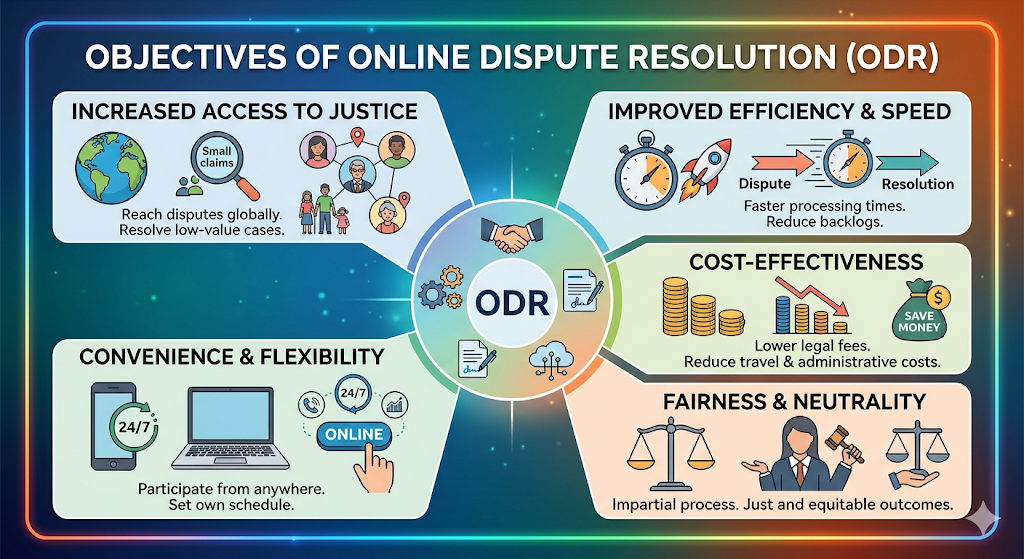
Online Dispute Resolution (ODR) is a mechanism that enables parties to resolve disputes using electronic technology, either in real-time or asynchronously, based on the ODR provider’s rules and the parties’ preferences. This digital process is often more cost-effective and convenient than traditional face-to-face methods of dispute resolution such as negotiation, mediation, or arbitration.
The United Nations Commission on International Trade Law (UNCITRAL) defines Online Dispute Resolution (ODR) as:
“a mechanism for resolving disputes, including consumer and commercial disputes, through alternative dispute resolution (ADR) techniques that are facilitated by the use of electronic communications and other information and communication technology.”

Core Characteristics of ODR:
The primary goal of ODR is to allow parties to settle conflicts electronically without stepping foot in a physical courtroom.
•Voluntary: Parties typically agree to the process.
•Informal & Confidential: It bypasses rigid courtroom procedures.
•Flexible: Agreements can be as broad or as specific as the parties desire.
Objective:The main objective of ODR is to enable parties to settle their disputes through electronic means, proceeding in real-time or asynchronously depending on the platform’s rules and the preferences of the parties involved. The actual terms of the agreement can be as broad or as specific as the parties desire.
2. Current Legal Framework Supporting ODR in India
A combined reading of several statutes confirms that Indian laws legally and technically support ODR mechanisms.
•The Information Technology Act, 2000: The enactment of this act has formally recognized e-commerce and e-governance, paving the way for digital dispute resolution mechanisms.
•The Arbitration and Conciliation Act, 1996: This act aligns with UNCITRAL Model standards, supporting modern arbitration methods.
•Bharatiya Nagarik Suraksha Sanhita, 2023 (BNSS): The BNSS explicitly embeds technology into criminal procedure. Section 530 is a landmark provision stating that all trials, inquiries, and proceedings may be held in electronic mode. Additionally, Sections 254, 265, and 266 permit the use of audio-video electronic means for recording prosecution and defense evidence. Summons can also be formally served via electronic communication under Sections 64 and 70.
•Bharatiya Sakshya Adhiniyam, 2023 (BSA): The new law of evidence fundamentally upgrades the admissibility of digital records. Under Section 61, electronic and digital records hold the same legal weight as traditional paper documents. Section 63 replaces the old Section 65B, providing the updated framework and certification requirements for the admissibility of electronic evidence (such as WhatsApp chats, emails, and CCTV footage) during online or physical proceedings.
3. The “Suitability for ODR” Checklist
Not every dispute belongs online.
The following questions determine whether ODR is an appropriate manner to settle an existing dispute:
a)Few Issues & Focus on Money? ODR is best-suited to deal with a small number of issues, and is often best when the issue at stake is an amount of money rather than issues pertaining to liability.
b)Few Parties? ODR works best when there are only a few parties.
c)Clear Facts, Minimal Credibility Issues? Given that most of ODR involves electronic communication, it works best where the issues can be clearly stated. It is more effective where factual issues are not dependant on credibility.
d)No Complex Witness Testimony? Some ODR processes may not easily allow for witnesses to testify.
e)Realistic Parties? Where the parties are unrealistic about outcomes, ODR may not be successful.
f)Settled Law? If there are issues of law that are unsettled, the matter may not be appropriate for ODR.
4. Methods & Formats of ODR
•Automated Negotiations: Negotiation done through developed technologies, often called “Blind Binding” services. Includes Double blind bidding (solves single monetary disputes between 2 parties) and Visual blind bidding (applies to negotiations between ‘n’ number of parties and issues).
•Assisted Negotiations: An alternative to mediation where technology evaluates the situation, provides parties with a set of advices, and solves the issue with informality and in a user-friendly manner.
•Expedient Non-Adjudicative Online Resolution: Bypasses adjudication entirely to prioritize speed, ideal for parties seeking quick resolutions. Platforms use algorithms similar to blind bidding where parties privately input acceptable settlement values.
•Crowd Justice: Public participation is central; on platforms like “Ujuj”, parties upload video arguments and registered users vote on a compensation percentage, democratizing justice.
•Online Arbitration: Involves virtual hearings, demanding logistical planning such as participant count, time zones, access to platforms (Zoom, Teams), and document management systems.
5. The 4-Step ODR Lifecycle
According to the International and Domestic Arbitration Centre (IDAC) of India, arbitration proceedings entail four basic steps:
•Filing & Notice: The disputed parties are served with a notice. The ODR process begins with filing e-documents, often secured through encryption or electronic signatures.
•Appointing a Neutral: Arbitrators are appointed to carry out the proceedings. Parties request an ODR service provider for a neutral panel.
•Proceedings: Proceedings and hearings are carried out. Depending on the case, video conferencing may or may not be used.
•Resolution & Execution: Execution of the award.
6. Comparative Analysis: Advantages vs. Disadvantages
(ODR vs. Traditional Courts & Physical ADR)
Advantages of ODR
•Geographical Freedom: It can be accessed from anywhere in the world without any geographical limitation acting as a barrier.
•Time & Cost Efficiency: It leads to efficient time management by cancelling out the time required for travelling, which also substantially reduces costs. Furthermore, the regulation provides for resolution of the dispute within 120 days of the filing of the complaint.
•Thoughtful Communication: The asynchronous internet communications have the advantage of being edited in contrast to impulsive.
Disadvantages / Challenges of ODR
The Digital Divide: There are significant obstacles to getting online, such as the high cost of service or a person’s geography. Many primarily access the internet through smartphones using limited data plans.
Accessibility Exclusions: Some users will just not be able to navigate the technology without assistance. ODR must accommodate needs like 4th-grade reading levels, non-English speakers, and individuals with disabilities.
Cultural Hesitancy: Found predominantly in developing nations, people have a lack of confidence over the online activities and hence their contribution to this field remains less.
7.CHALLENGES TO ODR
The Online Dispute Resolution is in an initial phase and has not taken a concrete shape. This phase is related to it evolutionary process and in this evolutionary process there are many barriers and hindrances to a successful online dispute resolution.
These challenges are as follows:
•Cultural Challenges- These are the challenges that are predominantly found in the developing nations of the continents of Asia, Africa and Latin America. The people have lack of confidence over the online activities and hence their contribution to this field remains less. Their ideas transmit culturally and flow in an unregulated manner.
There is the need of the government to understand and implement proper schemes to solve this challenge.
•ICT Infrastructure Challenge- One of the major problem in the ODR is the fact thatmany of the nations including India do not have robust internet infrastructure which is the first and foremost requirement of the ODR. Though, it has been the policy to focus on the internet facilities and it has been discussed continuously about considering the internet as the ‘ basic right’ yet for the ODR procedure to take place there should be a well- developed ODR platform, legal professionals along with software to have a perfect online dispute resolution mechanism.
•Regulatory Challenges- There has been attempts to create a uniform regional legal framework for the consumer protection including the e-consumers.
•Business Models- The main challenges that are faced under this heading are the business models and the business processes. Mainly the performance and the scalability of the ODR should to be measured.
•Adaptability to the present Context- The adaptability is a type of challenge which incorporates poor infrastructure, Low personal computer penetration. The Internet and the Broadband connections are expensive and unaffordable for the general masses which can be a major barrier. Moreover there has been ‘low bancarization’ people using basic banking services and the presence of low usage of online banking services
•Efficiency- The Court system is complex, expensive and inaccessible. The efficient system needs to be there in order to establish the principles of ADR and ODR. For this there must be a platform and a software to make the system of dispute resolution effective and efficient.
•Great Economic Divide between the Developing and the Developed Nations- Due to globalization, developing countries share the common characteristics of unequally distributed wealth the developed nations have a more potential for ODR than the developing and the underdeveloped states which causes a disparity to arise. A perfect ODR system has become a science fiction fantasy for the developing and underdeveloped nations.
8. Regulatory Challenges & The Scope of ODR in India
Regulatory Challenges to Implementation:
•Regulatory Uniformity: There has been attempts to create a uniform regional legal framework for the consumer protection including the e-consumers, but consistency remains difficult.
•Adaptability & Bancarization: A major challenge is adapting to the present context, marked by poor infrastructure, low personal computer penetration, and “low bancarization” (people using basic banking services with low usage of online banking).
•Business Models: Measuring the performance and the scalability of various ODR business models and processes is a significant hurdle.
9. Scope of ODR in India:
•The use of ODR in India is still in its early stages, but the COVID-19 pandemic significantly increased its relevance. The potential of ODR was evident with initiatives like e-Lok Adalats resolving disputes via WhatsApp calls.
•All three branches of government have taken steps to integrate technology into the legal system to ensure timely justice even during crisesThe Supreme Court, in the suo motu writ petition Expeditious trial of cases under Section 138 of the N.I. Act, 1881, referred to Meters and Instruments Pvt. Ltd. vs Kanchan Mehta, emphasizing the importance of using technology for paperless and less crowded courts.
•With “Digital India” reaching remote villages, technology can bridge the justice gap across geographical boundaries. Given the heavy workload—1,350 cases per judge in India versus 388 in the U.S.—technology-driven resolution systems could ease the judiciary’s burden and improve efficiency.

