
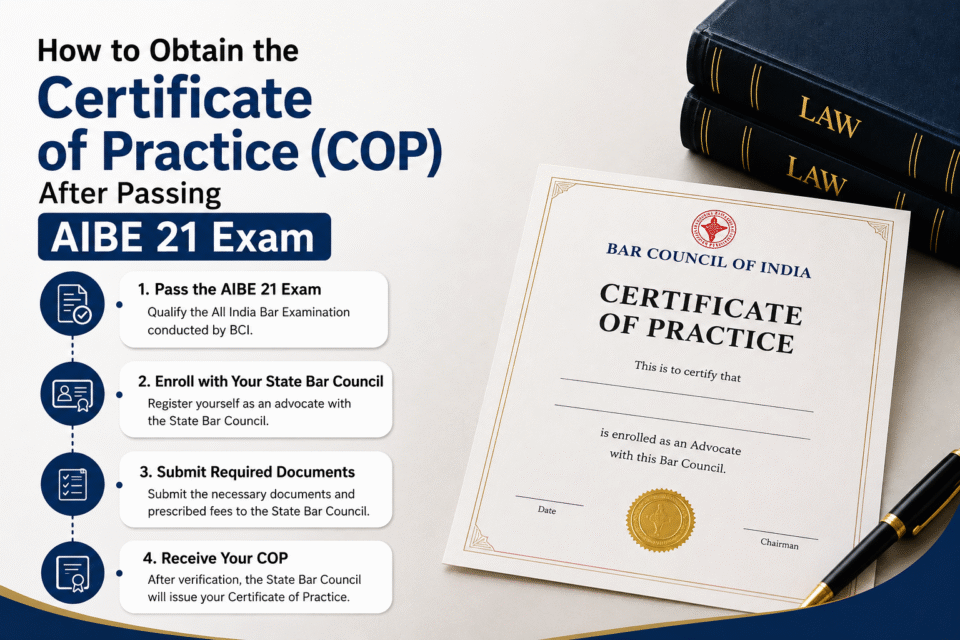
For every law graduate, enrolling with the State Bar Council and clearing the All India Bar Examination (AIBE) marks the beginning of a professional legal career. However, many candidates believe that passing the AIBE is the final step. In reality, the journey is not complete until the advocate receives the Certificate of Practice (COP).
The Certificate of Practice is an official recognition that an advocate is eligible to practice law in India. Without it, an advocate may face difficulties in establishing an independent legal practice and fulfilling various professional requirements.
If you have recently cleared AIBE 21 or are waiting for the results, this guide explains everything you need to know about obtaining your Certificate of Practice.
Understanding the Certificate of Practice (COP)
The Certificate of Practice is issued after an advocate successfully clears the All India Bar Examination conducted by the Bar Council of India (BCI). It serves as proof that the advocate has fulfilled the requirements prescribed under the Advocates Act, 1961 and the rules framed by the Bar Council of India.
In simple terms, the COP is the document that formally confirms your status as a practicing advocate.
Why Is the COP Important?
Many newly enrolled advocates underestimate the significance of the Certificate of Practice. In practical terms, it is one of the most important professional documents an advocate possesses.
A valid COP:
- Confirms your eligibility to practice law.
- Demonstrates compliance with Bar Council regulations.
- Strengthens your professional credibility.
- Is often required for various professional and administrative purposes.
- Acts as evidence that you have successfully cleared the AIBE.
For advocates intending to build a long-term litigation practice, obtaining the COP should be treated as a priority.
Who Is Eligible to Receive the COP?
To receive the Certificate of Practice after AIBE 21, a candidate must satisfy certain basic requirements.
1. Enrollment with a State Bar Council
Before appearing for the AIBE, a law graduate must be enrolled as an advocate with a State Bar Council. Upon enrollment, the advocate receives an enrollment number, which remains an important identifier throughout their professional career.
2. Successful Completion of AIBE 21
Only candidates who achieve the qualifying marks prescribed by the Bar Council of India are eligible to receive the Certificate of Practice.
3. Verification of Records
The Bar Council of India may verify enrollment details and supporting documents before issuing the certificate. Any discrepancy in records can delay the process.
Step-by-Step Process to Obtain COP After Passing AIBE 21
Step 1: Check Your AIBE Result Carefully
The first step is to verify your result on the official AIBE portal.
If your result reflects a “Pass” status, you become eligible for the next stage of the process. Candidates should download and preserve a copy of their results for future reference.
Step 2: Ensure Your Enrollment Details Are Correct
A significant number of delays occur because of discrepancies in enrollment records.
Make sure:
- Your name matches the enrollment records.
- The enrollment number is correctly mentioned.
- State Bar Council details are accurate.
- Uploaded documents are clear and legible.
Even minor errors can result in unnecessary delays.
Step 3: Submit Additional Documents, If Required
From time to time, the Bar Council of India may ask candidates to upload or verify documents such as:
- Enrollment Certificate
- Identity proof
- Enrollment details
- Other supporting records
Candidates should regularly check official notifications to ensure compliance with any additional requirements.
Step 4: Verification by the Bar Council of India
After document submission, the Bar Council undertakes a verification process.
During this stage, authorities examine:
- Enrollment status
- Candidate identity
- State Bar Council records
- AIBE qualification status
Once verification is completed successfully, the process moves to certificate generation.
Step 5: Issuance of the Certificate of Practice
After approval, the Certificate of Practice is prepared by the Bar Council of India.
The certificate generally contains:
- Name of the advocate
- Enrollment number
- State Bar Council details
- Certificate number
- Relevant professional particulars
Step 6: Distribution Through State Bar Councils
In most cases, the Certificate of Practice is forwarded to the respective State Bar Council.
The concerned State Bar Council may then:
- Notify advocates through official notices.
- Publish collection instructions on its website.
- Inform candidates regarding the collection procedure.
Advocates should remain in contact with their State Bar Council to stay informed about the latest updates.
Documents You Should Keep Ready
Although requirements may differ slightly from one State Bar Council to another, advocates should generally keep the following documents available:
- LL.B. Degree Certificate
- Enrollment Certificate
- Enrollment Number
- AIBE Admit Card
- AIBE Result or Scorecard
- Aadhaar Card or other identity proof
- Passport-size photographs
Having these documents readily available can make the process much smoother.
How Long Does It Take to Receive the COP?
One of the most common questions among newly qualified advocates is the expected timeline.
There is no fixed period applicable to every examination cycle. The issuance process depends on document verification, administrative processing, and coordination between the Bar Council of India and the State Bar Councils.
As a result, candidates may need to wait several weeks or even a few months after the declaration of results before receiving their Certificate of Practice.
Patience is important, but regular monitoring of official notifications is equally essential.
Common Reasons for Delay
Delays in receiving the COP are usually linked to avoidable issues such as:
- Incorrect enrollment details.
- Missing documents.
- Unverified enrollment records.
- Discrepancies in personal information.
- Pending verification by the State Bar Council.
Advocates should review all information carefully to minimize such problems.
What Should You Do If You Have Not Received Your COP?
If a considerable period has passed since the declaration of the AIBE 21 result and you have not received your Certificate of Practice, consider taking the following steps:
- Check official AIBE notifications.
- Verify whether any document submission is pending.
- Contact your State Bar Council.
- Keep copies of all relevant documents ready.
- Follow up through the official communication channels of the Bar Council of India.
In most cases, delays are resolved once verification issues are addressed.
A Practical Tip for Young Advocates
Many junior advocates become so focused on internships, chamber work, and court appearances that they forget to track the status of their Certificate of Practice.
A good habit is to maintain a dedicated folder containing:
- Enrollment documents
- AIBE records
- Result copies
- Correspondence with Bar Councils
Organized records can save considerable time whenever verification or professional documentation is required.
Conclusion
Passing AIBE 21 is a significant achievement, but it is not the final destination. Obtaining the Certificate of Practice is the step that formally completes your entry into the legal profession.
While the process may seem administrative in nature, it carries immense professional importance. By keeping your records updated, complying with verification requirements, and regularly checking official notifications, you can ensure a smooth and hassle-free experience.
For every aspiring advocate, the Certificate of Practice is more than just a document—it is the gateway to a professional career in the legal field and a symbol of readiness to serve the cause of justice.

