
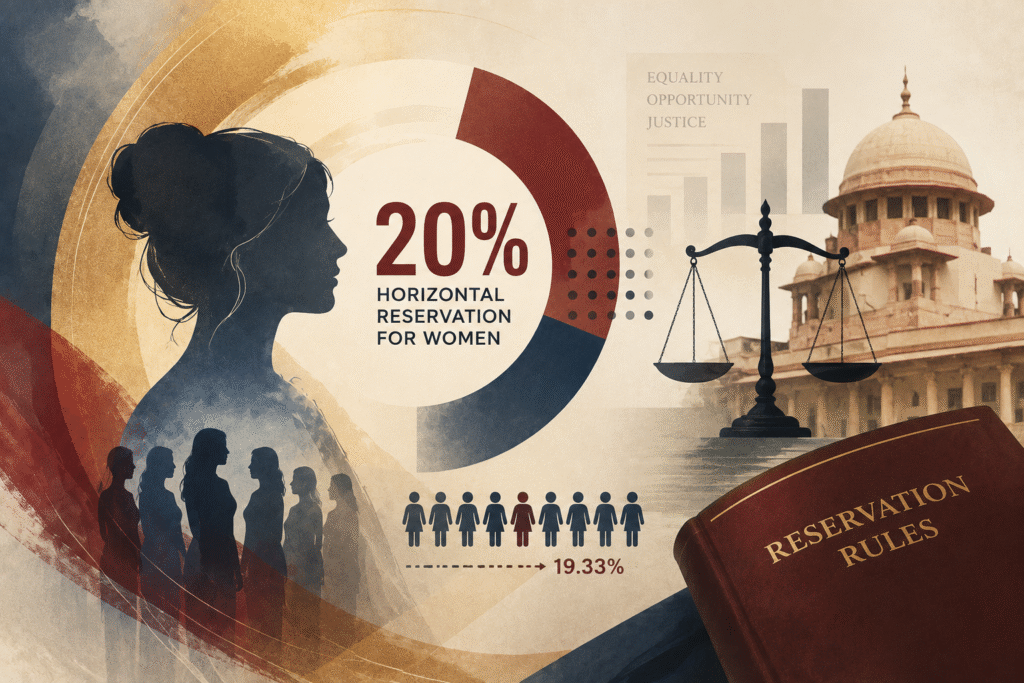
The result of the Uttar Pradesh Review Officer/Assistant Review Officer (RO/ARO) Recruitment Examination, 2023 raises an important question regarding the implementation of 20% horizontal reservation for women under the applicable reservation rules.
Out of 419 successful candidates, only 81 are women, constituting 19.33% of the total selections. The figure falls short of the prescribed 20% horizontal reservation.
A further examination of the result reveals that of these 81 women candidates, only 62 are domiciles of Uttar Pradesh, whereas 19 belong to other States. Consequently, the representation of women domiciled in Uttar Pradesh is reduced to 14.79% of the total selections.
The eligibility clause of the recruitment notification assumes significance. While reservation for Scheduled Castes, Scheduled Tribes, Other Backward Classes, Economically Weaker Sections, Dependents of Freedom Fighters, Ex-servicemen and Persons with Disabilities is expressly confined to candidates of Uttar Pradesh, the notification extends horizontal reservation to “Female Candidates” without prescribing domicile of Uttar Pradesh as an eligibility condition.
The relevant clause reads:
“Reservation for Scheduled Castes of U.P./Scheduled Tribes of U.P./Other Backward Classes of U.P./Economically Weaker Sections of U.P. shall be admissible in accordance with the relevant Government Rules. Reservation for horizontal categories, namely Dependents of Freedom Fighters of U.P., Female Candidates, Ex-servicemen of U.P. and Persons with Disabilities of U.P., shall be admissible as per rules.”
Thus, unlike every other reserved category, domicile has not been made an express condition for claiming the benefit of women’s reservation.
The recruitment process has already been subjected to judicial review before the Allahabad High Court on the issue of migration of OBC candidates, and the selection process presently stands stayed. However, the issue relating to implementation of women’s horizontal reservation remains sub silentio, as it has not yet been canvassed before the Court.
The selection data gives rise to two possible legal inferences.
First, migration of meritorious women candidates to the unreserved category may not have been permitted, thereby confining women substantially within the horizontal quota itself. Such an approach would require examination in light of the settled principles governing horizontal reservation.
Secondly, the shortfall 0.67% from the prescribed 20% may indicate that reserved vacancies earmarked for women have remained unfilled on account of mass disqualification of women candidates. Such a situation would equally require legal justification, particularly where horizontal reservation is intended to ensure minimum representation.
Either eventuality raises substantial questions regarding the proper implementation of the reservation policy. The issue is therefore not confined to migration alone but also concerns the legality of leaving women’s reserved vacancies unfilled.
The controversy surrounding the UP RO/ARO Recruitment 2023 thus extends beyond the question presently engaging judicial attention. The implementation of women’s horizontal reservation deserves an independent examination during judicial review to ensure fidelity to the statutory reservation framework and the constitutional mandate of equality in public employment.
The author is an Advocate practising before the Allahabad High Court and specialises in Service Law.

