
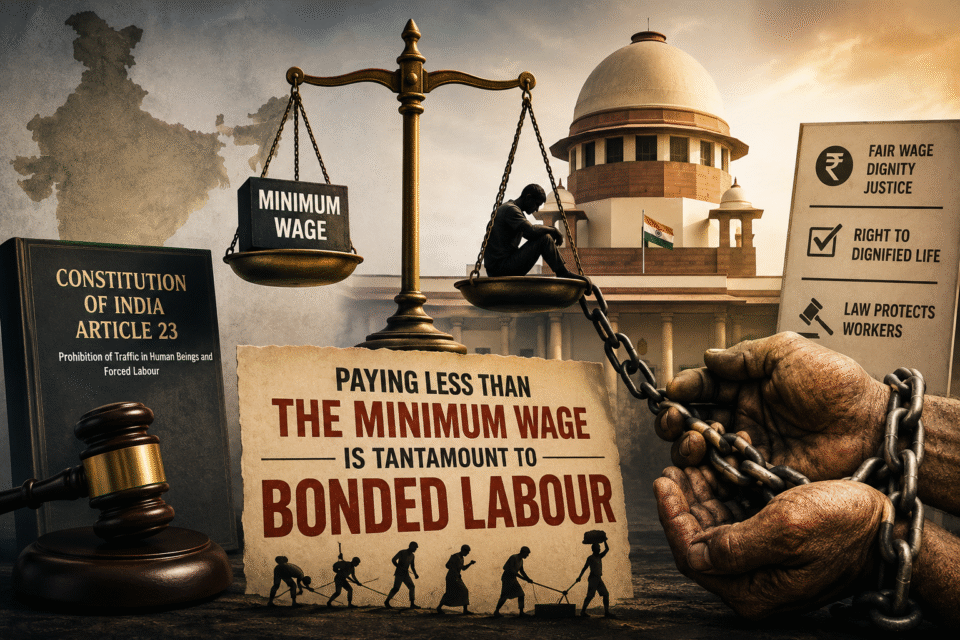
Article 23 of the Constitution of India prohibits human trafficking, begar, forced labour, and all other forms of bonded labour. Any violation of this constitutional guarantee is punishable under law.
In the landmark case of Bandhua Mukti Morcha v. Union of India (AIR 1984 SC 802), the Supreme Court gave an expansive interpretation to the concept of forced labour. The Court held that where a person is compelled by economic necessity to work for wages below the statutory minimum wage, such employment may amount to forced labour within the meaning of Article 23. Poverty and lack of alternatives cannot be used to justify exploitation of workers.
To protect labourers from such exploitation, the Minimum Wages Act empowers state governments to fix and periodically revise minimum wages for different categories of workers. In Uttar Pradesh, with effect from 1 April 2026, the minimum monthly wage for an unskilled worker is ₹12,356, for a semi-skilled worker ₹13,590, and for a skilled worker ₹15,224. These standards are binding not only on private establishments and industries but also on agencies engaging workers through contractual arrangements.
Despite this legal framework, it is not uncommon to find contractual and honorarium-based workers in government institutions receiving remuneration significantly below the prescribed minimum wage. The issue recently came under judicial scrutiny in U.P. Junior High School Council Instructor Welfare Association v. State of Uttar Pradesh (2026 INSC 117), where the Supreme Court expressed concern over the meagre honorarium paid to instructors. Observing that such remuneration was inconsistent with the right to live with dignity, the Court directed the State Government to enhance the honorarium from ₹7,000 to ₹17,000 per month and to pay arrears from the academic session 2017–18.
Similarly, the Uttar Pradesh Government recently increased the honorarium of Shiksha Mitras working in primary schools from ₹10,000 to ₹18,000 per month. While this measure has provided a temporary relief to Shiksha Mitras working in primary schools on contractual basis, there remains no comprehensive policy governing the wages, service conditions, and social security of contractual workers employed across different departments of the State.
The government is expected to act as a model employer. Employees performing similar functions should not be subjected to arbitrary disparities in remuneration merely because they are engaged under different departments or contractual arrangements. If contractual employees in one department are granted substantial enhancement in wages, the claims of similarly situated employees in other departments also deserve fair consideration. Failure to do so may invite scrutiny under Article 14 of the Constitution, which guarantees equality before the law and equal protection of the laws.
With a view to bringing greater transparency to the engagement and payment of outsourced personnel, the State Government has established the Uttar Pradesh Outsourcing Services Corporation Limited (UPCOS). However, concerns of contractual employees relating to wage security, regular revision of remuneration, and protection against arbitrary termination is left untouched and remains unadreesed.
Where contractual employees are paid less than the statutory minimum wage or are subjected to unreasonable and exploitative service conditions, they are not without remedies. Constitutional protections under Article 23, labour welfare legislation, and judicial precedents of the Supreme Court provide significant legal safeguards against such exploitation.
(Abhishek Shukla is an Advocate practising at the Allahabad High Court and has a specialization in service and administrative law.)

